Land Preparation in the Philippines: A Guide for Every Crop
Land preparation in the Philippines is the work you do on a field before the first seed or seedling goes in. It decides how well water moves, how many weeds come up and how evenly the crop grows. This guide covers the basic operations, the machines, the timing before planting and a table that sends each crop to its own guide.
Why land preparation in the Philippines decides the crop
A good seed cannot make up for a bad field. A poorly prepared rice field could yield 5 percent less. Proper leveling solves more than 50 percent of the problems in rice production, because it helps water management, weed control and snail control.
Money follows the same rule. Proper land leveling can save about 1,850 pesos per hectare in expenses. So the weeks before planting are not lost time. They are the cheapest part of the season to get right.
The basic operations, in order
Every crop uses a mix of the same few jobs. What changes is how deep, how fine and how wet the soil should be. Here is the usual order.
Clear the field and handle residue
Remove or cut the old crop, trash and weeds. For rice, clean and repair the dikes (pilapil) and ditches too. Clean dikes cut pest buildup and compacted dikes stop seepage.
Plow
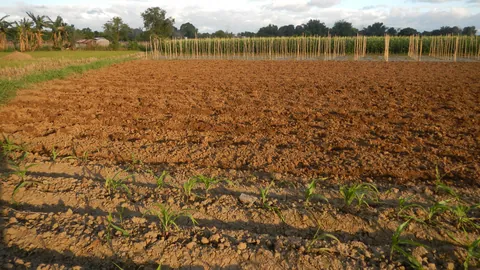
Plowing breaks and turns the soil and buries stubble and weeds. For rice, plow or rotovate 21 to 30 days before planting. For corn, plow 15 to 20 cm deep when the soil moisture is right.
Harrow
Harrowing breaks clods and starts the leveling. In the usual rice schedule, you harrow every 7 days after plowing. The first pass follows the plowing pattern and the second goes crosswise.
Level
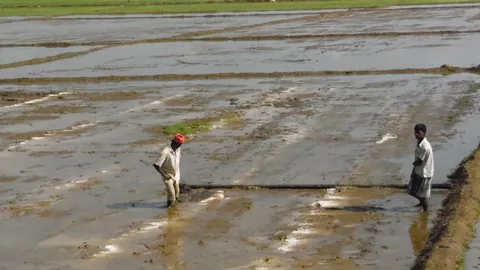
In rice, level the field with 5 cm of water and a wooden plank or a tiller attached leveler. In upland fields, level so that water does not pond in low spots.
Puddle (lowland rice only)
Puddling works the soil under water into soft mud. A well puddled field is part of a well leveled field. Dry land crops skip this step.
Make beds, ridges, furrows or holes
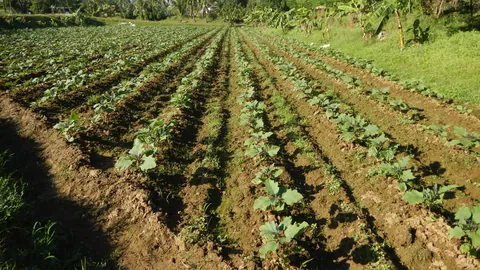
Upland crops are planted in rows. For corn, set furrows 70 to 75 cm apart. Sugarcane furrows are about one meter apart.
Tillage machines: carabao, hand tractor and four wheel tractor
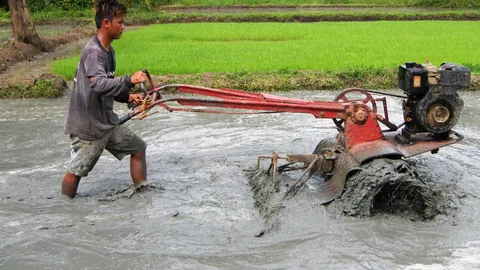
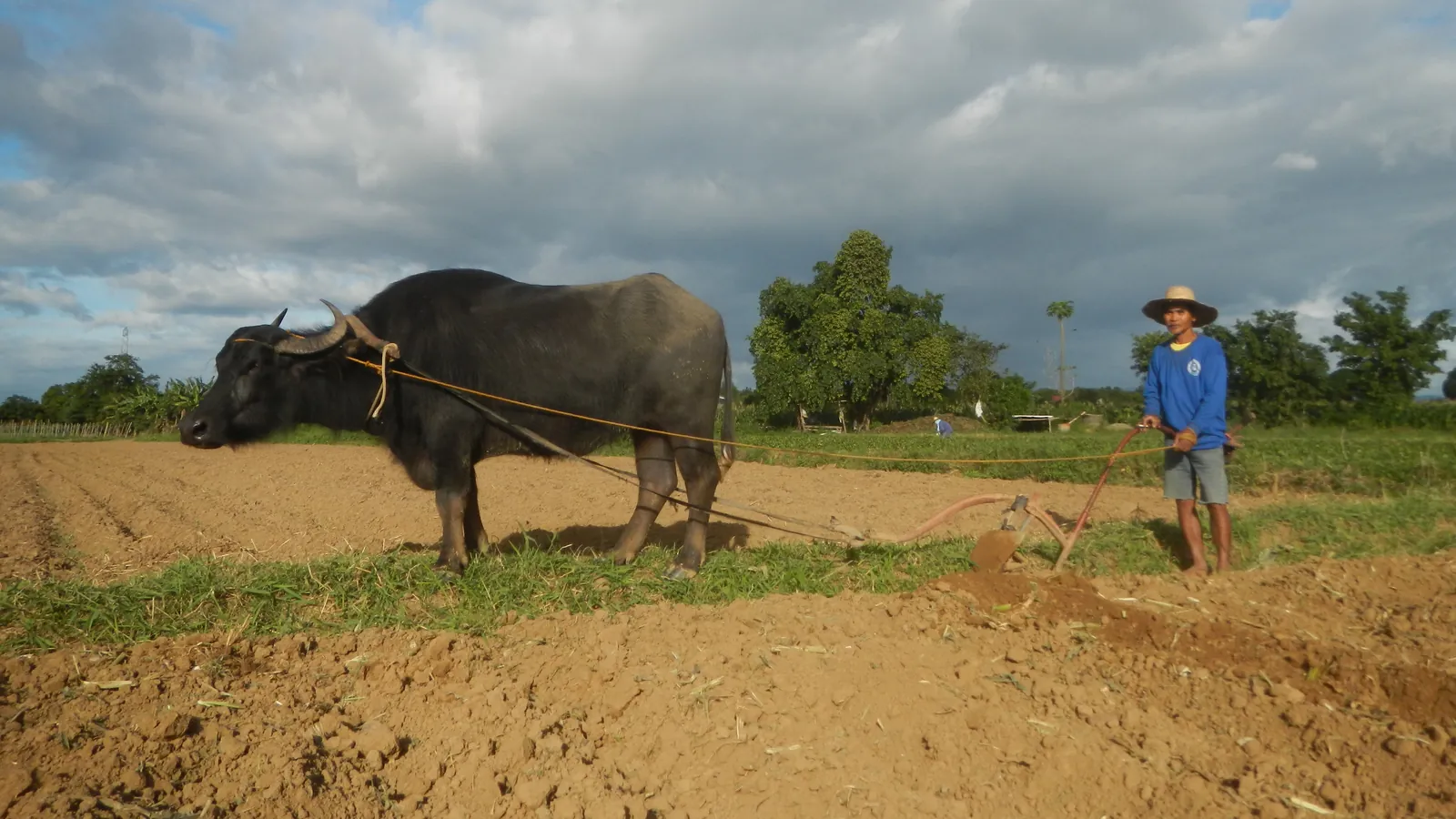
Most Filipino farms are small, so the machine follows the farm size and the crop. For working rice and corn land, the carabao pulling a single native moldboard plow is still the animal most farms rely on. Two wheel tractors, which we call the hand tractor, are used more each year, while sugarcane plantations use four wheel tractors.
| Power | Main tillage tools | Common use |
|---|---|---|
| Carabao | Native moldboard plow | Rice and corn on small plots |
| Hand tractor (two wheel) | Disk plow, single moldboard plow, rotary tiller | Rice and corn |
| Four wheel tractor | Moldboard plow, disk plow, disk harrow, rotavator | Larger farms and sugarcane |
Some tools are built for hard conditions. The Laboy Tiller works in soft, deep mud with long stubble, and the Microtiller works in fields with knee deep hard pans. A ride on attachment lets the hand tractor operator sit while plowing, harrowing and leveling, which lowers the operator's heart rate by about 10 beats per minute.
PhilMech has delivered four wheel tractors to farmer cooperatives, for example in Leyte. If you farm with a group, ask your municipal agriculture office and PhilMech about machines and custom hire. Laser guided leveling was shown in a 16 day demonstration on 10 hectares in Alaminos, Pangasinan.
Timing before planting
Rice takes a field preparation period of 21 days, with plowing and harrowing once a week for three rounds before the final leveling. The weekly gap lets weeds and dropped seeds sprout so the next pass kills them. For corn, harrow two to three times with a one week interval for weed control as well.
Crack plowing is a shallow pass on dry soil, made right after harvest or when the first rains come, so the field is already opened before the main plowing.
| Days before planting | Work |
|---|---|
| After harvest or at first rains | Crack plowing, clean dikes and ditches |
| 30 to 21 | First plowing or rotovating, with water if the field is dry |
| About 14 | First harrowing along the plowing pattern |
| About 7 | Second harrowing, crosswise |
| Day of planting or the day before | Final harrowing and leveling with 5 cm of water |
The schedule above follows the usual 21 to 30 day window and the weekly harrowing rhythm. Adjust it to your soil and water supply, and ask your technician when the dry spell is long.
On anee.io, every land preparation day goes on the cropping calendar, dated back from planting. Set the planting date of a lot and the plowing, harrowing and leveling days line up behind it.
See the cropping calendarMinimum tillage and zero tillage
Minimum tillage disturbs the soil less. Zero tillage plants straight into the old stubble. In both systems, farmers usually control the standing weeds with a non selective herbicide such as glyphosate, and you must follow the FPA label.
Research in Bukidnon in 1995 compared zero tillage, minimum tillage and the usual farmer practice in corn using glyphosate plus ammonium sulphate. Corn yield matched or beat the conventional method, and the system saved cost and time. Zero to minimum tillage is also one of the soil conservation practices for hilly corn areas.
Still, these systems do not suit every field. A field that needs leveling, or one that has a hard pan, needs real tillage first.
Change the work by soil
Heavy clay needs more passes than sandy or loam soil, and it is easier to work at the right moisture. For sugarcane, the number of plowing and harrowing rounds depends on soil type, with clay needing more than light sandy loam. Acid soil needs agricultural lime first, so read our guide on acidic soil preparation.
Sodic or alkaline soil and saline soil each have their own fixes. See sodic and alkaline soil preparation and saline soil preparation before you plant.
Land preparation by crop: where to read next
| Crop | Main work | Guide |
|---|---|---|
| Transplanted rice | Plow, harrow weekly, puddle, level | Rice land preparation |
| Direct seeded rice | Level well, canals, stale seedbed | Direct seeded rice land preparation |
| Corn | Plow, harrow, furrows | Corn land preparation |
| Vegetables | Beds and drainage | Vegetable land preparation |
| Onion and garlic | Fine, raised beds | Onion and garlic land preparation |
| Cucurbits | Hills or rows | Cucurbit land preparation |
| Root crops | Deep, loose soil | Root crop land preparation |
| Legumes | Fine seedbed | Legume land preparation |
| Sugarcane | Deep plowing, subsoiling, furrows | Sugarcane land preparation |
| Banana | Holes and drainage | Banana land preparation |
| Fruit trees | Holes and spacing | Fruit tree land preparation |
Common mistakes
- Plowing once and planting the next day, so the weeds that sprout later beat the crop.
- Leveling without water in rice, which hides the high and low spots until it is too late.
- Skipping the dike and ditch repair, which leaves rat holes and seepage.
- Working clay when it is too wet or too dry, which makes clods.
- Ignoring soil pH, so lime and fertilizer are wasted on acid soil.
Besides the calendar, you can ask Anee, the smart farm technician, what to do in Tagalog or English. Anee reads your lot, your crop and the week's weather before answering.
Questions about land preparation
How many days before planting should I plow?
What is the difference between plowing and harrowing?
Can I use a carabao instead of a tractor?
Is zero tillage safe for corn?
Get every step of land preparation in the philippines right
Register for free to read every step, then date each one on your own calendar with the Land Prep Planner, counted back from your planting day.
Free to register. No credit card. Works on any phone.