Rice Bug (Alitangya or Atangya): Damage, Thresholds and Control
The rice bug, Leptocorisa oratorius, is the slender, foul smelling insect that Tagalog farmers call atangya. It sucks the grains of palay (rice still in the husk) while they are still milky, and a heavy attack leaves panicles full of empty, spotted grains. This guide shows how to tell it from the black bug, when to count it, and when a spray really pays.
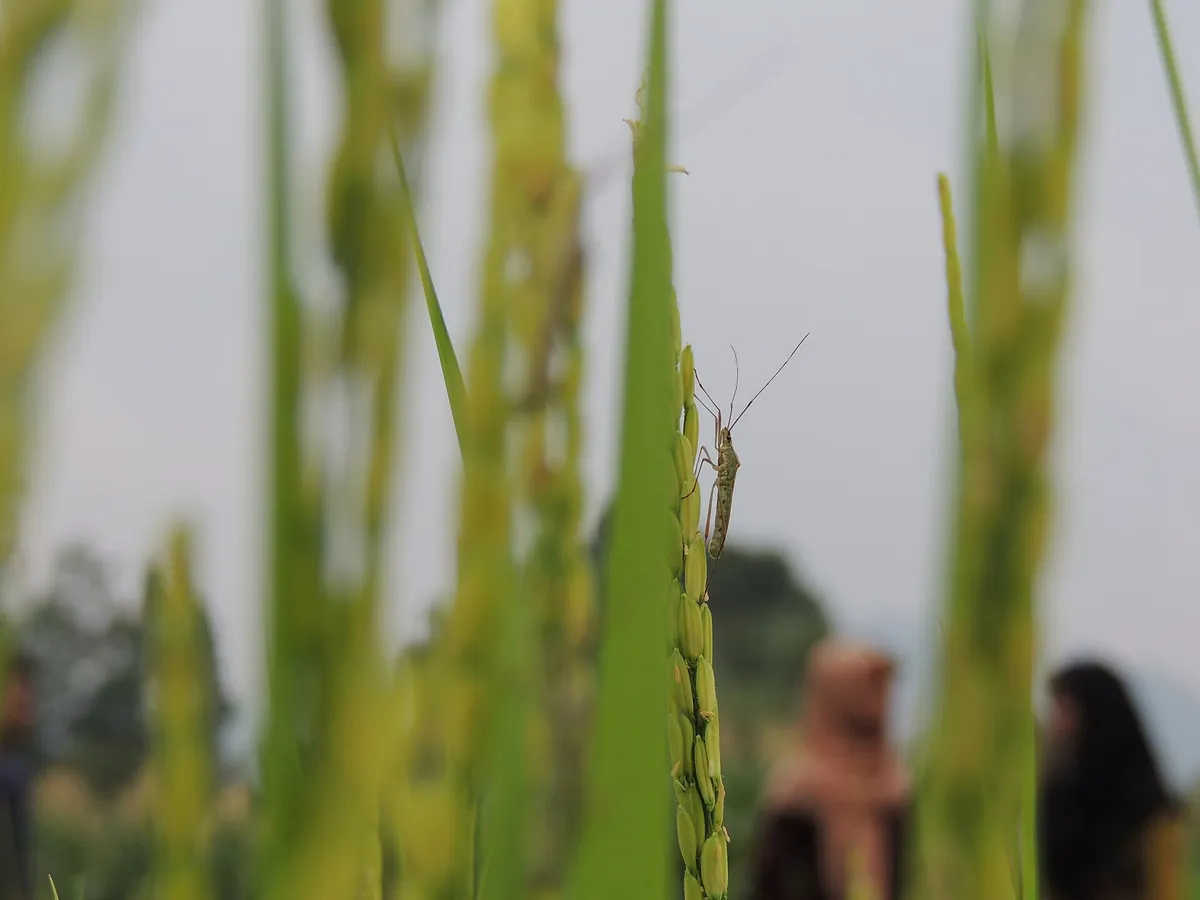
What the rice bug looks like
Most rice insects attack the leaves, the stems or the roots. This one waits for the grain. Adults are long and thin, with long legs and long antennae, and their color is greenish brown. The nymphs, or young bugs, have green bodies that blend with the leaves, so many farmers miss them.
Eggs sit in small batches along the midrib of the leaf. They are oval, shiny and reddish brown. Pick up an adult and you will know it at once, because it gives off a strong, bad smell. Adults feed in the early morning and late afternoon. Under bright sun they hide in grassy areas. Shake a hill and the nymphs drop down the plant, while the adults fly off a little way.
Rice ear bug, atangya, tayangaw and alitangya
In English you will read about the rice bug, the rice ear bug or the rice earhead bug. Its Tagalog name is atangya and its Ilocano name is dangaw. One source from Camarines Sur gives tayangaw. We found no second source for it, so treat it as a local word. The general words for insects and bugs in Tagalog are kulisap and insekto, and our list of farm words in Tagalog has more.
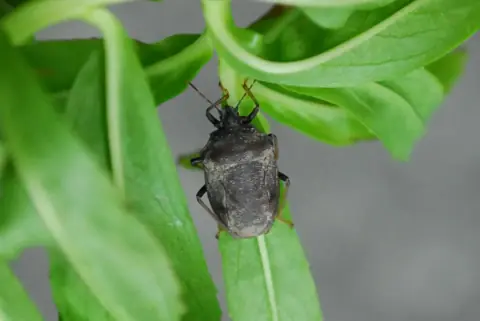
Be careful with alitangya. Tagalog dictionaries, Wiktionary among them, give alitangya as the name of the rice black bug, the round, dark stink bug also called itim na atangya. Plain atangya means the rice bug. Because the names overlap, trust the shape of the insect more than the name. A slender, long legged bug on the panicle is the rice bug. A broad, oval black bug at the base of the hill is the rice black bug.
How rice bugs damage palay
Both nymphs and adults push their mouthparts into the developing grain and suck out its contents. They feed from just before flowering up to the soft dough stage, and every soft, milky grain is at risk. The nymphs do more damage than the adults. Before the grains form, the bugs feed on young shoots and leaves, but the serious damage comes at the milky stage. Rice bugs can sometimes cut yield by as much as 30 percent.
Signs of rice bug damage
- Empty or unfilled grains, and small or shriveled ones
- Deformed grains with brown or dark spots where the bugs fed
- Panicles that stay erect in heavily infested fields, since light grains do not bend them
- A bad smell in the raw and cooked rice, and straw that cattle refuse to eat
Nutrient deficiency and flower thrips can leave similar grains. So before you act, confirm the cause by finding the bugs, their eggs or their smell.
When rice bugs build up
The bug lives in every rice environment, but it is more common in rainfed and upland rice. Between crops it lives on wild grasses, then it moves into rice fields when the crop flowers. It is less active during the dry season. Watch your field closely when:
- Woodlands, weedy areas or wild grasses along canals sit next to your field
- Farms around you plant at different times, so flowering fields follow one another for weeks
- The monsoon rains begin, or the weather stays warm with overcast skies and frequent drizzles
- The rainy season is ending, since numbers rise at that time
How to count rice bugs and when to act
Start before flowering
Begin scouting just before the panicles come out and keep going every day until the hard dough stage. The risky window is about 30 days, from flowering to soft dough.
Walk the field early or late
Go out at dawn or toward evening, when the bugs sit on the panicles. Walk diagonally across the field and check 20 hills.
Count every nymph and adult
Adults often fly off before you reach the hill, so your count may show mostly nymphs. Write the number down with the date and the lot.
Compare with the threshold
Consider a spray only when the count passes a threshold in the table below. The thresholds count differently, some by 20 hills and some by a square meter. If your count stays under, keep counting instead of spraying.
| Crop stage | Consider control when you find |
|---|---|
| Flowering to hard dough | More than 10 bugs in 20 hills |
| Milky stage | More than 5 nymphs and adults per square meter |
| Grain filling | More than 10 nymphs and adults per square meter |
anee.io makes this easier. Each lot on your cropping calendar counts its own days after transplanting, and the growth stages view tells you when that lot reaches flowering and the milky stage. Put a daily scouting reminder on the board for those weeks, then log each count in a note with a photo.
Cultural and natural control of atangya
- Clean the surroundings. Cut grassy weeds in the field, on the pilapil (levees) and along canals, so the bugs have fewer places to breed between crops.
- Plant together. The whole community should plant at the same time after at least a month of fallow, so bugs cannot move from early fields to late ones.
- Keep the crop even. A level field with even fertilizer and water grows at one pace, so the whole lot passes the milky stage together.
- Net them. Sweeping a net through the crop at dawn or toward evening works while numbers are low, though it takes labor.
- Bait them. Rotting meat, fish or snails are baits that draw the bugs to one spot, where you can collect and destroy them.
- Grow awned varieties where you can. Awned varieties resist the bug, and panicles that stay longer inside the leaf sheath get some protection too.
- Protect natural enemies. Small wasps such as Gryon nixoni and long horned grasshoppers kill the eggs. Spiders, crickets and lady beetles eat nymphs and adults, and the fungus Beauveria bassiana infects them.
Careless insecticide use kills the wasps and spiders that hold pests down, and then the pests return in bigger numbers. The brown planthopper is the classic example in rice.
Chemical control: Alika, Karate and lambda cyhalothrin
Use a pesticide only when the count calls for it, and ask an agricultural extension worker first. If your counts pass the threshold, choose a product whose FPA registered label lists this pest on rice.
Two familiar examples come from Syngenta. The Karate insecticide (Karate 2.5 EC) contains lambda cyhalothrin, a pyrethroid in IRAC Group 3A. Its Philippine product page names rice bug on rice, along with leaffolder, black bugs, armyworms and green leafhopper. The Alika insecticide (Alika 247 ZC) mixes lambda cyhalothrin with thiamethoxam, a Group 4A neonicotinoid, and its page lists rice bug, stem borer and leafhoppers on rice.
Both are broad spectrum products, so they can also kill spiders and other friendly insects. Read the whole label before you mix: the rate per tank, the number of sprays, the pre harvest interval and the protective gear. Rice bugs feed until the grain hardens, close to harvest, so the pre harvest interval deserves extra care. Our guides to Alika, Virtako and Chess and to Karate, Cymbush and Selecron compare these products, and the FPA guide explains how to check a registration.
Not sure whether the insect on your panicle is a rice bug or a black bug? Send a photo to Anee, the smart farm technician inside anee.io. She answers in Tagalog or English, and she checks the growth stage of your lot before she replies.
Active Ingredients on Philippine Labels
| Active ingredient | IRAC group | On Philippine labels |
|---|---|---|
| Lambda cyhalothrin | IRAC 3A | A first choice. 91 registered products name it on rice. |
| Malathion | IRAC 1B | A sound second choice. 40 registered products name it on rice. |
| Lambda cyhalothrin plus thiamethoxam | IRAC 3A plus 4A | A sound second choice. 29 registered products name it on rice. |
| Thiamethoxam | IRAC 4A | A sound second choice. 19 registered products name it on rice. |
| Dinotefuran | IRAC 4A | A sound second choice. 9 registered products name it on rice. |
| Cypermethrin | IRAC 3A | A sound second choice. 6 registered products name it on rice. |
| Beta cypermethrin | IRAC 3A | A sound second choice. 5 registered products name it on rice. |
| Carbosulfan | IRAC 1A | A sound second choice. 2 registered products name it on rice. |
| Esfenvalerate | IRAC 3A | A sound second choice. 2 registered products name it on rice. |
| Alpha cypermethrin | IRAC 3A | A sound second choice. 1 registered product names it on rice. |
The table stops at the ten best. 11 more on Philippine labels for it are older or broad chemistry. The Pest Finder in anee.io lists every one, crop by crop, with the products sold here.
anee.io dates every lot from its own day zero, shows its growth stage on any date, and lets you ask Anee about a photo of the bug you found.
Start free on anee.ioRice bug questions farmers ask
What is the rice bug called in Tagalog?
When does atangya attack palay?
Are rice bugs and rice black bugs the same?
Should I spray every season?
Which insecticide works on rice bugs?
Stop Rice Bug (Alitangya or Atangya) from costing you the harvest
With Libre + Anee, read the whole guide: how to be sure it is this pest, when it pays to act, and what to spray, by active ingredient.
The account is free, no credit card.