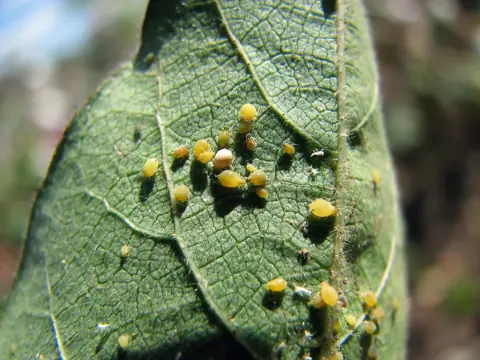
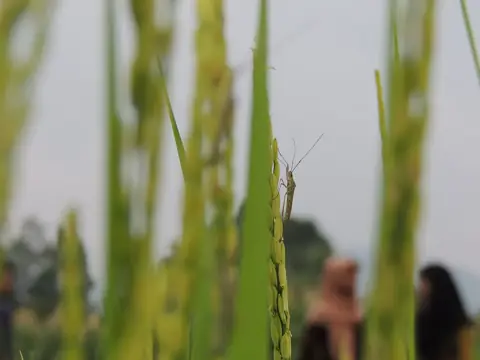
Thrips: The Tiny Insect Behind Silvery Leaves on Rice, Onion, Sili and Mango
Thrips are slender insects about a millimeter long that rasp the skin of leaves, flowers and fruit and suck up what leaks out. The thrips insect leaves silvery streaks on onion, rolled tips on young palay, bronze and upward curled leaves on sili, and brown scars on mango. Because they hide in leaf folds and flowers, you often see the damage before you see the pest.
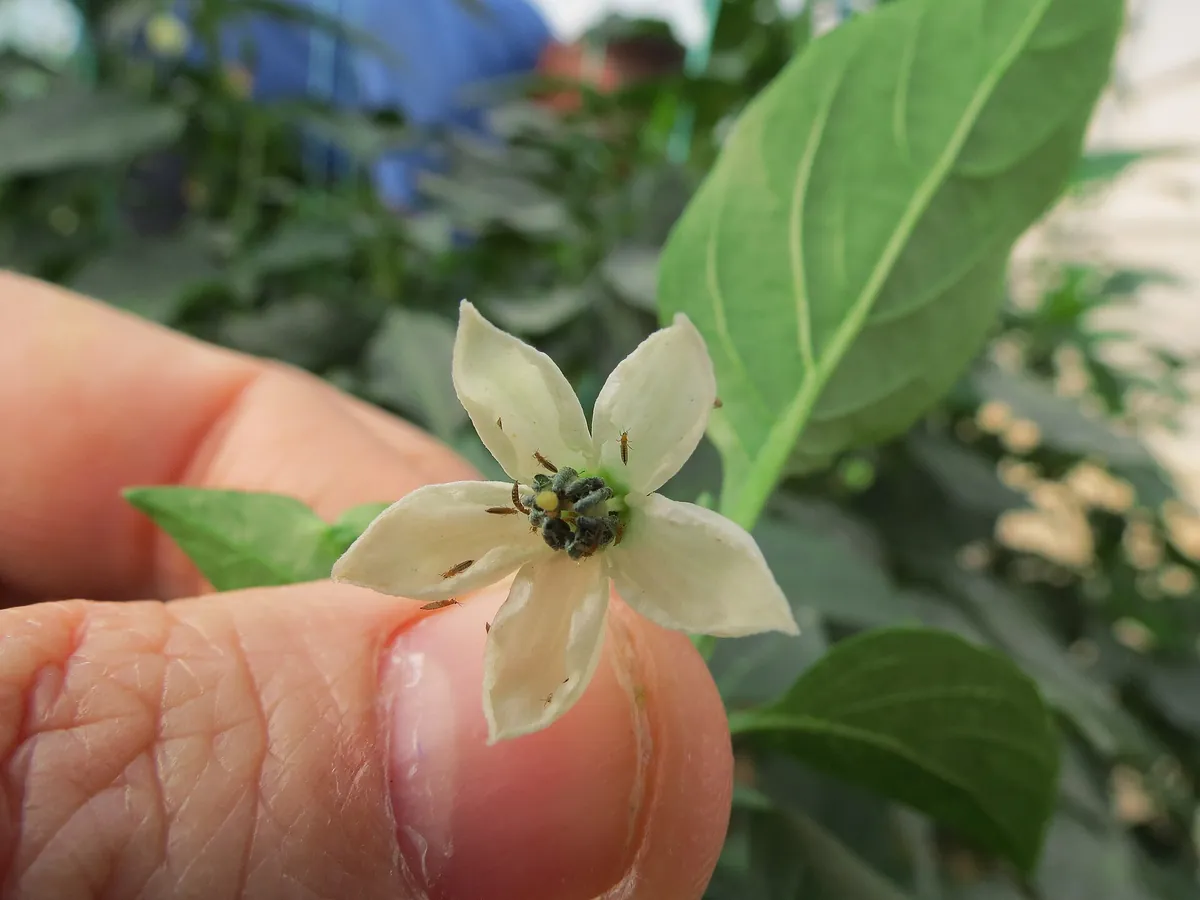
Thrips belong to the insect order Thysanoptera, which means fringed wings. Look at one under a hand lens and you will see two pairs of narrow wings edged with long hairs. Most kinds fall into the soil or the dead leaves below to pupate, and in warm weather one generation can be done in just two weeks. So numbers climb fast in a hot, dry spell.
These are among the smallest Philippine insects a farmer has to manage, but the damage adds up. On top of the feeding scars, some species carry plant viruses. Chilli thrips, for example, can spread capsicum chlorosis virus and watermelon silver mottle virus. For the other pests of palay, see our guide to rice insects.
Thrips species on Philippine crops
| Crop | Main species | Damage you see |
|---|---|---|
| Rice (palay) | Rice thrips, Stenchaetothrips biformis | Silvery streaks or yellow patches, leaves rolled from the edge to the middle, withered tips. Worst on seedlings in the dry season. |
| Onion | Onion thrips, Thrips tabaci | Silvery patches and streaks on the leaves. Heavy feeding withers the leaves and cuts bulb size. |
| Chili (sili) | Chilli thrips, Scirtothrips dorsalis | Young leaves, buds and fruit turn bronze, and the leaves curl upward and twist. |
| Eggplant, melon, beans | Melon thrips, Thrips palmi | Silvery or brown leaves that curl upward like a boat, scarred fruit, stunted tips. |
| Mango | Thrips hawaiiensis and Scirtothrips dorsalis, among others | Damaged flowers and brown scars on the fruit skin, known in Davao as 'chico chico'. |
Rice thrips in the seedbed
Rice thrips attack at the seedling stage or about two weeks after early sowing. They do the most harm in the dry season. A field with no standing water suffers more. But drought also rolls rice leaves, so unroll a curled leaf and look for yellow larvae and dark brown adults inside before you blame the pest.
If they are there, flood the field to submerge the plants for two days. Ask your municipal agriculturist which resistant rice varieties are available in your area, and see our page on palay for the crop stages.
Mango thrips at flowering
Scirtothrips dorsalis is present in most mango areas of the country. In a Carabao mango orchard in Piat, Cagayan, researchers found Thrips hawaiiensis to be the main species on the flowers, with Scirtothrips dorsalis a distant second. They advise watching flowers and young fruit closely in the summer months, when warm weather pushes their numbers up.
How to monitor thrips
Tap and count
Hold a white sheet of paper or a plastic tray under a flower cluster, a young shoot or an onion plant and tap it. Thrips drop and show up as tiny moving dashes. In the Cagayan mango study, researchers sampled five flowering twigs per tree this way.
Hang sticky traps
Blue or bright yellow sticky traps catch the flying adults. Blue often draws more, but results change with the species and the crop, so try both at the start of the season. Hang them at crop height and count the catch every week.
Look inside the folds
Unroll curled rice leaves, open the neck of onion leaves, and check the underside of young sili leaves. That is where larvae hide.
Write it down
Note the date, the lot and the count. A count that rises from week to week tells you more than a single look.
Natural enemies of thrips
These pests have plenty of enemies in a field that is not sprayed too often. In rice, predatory thrips, lady beetles, anthocorid bugs and rove beetles feed on them. In vegetables and orchards, minute pirate bugs, green lacewings and predatory mites also eat them.
Broad spectrum sprays kill these helpers too, which leaves the next wave with nothing to stop it. So start with the soft steps. Weed around the crop, because grasses and weeds host them, and avoid planting the same host crop in overlapping batches. Horticultural oil and insecticidal soap work on contact and spare more of the natural enemies.
Insecticide rotation for thrips
These insects build resistance fast when one insecticide group goes on over and over. Every insecticide label shows an IRAC group number. Rotate between groups from one spray to the next, and never tank mix two products from the same group. Spray only when your counts call for it, aim for the leaf folds and flowers where they hide, and respect the days to harvest on the label.
Active Ingredients on Philippine Labels
| Active ingredient | IRAC group | On Philippine labels |
|---|---|---|
| Spinosad | IRAC 5 | A first choice. 12 registered products name it on onion. |
| Spinetoram | IRAC 5 | A first choice. Registered products name it on mango and potato. |
| Flometoquin | IRAC 34 | A first choice. 1 registered product names it on eggplant. |
| Abamectin | IRAC 6 | A sound second choice. Registered products name it on tobacco, onion, tomato, eggplant and more. |
| Chlorfenapyr | IRAC 13 | A sound second choice. 19 registered products name it on potato. |
| Abamectin plus spiromesifen | IRAC 6 plus 23 | A sound second choice. Registered products name it on onion, tomato, chili, bell pepper and more. |
| Azadirachtin | IRAC UN | A sound second choice. 1 registered product names it on eggplant. |
| Cyantraniliprole | IRAC 28 | A sound second choice. Registered products name it on mango, onion, tomato, eggplant and more. |
| Isocycloseram | IRAC 30 | A sound second choice. Registered products name it on eggplant and watermelon. |
| Tolfenpyrad | IRAC 21A | A sound second choice. 1 registered product names it on eggplant. |
The table stops at the ten best. 21 more on Philippine labels for it are older or broad chemistry. The Pest Finder in anee.io lists every one, crop by crop, with the products sold here.
Resistance. Onion thrips and melon thrips in Asia survive pyrethroids, many organophosphates and carbamates, and often imidacloprid. Spinosad has failed where it was sprayed every week. Keep one group for a window of 2 to 3 weeks, then switch: spinosad or spinetoram (5), then abamectin (6) or cyantraniliprole (28), then a newer group such as flometoquin (34).
- Group 1B, organophosphates, such as profenofos. Fast acting but hard on natural enemies.
- Group 5, spinosyns, such as spinosad. Strong on thrips, but it can harm natural enemies, so keep it off open flowers.
- Contact options, such as horticultural oil and insecticidal soap. Gentler, but they need good coverage and repeat sprays.
Selecron insecticide and thrips
Selecron insecticide from Syngenta contains profenofos, an organophosphate in IRAC group 1B. Its Philippine label lists thrips on cotton, potato, eggplant and watermelon, and blossom thrips on mango. The same label does not list rice or onion. Syngenta's Karate and Cymbush pages do list thrips on onion, so ask your dealer which product is registered for your crop. Profenofos is toxic to people as well as insects, so wear gloves, a mask and long sleeves. Our guide to Karate, Cymbush and Selecron insecticides covers the product in more detail.
Use only insecticides registered with the Fertilizer and Pesticide Authority for your crop and your pest, at the label rate and interval. Read the days to wait before harvest, and never mix your own cocktail of chemicals.
How anee.io helps you catch thrips early
The damage builds in days, so timing matters more than the product. The growth stages and weather view in anee.io shows when each lot reaches the seedling, flowering or bulbing stage. Its forecast also warns you of a hot, dry week.
Put a weekly scouting task on the cropping calendar, then log trap counts and photos in your notes. Not sure what you found? Send a close up photo to Anee, the smart farm technician, and ask in Tagalog or English whether it looks like thrips, mites or something else. If the pest has eight legs, it is a mite, and our page on hanip, mites and aphids takes over.
Sign up for anee.io, set up your lots, and get each lot's stage and weather in one view. When you find damage, Anee reads the photo and answers in Tagalog or English.
Sign up for anee.ioThrips questions farmers ask
What does the thrips insect look like?
What is the best sticky trap color for thrips?
Can I use Selecron insecticide on onion thrips?
Why are my rice leaves rolled and silvery at the tips?
Do thrips spread disease?
Stop Thrips from costing you the harvest
With Libre + Anee, read the whole guide: how to be sure it is this pest, when it pays to act, and what to spray, by active ingredient.
The account is free, no credit card.