Eggplant Leafhopper: How to Spot It and Stop the Hopperburn
The eggplant leafhopper is a tiny green insect that sucks sap from the underside of talong leaves. Its feeding curls the leaf edges and burns them yellow and brown, a damage called hopperburn. This page shows how to spot it early and how to control it with the least spraying.
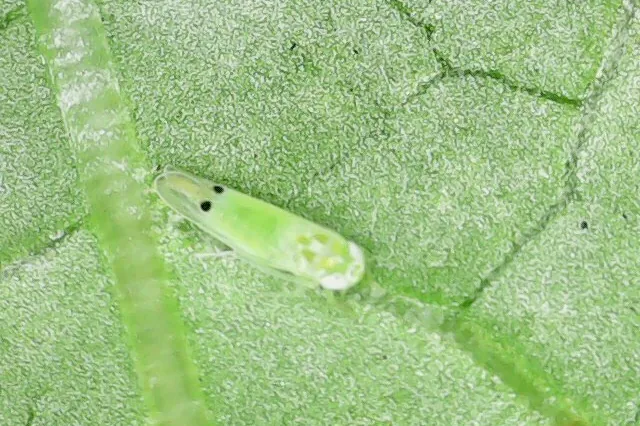
What Is Eggplant Leafhopper?
The eggplant leafhopper (Amrasca biguttula biguttula) is found in the Philippines, India, Pakistan, Sri Lanka and Taiwan. It feeds on eggplant and on other crops, including okra. Together with the eggplant fruit and shoot borer, it is a main reason that a large share of eggplant production cost goes to pesticides in the Philippines.
Both the adults and the nymphs feed on the underside of the leaves. They damage the phloem, and the leaf then shows burn like symptoms that can pass for a disease. Because the insects hop away fast when you disturb them, many farmers see the damage first and the pest later.
| Fact | Details |
|---|---|
| Name | Eggplant leafhopper |
| Scientific name | Amrasca biguttula biguttula |
| Kind | Insect |
| Crops it attacks | Eggplant (talong), also okra and other crops |
| Local names | None recorded |
| Where it strikes | Leaves and the whole plant |
| When it strikes | It breeds almost all year but is more common in dry periods, and it attacks eggplant from the young plant stage through fruiting. |
| Life cycle | Females lay minute eggs inside the leaf tissue on the underside of the leaf. The nymphs feed there, then become adults. The whole life cycle lasts 5 to 7 weeks, and generations overlap through the season. |
How to Identify Eggplant Leafhopper
Turn the leaves over, especially the lower and middle ones. The adults are 1 to 3 mm long, greenish yellow, slender and tapered, with two black spots toward the end of the wings. They run sideways and hop when disturbed. On the plant, look for leaf edges that curl upward and turn yellow, then brown. Do not confuse this with whitefly, which is a white, powdery looking insect that flies up in a cloud when you shake the plant.
- Leaf margins that curl upward and look yellowish or burned.
- Brown, dead patches at the leaf edge with a yellow halo around them.
- Small leaves with a mosaic pattern of yellowing.
- Very low fruit set on plants with heavy damage.
- Greenish yellow insects, 1 to 3 mm long, hopping sideways off the underside of the leaf.
Hopperburn can look like a nutrient problem or a leaf disease. The test is the underside of the leaf. If you find the small hopping insects there, it is the leafhopper. Whitefly and thrips also leave yellow or silvery leaves, but they look different under a hand lens.
How Eggplant Leafhopper Hurts Your Crop
The damage from this leafhopper is curled and burned leaves, small leaves and very low fruit set. A heavy infestation weakens the plant, so it makes fewer and smaller fruits.
We found no Philippine action threshold in the sources we read. So the practical rule is to scout once a week from transplanting. Check the undersides of 10 leaves on 10 plants, and act when the insects keep building up and the first leaf edges curl.
How to Control Eggplant Leafhopper
- Scout every week. Turn over leaves from the lower and middle part of the plant and count the nymphs and adults.
- Use mulch. In a trial, plastic mulch and fipronil gave the best return on investment, at 38.87 percent and 44.41 percent, while rice straw mulch gave 15.36 percent.
- Choose varieties that resist the leafhopper where they are sold for your area. Breeders are working on eggplant that resists the leafhopper and the borer.
- Try botanical sprays first, especially in organic plots. In a study, weekly sprays of a 5 percent extract of chili pepper (Capsicum frutescens) or kakawate (Gliricidia sepium), starting 21 days after transplanting, gave the greatest drop in leafhopper numbers and higher marketable yield.
- Do not rely on the fungus Metarhizium anisopliae. A trial found its isolates killed only about 10 percent of the insects.
- Keep weeds and old okra or eggplant plants away from the field, so the hoppers do not move in from them. See the integrated pest management guide.
When a Spray Makes Sense
A spray makes sense only when scouting shows the numbers keep rising and the leaf edges are already curling. Spray the underside of the leaves, where the insects sit. Follow the FPA registered label and the waiting time before harvest, and rotate groups.
| Active ingredient | IRAC group | On Philippine labels |
|---|---|---|
| Dinotefuran | IRAC 4A | A first choice. 10 registered products name it on eggplant. |
| Flonicamid | IRAC 29 | A first choice. 6 registered products name it on eggplant. |
| Thiamethoxam | IRAC 4A | A sound second choice. 19 registered products name it on eggplant. |
| Imidacloprid | IRAC 4A | A sound second choice. 5 registered products name it on okra. |
| Chlorantraniliprole plus thiamethoxam | IRAC 28 plus 4A | A sound second choice. 3 registered products name it on eggplant. |
| Acetamiprid | IRAC 4A | A sound second choice. 1 registered product names it on eggplant. |
| Afidopyropen | IRAC 9D | A sound second choice. 1 registered product names it on eggplant. |
| Azadirachtin | IRAC UN | A sound second choice. 1 registered product names it on eggplant. |
| Clothianidin | IRAC 4A | A sound second choice. 1 registered product names it on eggplant. |
| Cyantraniliprole | IRAC 28 | A sound second choice. 1 registered product names it on eggplant. |
The table stops at the ten best. 19 more on Philippine labels for it are older or broad chemistry. The Pest Finder in anee.io lists every one, crop by crop, with the products sold here.
Resistance. Cotton leafhopper in South Asia now survives many pyrethroids and organophosphates and, in places, imidacloprid and thiamethoxam. Keep one group per window and switch: a neonicotinoid (4A), then flonicamid (29), then afidopyropen (9D) or tolfenpyrad (21A).
Use only products registered with the Fertilizer and Pesticide Authority, and follow the label for the rate, the timing and the protective clothing. Switch to a different insecticide group next time, so the pest does not learn to survive it. Our guide to integrated pest management explains how.
Keep It Out Next Season
- Plant on plastic or rice straw mulch. Mulched fields carried fewer hoppers in trials.
- Choose varieties that resist the leafhopper where they are sold for your area.
- Keep weeds and old okra, cotton or eggplant plants away, and do not put okra next to a young eggplant block.
- Clear crop remains after harvest and plant a different crop after eggplant.
- Go easy on nitrogen. Soft, fast growth draws more hoppers.
Natural Enemies and Biological Help
- Spiders, lacewings, lady beetles and predatory bugs eat the hoppers. Broad sprays kill them first.
- Weekly 5 percent chili or kakawate extract sprays from 21 days after transplanting cut hopper numbers in a trial.
Not Sure What You Are Seeing?
Take a clear photo of the insect, the damage and the whole plant, then ask Anee, the smart farm technician in anee.io, in Tagalog or English. Anee tells you what it most likely is and what to do at the age of your crop. You can also put your scouting days on the cropping calendar, so the team knows when to walk the field.
anee.io keeps your scouting, spraying and harvest on one calendar, and Anee answers when something looks wrong.
- Scouting days dated from each lot's own planting day
- Photos and notes for every lot
- Anee, the smart farm technician, in Tagalog or English
Questions Farmers Ask About Eggplant Leafhopper
Why are my eggplant leaves curling and turning brown at the edges?
Does the leafhopper spread a virus in eggplant?
Can I control it without synthetic insecticide?
Stop Eggplant Leafhopper from costing you the harvest
With Libre + Anee, read the whole guide: how to be sure it is this pest, when it pays to act, and what to spray, by active ingredient.
The account is free, no credit card.