Whitefly in Vegetables: How to Spot It and Stop It
Whitefly is a tiny white insect that feeds on the underside of vegetable leaves. It weakens the plant, leaves a sticky honeydew and carries plant viruses. This page shows how to spot whitefly early and how to keep it under control without wiping out its natural enemies.
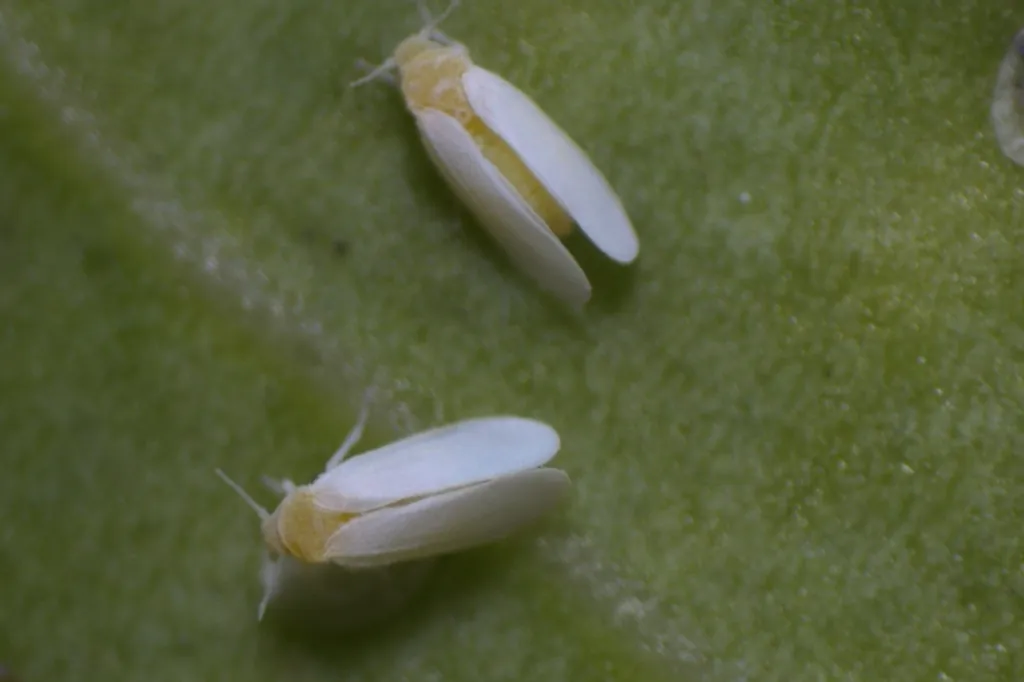
What Is Whitefly?
The whitefly Bemisia tabaci is a small sap sucking insect with a very wide host range. It carries many plant viruses, including those of tomato, cucurbits and cotton. It also feeds on eggplant, root crops, legumes, onion and tobacco.
A study found that B. tabaci is not one thing but a group of at least 41 biotypes, which differ in host choice, in their resistance to insecticides and in how well they carry viruses. In the Philippines, researchers found the B biotype on cotton, eggplant, squash and tomato, and also Asia biotypes on eggplant. That mix is one reason sprays often fail.
| Fact | Details |
|---|---|
| Name | Whitefly |
| Scientific name | Bemisia tabaci |
| Kind | Insect |
| Crops it attacks | Tomato, eggplant, squash and other cucurbits, beans, onion and cotton |
| Local names | None recorded |
| Where it strikes | Leaves and the whole plant |
| When it strikes | It attacks from the seedling stage through harvest, and it builds up fast in hot, dry weather and where crops overlap. |
| Life cycle | Females lay eggs on the underside of leaves. The eggs hatch into mobile crawlers, which settle and turn into scale like nymphs, and then into winged adults. Adults fly in from weeds, old crops and neighboring fields. |
How to Identify Whitefly
Shake a plant gently, or turn over a young leaf. Adults are tiny, about 1.5 mm, with yellowish bodies and white wings, and they fly up in a small cloud. On the underside you will see the pale, flat, scale like nymphs that do not move. Leaves may be yellow, curled or covered with a sticky shine and black sooty mold. Aphids and thrips also make leaves sticky or silvery, but they do not fly up as a white cloud.
- Small white flying insects that rise from the leaves when you shake the plant.
- Pale, flat, scale like nymphs on the underside of the leaves.
- Yellow and curled leaves, and plants that grow slowly.
- A sticky honeydew on the leaves and a black sooty mold on top of it.
- Fruits that ripen unevenly in tomato.
- Plants with virus symptoms, such as curled, yellow, stunted leaves, near the whitefly colonies.
Aphids and thrips also leave sticky or silvery leaves. Only whitefly lifts off as a small white cloud when you shake the plant.
How Whitefly Hurts Your Crop
The direct damage comes from sap loss and from the honeydew, which feeds sooty mold. But the bigger loss usually comes from the viruses the whitefly carries. In tomato these include the begomoviruses behind tomato leaf curl. A virus cannot be cured, so one early infestation can ruin a planting.
UC IPM uses a treatment threshold of about 4 adults per leaf for sweetpotato whitefly in tomato in California. That number comes from another climate and another crop, so treat it as a guide only. Because a virus cannot be cured, act on young plants as soon as you see adults.
How to Control Whitefly
- Use clean seedlings from a nursery covered with a fine net, and inspect the seedlings for nymphs and eggs before transplanting.
- Install yellow sticky traps at planting, around the field, to catch adults that fly in from other crops. Use them also to monitor the numbers.
- Plant a barrier of maize around the field or a trap crop of cucurbits to hold the adults off the main crop, as the Pacific Pests fact sheet advises.
- Remove weeds, old crop remains and neighboring volunteer plants that harbor whitefly. Avoid planting new crops right next to old ones, so the generations do not overlap.
- Use reflective silver mulch where you can. UC IPM reports it can delay the build up in tomato by 4 to 6 weeks.
- Protect the natural enemies, such as parasitic wasps, lacewings and lady beetles. The fungus Verticillium lecanii is also used against the nymphs. See the integrated pest management guide.
When a Spray Makes Sense
Pacific Pests warns that strong insecticides lead to resistant strains and advises soap, oils and plant products first. If you still need to spray, use the underside of the leaves and rotate groups. Follow the FPA registered label.
| Active ingredient | IRAC group | On Philippine labels |
|---|---|---|
| Cyantraniliprole | IRAC 28 | A first choice. Registered products name it on tomato and eggplant. |
| Abamectin plus spiromesifen | IRAC 6 plus 23 | A first choice. Registered products name it on tomato, eggplant, chili, bell pepper and more. |
| Afidopyropen | IRAC 9D | A first choice. 1 registered product names it on eggplant. |
| Dinotefuran | IRAC 4A | A sound second choice. Registered products name it on tomato, eggplant and watermelon. |
| Flometoquin | IRAC 34 | A sound second choice. 1 registered product names it on eggplant. |
| Tolfenpyrad | IRAC 21A | A sound second choice. 1 registered product names it on eggplant. |
| Lambda cyhalothrin plus thiamethoxam | IRAC 3A plus 4A | Older or broad chemistry: a last resort. Registered products name it on tomato and eggplant. |
| Chlorantraniliprole plus thiamethoxam | IRAC 28 plus 4A | Older or broad chemistry: a last resort. 3 registered products name it on eggplant. |
| Acetamiprid plus bifenthrin | IRAC 4A plus 3A | Older or broad chemistry: a last resort. 1 registered product names it on tomato. |
| Chlorfluazuron | IRAC 15 | Older or broad chemistry: a last resort. 1 registered product names it on watermelon. |
These are on Philippine labels for it, but we leave them off the list above, for the reasons below.
- Beta cyfluthrin: Pyrethroids kill the wasps that hold whitefly down, and whitefly comes back worse after them.
Resistance. Bemisia whitefly in Asia widely survives organophosphates, pyrethroids and imidacloprid, and in places other neonicotinoids and pyriproxyfen. Keep one group per window of 2 to 3 weeks: spiromesifen or spirotetramat (23), then afidopyropen (9D) or cyantraniliprole (28), then dinotefuran (4A) or flometoquin (34). Never two neonicotinoids in a row.
Use only products registered with the Fertilizer and Pesticide Authority, and follow the label for the rate, the timing and the protective clothing. Switch to a different insecticide group next time, so the pest does not learn to survive it. Our guide to integrated pest management explains how.
Keep It Out Next Season
- Raise seedlings under fine net and check them for eggs and nymphs before transplanting.
- Hang yellow sticky traps around the field from planting, to catch adults flying in and to count them.
- A border of corn around the field, or silver plastic mulch, keeps many adults off young plants.
- Remove weeds, volunteer plants and old crop remains, and never plant a new crop beside an old one full of whitefly.
- Plant on the same dates as your neighbors and pull out the crop right after the last harvest.
- Choose varieties that tolerate leaf curl virus where they are sold for your area.
Natural Enemies and Biological Help
- Encarsia and Eretmocerus wasps, lacewings and lady beetles eat whitefly. Pyrethroid sprays kill them and the whitefly comes back worse.
- Insecticidal soap, oil and neem sprayed under the leaves kill nymphs with little harm to the wasps.
- Fungi such as Beauveria bassiana and Lecanicillium lecanii work on nymphs in humid weather.
Not Sure What You Are Seeing?
Take a clear photo of the insect, the damage and the whole plant, then ask Anee, the smart farm technician in anee.io, in Tagalog or English. Anee tells you what it most likely is and what to do at the age of your crop. You can also put your scouting days on the cropping calendar, so the team knows when to walk the field.
anee.io keeps your scouting, spraying and harvest on one calendar, and Anee answers when something looks wrong.
- Scouting days dated from each lot's own planting day
- Photos and notes for every lot
- Anee, the smart farm technician, in Tagalog or English
Questions Farmers Ask About Whitefly
How do I tell whitefly from aphids?
Why does my spray not kill the whitefly?
Can whitefly give my tomato a virus?
Stop Whitefly from costing you the harvest
With Libre + Anee, read the whole guide: how to be sure it is this pest, when it pays to act, and what to spray, by active ingredient.
The account is free, no credit card.