Rice Leaffolder: Damage, When It Matters and How to Control It
The rice leaffolder, Cnaphalocrocis medinalis, is a small moth whose caterpillar folds a rice leaf into a tube and scrapes the green from the inside. In Tagalog it is mambibilot or maniniklop. The white streaks look alarming, but rice often recovers from damage in the early weeks, so knowing when it truly matters saves you money.
How to recognize the rice leaffolder
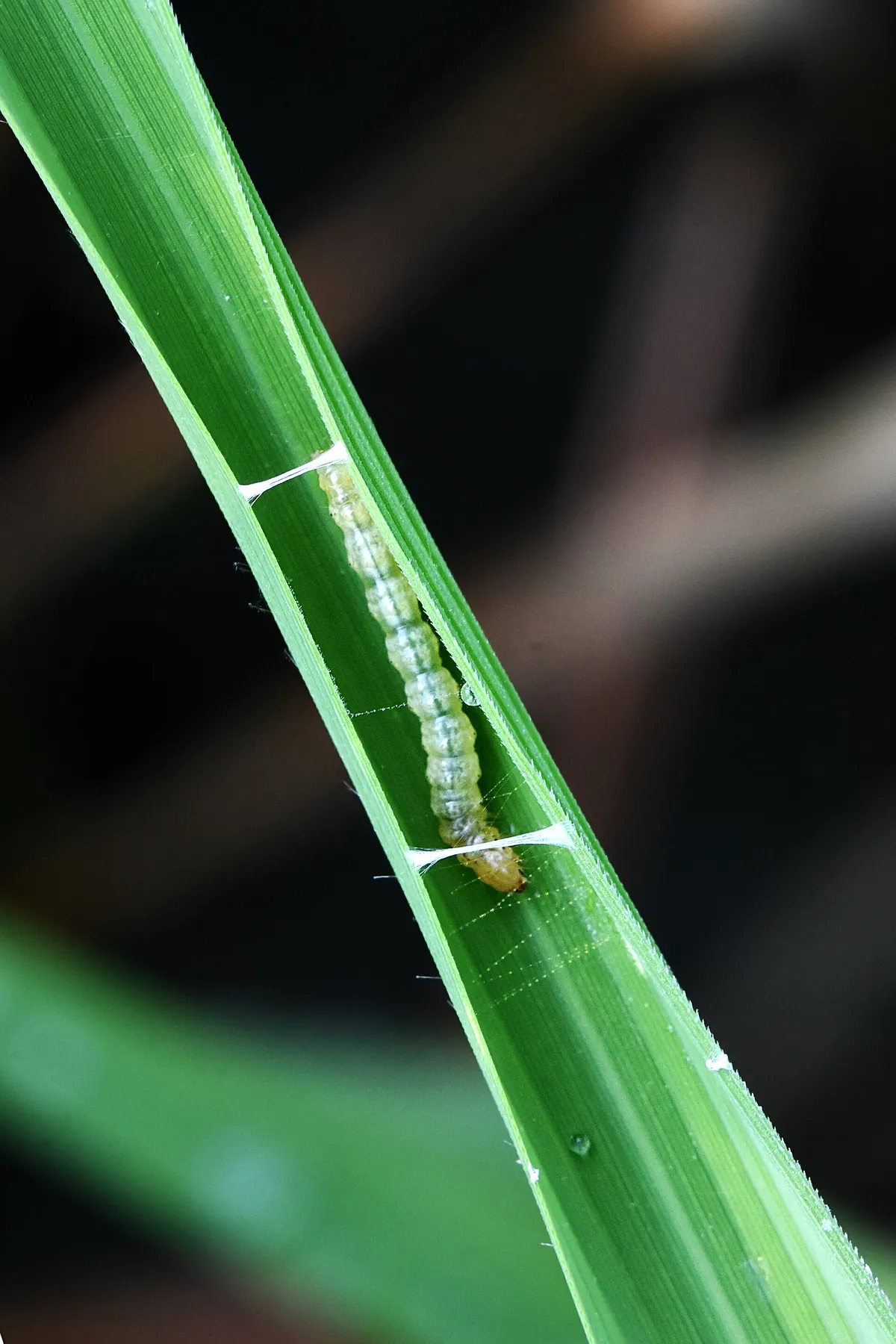
The adult is a light brown moth with a wingspan of 1.2 to 2 centimeters and a dark band along the outer edges of the wings. By day it rests in shady, grassy spots, and at night it flies to lights. The caterpillar is a clear, pale green and grows up to 2.5 centimeters long. A second species, Marasmia patnalis, causes the same kind of damage in Philippine fields.
Eggs are flat, oval and whitish yellow, laid one or two at a time on young leaves. They hatch in 4 to 7 days. Then the caterpillar feeds inside folded leaves for 15 to 25 days before it pupates, and the moth comes out 6 to 8 days later. The whole cycle takes 25 to 52 days.
Signs of leaffolder damage
- Leaves folded lengthwise into tubes and held shut with silk
- Long, white, see through streaks where the caterpillar scraped the leaf
- Leaf tips sometimes fastened to the base of the same leaf
- Caterpillar droppings inside the fold
- In heavy attacks, fields that look scorched, with many folded leaves
Leaffolders feed from the seedling stage to flowering. Plants are at risk for up to about 10 weeks after transplanting.
When rice leaffolder damage matters
Not all white leaves cost you grain. During the vegetative stage the crop can generally recover from leaffolder feeding. It starts to matter in the reproductive stage, once more than half of the flag leaf and of the two leaves just below it on each tiller is eaten. The flag leaf feeds the filling grain, so protect it most.
Philippine researchers have also tested action thresholds for leaffolders on rice (Litsinger and others, 2006, listed under Sources). So ask your technician for the local threshold instead of spraying because the leaves look bad.
Field advice points the same way. An insecticide sprayed early hardly reaches a caterpillar sealed inside its folded leaf, so let the spiders, wasps and other friendly insects in the paddy deal with it. Keep every insecticide off the crop for the first 30 to 40 days. Our guide on when to spray rice pests sets these limits side by side for the main rice pests.
What makes leaffolders build up
- Heavy fertilizer, especially nitrogen such as urea fertilizer
- High humidity and shady parts of the field
- Grassy weeds in the field and along its borders
- Rice after rice under irrigation, and ratoon crops
- Insecticide sprays that kill natural enemies and cause resurgence
- The rainy season, when leaffolders are more common
How to scout and decide
Scout weekly from tillering
Walk the field each week from tillering to flowering and look at the youngest leaves for fresh folds.
Open a few folds
Unroll some folded leaves. An empty fold may mean the caterpillar has moved on or died, and then the damage will not grow there.
Focus on the flag leaf
From booting on, check the flag leaf and the two leaves below it. It matters once more than half of the flag leaf and of the two leaves under it on each tiller is eaten. Act only if yours is heading that way.
Count the helpers
Note the spiders, wasps and other natural enemies you see. Many helpers mean the pest is already under attack.
Name the cause first
If more than half of the leaves show damage, find out what caused it before you act. Other pests, such as the rice caseworm, also strip rice leaves.
anee.io keeps this simple. The cropping calendar counts days after transplanting for each lot, so a weekly scouting task falls on the right dates. The growth stages view shows when each lot reaches booting and heading, when the flag leaf matters most. Add notes and photos to the lot, and ask Anee, the smart farm technician, whether the folds you found call for action. She answers in Tagalog or English.
Natural enemies of the rice leaffolder
Many small wasps lay their eggs in leaffolder eggs and caterpillars. A 2012 review by Gurr and colleagues found that these parasitoids can reach high rates of parasitism, though not in every field or season. Spiders and other hunters in the paddy add to the pressure.
The same review makes a point every farmer should hear. Because the damage looks dramatic, farmers spray early, and those early sprays disrupt biological control of the leaffolder and of other pests. It also notes that rice can tolerate heavy leaf loss with no effect on grain yield. It suggests that flowering plants on the bunds, which feed parasitic wasps with nectar, may help against the leaffolder too.
Control: cultural first, chemical last
Active Ingredients on Philippine Labels
| Active ingredient | IRAC group | On Philippine labels |
|---|---|---|
| Chlorantraniliprole | IRAC 28 | A first choice. 35 registered products name it on rice. |
| Cartap hydrochloride | IRAC 14 | A first choice. 2 registered products name it on rice. |
| Chlorantraniliprole plus thiamethoxam | IRAC 28 plus 4A | A sound second choice. 6 registered products name it on rice. |
| Flubendiamide | IRAC 28 | A sound second choice. 2 registered products name it on rice. |
| Indoxacarb | IRAC 22A | A sound second choice. 2 registered products name it on rice. |
| Tetraniliprole | IRAC 28 | A sound second choice. 2 registered products name it on rice. |
| Thiosultap (dimehypo) | IRAC 14 | A sound second choice. 2 registered products name it on rice. |
| Cyclaniliprole | IRAC 28 | A sound second choice. 1 registered product names it on rice. |
| Isocycloseram | IRAC 30 | A sound second choice. 1 registered product names it on rice. |
| Lufenuron plus cyantraniliprole | IRAC 15 plus 28 | A sound second choice. 1 registered product names it on rice. |
The table stops at the ten best. 16 more on Philippine labels for it are older or broad chemistry. The Pest Finder in anee.io lists every one, crop by crop, with the products sold here.
These are on Philippine labels for it, but we leave them off the list above, for the reasons below.
- Clothianidin: Made for sucking insects such as hoppers. It does little against caterpillars inside the fold.
Resistance. Leaffolder in China has grown less sensitive to chlorantraniliprole after heavy use. Do not spray group 28 twice in a row. Switch with cartap (14), indoxacarb (22A) or tebufenozide (18).
- Use resistant varieties where your Municipal Agriculture Office has them.
- Follow rice with a different crop or a fallow period, and avoid ratooning.
- Flood and plow the field after harvest if you can.
- Remove grassy weeds from the field and the bunds.
- Cut back tree branches that shade the paddy. Shady edges give the leaffolder moths a place to settle.
- Plant at a moderate density and use balanced fertilizer rates, as in our guide to fertilizer for rice.
- Avoid insecticides in the early crop stages. Early sprays rarely pay back and can trigger outbreaks of the brown planthopper.
Leaffolder folds in the first month look bad but usually do not cost yield. Hold the spray and keep scouting. If a spray is ever needed, it will be at the flag leaf stage.
Chlorantraniliprole and the Virtako insecticide
If the flag leaf is at real risk and your technician agrees, an insecticide for chewing pests can help. Chlorantraniliprole, a Group 28 diamide in the IRAC system, is one active ingredient used against leaffolders. FMC's Prevathon 5SC contains chlorantraniliprole alone, and its Philippine label lists leaffolder and stem borer on rice.
The Virtako insecticide (Virtako 40 WG) from Syngenta pairs chlorantraniliprole with thiamethoxam. Its Philippine product page lists stem borer, black bug and green leafhopper on rice, not leaffolder. So check the label on the pack before you use it for this rice insect. Karate 2.5 EC, a lambda cyhalothrin product, does list leaffolder on rice, but as a broad spectrum pyrethroid it also kills natural enemies.
Whatever you choose, follow the label rate and interval, respect the FPA registration, and rotate insecticide groups so the pest does not build resistance. Our guides to Alika, Virtako and Chess and to Karate, Cymbush and Selecron compare these products.
anee.io shows when each lot reaches booting and heading, reminds your team to scout, and lets Anee read a photo of the folded leaves.
Create a free accountRice leaffolder questions
What is the leaffolder called in Tagalog?
Does leaffolder damage reduce yield?
When should I spray for leaffolder?
Is Virtako registered for leaffolder?
What kills leaffolders naturally?
- Litsinger and others (2006), Evaluation of action thresholds for chronic rice insect pests in the Philippines. III. Leaffolders
- Gurr and others (2012), Parasitoids of the rice leaffolder Cnaphalocrocis medinalis, Agricultural and Forest Entomology
- FMC Philippines: Prevathon 5SC
- Syngenta Philippines: Virtako 40 WG
- Syngenta Philippines: Karate 2.5 EC
Stop Rice Leaffolder from costing you the harvest
With Libre + Anee, read the whole guide: how to be sure it is this pest, when it pays to act, and what to spray, by active ingredient.
The account is free, no credit card.