When to Spray Rice Pests: Action Thresholds for Palay
Knowing when to spray palay saves money and keeps pests from coming back stronger. The answer is rarely the moment you see an insect. The rule is to count first, let natural enemies work, and spray only when a pest crosses its action threshold. Below are those thresholds for eight common rice pests and diseases.
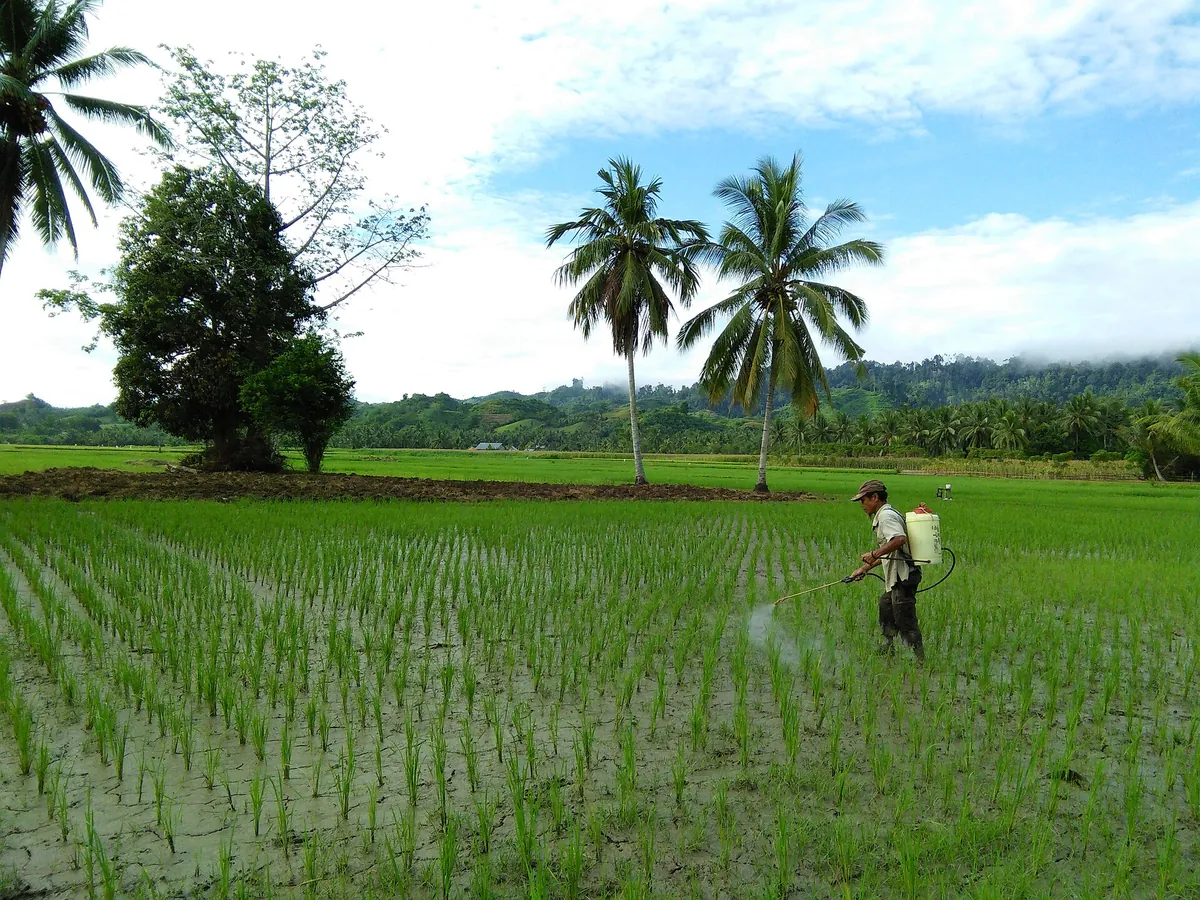
An action threshold is the count or damage level at which a pest starts to cost more than the spray. Below it, the crop outgrows the damage, and the spiders, wasps and beetles in your field keep the pest down for free. Our guide to integrated pest management explains the idea, and this page puts the numbers for when to spray in one place.
First rule: no insecticide in the first 30 days
Do not spray insecticide in the first 30 days after transplanting, or 40 days after sowing for direct seeded rice. The rule holds for leaf eating pests and for brown planthopper.
There are two reasons. Young rice makes up for early leaf damage by growing new leaves and tillers. And an early spray kills the spiders, mirid bugs and wasps that feed on planthoppers. Early season spraying is one cause of planthopper outbreaks, because the surviving hoppers multiply once nothing eats them.
How to count before you decide when to spray
Walk each lot along a diagonal and check 10 hills spread across it. Count insects early in the morning, from 5 to 7, or late in the afternoon around 5. For planthoppers, tap each hill three times so they drop onto the water, then count them. Write the numbers down every week, so you judge the trend and not one bad day.
| Problem | Leave it while | Act when | First step |
|---|---|---|---|
| Brown planthopper | Fewer than 1 per tiller | 1 or more per tiller, or about 25 to 30 per hill | Drain the field for about a week |
| Rice black bug | 5 or fewer per hill | More than 5 per hill | Metarhizium at low counts, deep water and a spray above 5 |
| Leaffolder | First 30 to 40 days, and while natural enemies keep up | Rarely, and only on your technician's advice | Trim shade trees, fertilize at the right rate |
| Stem borer | Damage during tillering | The jar test hatches more larvae than wasps | Contact or stomach insecticide |
| Bacterial leaf blight | Scattered infection | About 30 percent or more of the field | Drain, then copper fungicide if needed |
| Blast | No blast before heading | Leaf blast during tillering | Fungicide at early heading and half heading |
| Golden apple snail | Past tillering | Snails feed on seedlings | Saturated soil, then a matched molluscicide |
| Rats | Never | Any fresh burrow or cut tiller | Community burrow work and sealed bait |
Brown planthopper
If you find no more than 1 brown planthopper per tiller, leave your sprayer in the shed. A count of 1 or more per tiller, or about 30 per hill, is high and calls for action. Even then, start by draining the field completely for about a week, then irrigate only as needed. From booting to ripening, a recommended insecticide is allowed once counts reach about 25 per hill.
Add one more check: if spiders, mirid bugs and other natural enemies outnumber the hoppers, do not spray, even with some hopperburn. For the long run, plant a resistant variety, keep nitrogen to the recommended rate and practice alternate wetting and drying. Avoid broadcast seeding while planthoppers are attacking your area. Our brown planthopper profile has the details.
Rice black bug
At 5 or fewer black bugs per hill, spray the fungus Metarhizium anisopliae, a biological control. Above 5 per hill, a recommended insecticide becomes an option. First raise the water to about 15 cm so the bugs climb up the stems, then spray in cool weather while they sit on top of the plants.
Flooding also works on the eggs. Eggs kept under water for more than 24 hours do not hatch, so keep water in the field from tillering to ripening. In heavy attacks, light traps with bright bulbs pull in huge numbers, best run around the full moon. Plow under any field the bugs have ruined right away. Read more on the rice black bug.
Rice leaffolder
Do not rush to spray leaffolders. The larva hides inside the folded leaf, so most sprays never reach it, while they do kill the spiders and wasps that hunt it. Let those friendly insects work, and spray nothing in the first 30 to 40 days. Trim tree branches that shade the paddy, since the moths like to rest there, and fertilize at the right rate, not more. The rice leaffolder page shows why the flag leaf matters most.
Stem borer
Young rice can recover from stem borer damage during tillering, so do not spray at the first deadheart. Keep the field free of weeds and drought stress, and give enough fertilizer to help the plants replace lost tillers. Before transplanting, pick off any egg masses you find on the seedlings.
From panicle initiation to heading, run a light trap to watch the moth numbers. If moths swarm from booting to flowering, try the jar test. Collect egg masses from the field, put them in a covered jar and wait for them to hatch. If more larvae than tiny wasps come out, the natural enemies are losing, and a contact or stomach insecticide makes sense. Our rice stem borer page shows deadhearts and whiteheads.
Bacterial leaf blight
No spray cures bacterial leaf blight, and resistant varieties are the cheapest and most reliable control. So the first steps are water and hygiene. Drain the field when you see infection, and never let water from a sick paddy flow into healthy ones. Do not walk from sick plants into healthy ones while the leaves are wet.
Use a copper based fungicide only when about 30 percent or more of the field shows the disease, and only if needed. Next season, plant a resistant variety and split your nitrogen, as our bacterial leaf blight guide explains.
Rice blast
Blast, or mata mata, shows as diamond shaped spots with grey centers and reddish brown edges. If leaf blast appears during tillering, protect the panicles. Apply a fungicide at the start of heading, then again when about half the panicles are out, to head off neck and panicle blast. Tricyclazole and pyroquilon are among the usual active ingredients.
Keep the field irrigated, because blast strikes water short fields hardest, and avoid too much nitrogen. After harvest, plow under infected stubble right away so it rots fast. The rice blast guide shows each form of the disease.
Golden apple snail
Golden apple snails eat young rice, so the danger runs from seedling to tillering. Keep the soil saturated but not flooded up to 15 DAT or 25 DAS. Snails cannot swim through mud to reach the seedlings, and a study found this the most practical control.
If you still need a molluscicide, match the active ingredient to your water. Choose metaldehyde where water flows in strongly or sudden rain is likely, and niclosamide where water is scarce and no rain is expected. Apply it while the paddy holds water, in the cool of the early morning or late in the day. More on the golden apple snail.
Rice field rats
Rats do not wait for a threshold, so start at least a month before sowing and work as a community. Clean the bunds so you can see the burrows. Dig out small, shallow burrows or pour a mix of mud and water into them, and drive rats out of big, deep ones with a flame thrower.
Then keep up sustained baiting through the season, with the bait inside burrows where rain cannot spoil it. Use only rat poison sold in sealed packs, and follow the directions on the pack. See rice field rats for the signs.
Use only products registered with the Fertilizer and Pesticide Authority, and read the label for the rate and the waiting days before harvest. Wear gloves, a mask and long sleeves. Check the forecast too, because rain soon after spraying washes the product off, as our page on rain before spraying explains.
Keep your pest counts in anee.io
In anee.io, scouting goes on the calendar like any other task. Add a weekly pest walk to the cropping calendar, and each lot gets its own dates, so you also see when a lot passes 30 DAT. If you find something you cannot name, the pest and disease finders narrow it down by crop and signs.
You can also send a photo to Anee, the smart farm technician. She answers in Tagalog or English, and she checks your lot's stage and weather before she says whether to spray.
Sign up free, add your lots, and anee.io dates every pest walk from each lot's own planting day.
Start free