Bacterial Leaf Blight in Rice: Signs, Kresek and Control
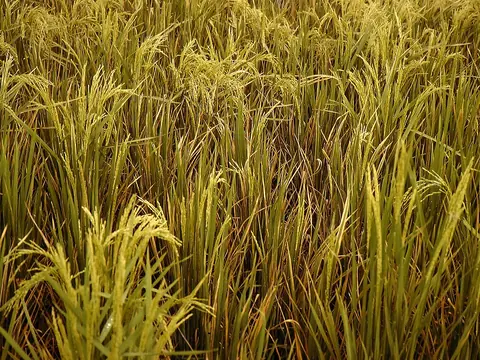
Bacterial leaf blight, caused by the bacterium Xanthomonas oryzae pv. oryzae, is one of the most serious diseases of rice and a top threat in the Philippines. It turns leaves yellow and straw colored from the tips down. In young plants it causes kresek, a wilt that can kill the whole plant. No spray cures it well, so prevention is the real control.
What Is Bacterial Leaf Blight?
Bacterial leaf blight, often shortened to BLB, attacks rice in irrigated and rainfed lowlands. This is one of the most serious diseases of rice. It thrives at 25 to 34 degrees Celsius with relative humidity above 70 percent. Strong winds and days of heavy rain carry it quickly from plant to plant. That is why it is among the major diseases to watch in the rainy season.
It is also a national problem. From 2021 to 2025, BLB was among the top five threats to rice. It was expected to spread in Central Luzon and Bicol early in 2026. Regional names include nauga nga dahon in Cebuano, nadurot nga tanum in Waray and naggapula in Ilonggo. Its cousin, bacterial leaf streak, looks the same at first.
| Fact | Details |
|---|---|
| Name | Bacterial leaf blight |
| Scientific name | Xanthomonas oryzae pv. oryzae |
| Kind | Bacterium (a bacterial disease) |
| Crops it attacks | Rice |
| Local names | Nauga nga dahon and natala nga tanum (Cebuano), nadurot nga tanum (Waray), naggapula (Ilonggo), and kresek for the seedling wilt |
| Where it strikes | Leaves, seedlings and the whole plant |
| When it strikes | Kresek strikes at the seedling stage. The leaf blight shows from tillering to heading, mostly in the wet season, when wind and rain spread the bacteria. |
| How it spreads | The bacteria survive in infected stubble, straw, ratoons, volunteer seedlings and weeds. They ooze from fresh lesions in droplets. Wind and rain carry them to other leaves, and they enter easily through wounds on roots and leaves. |
How to Identify Bacterial Leaf Blight
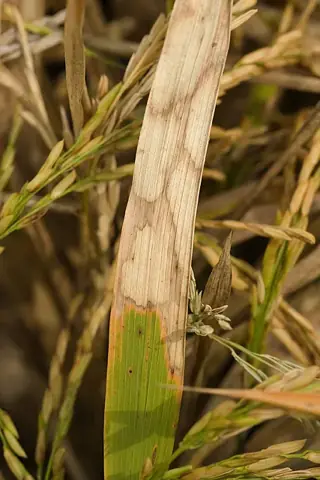
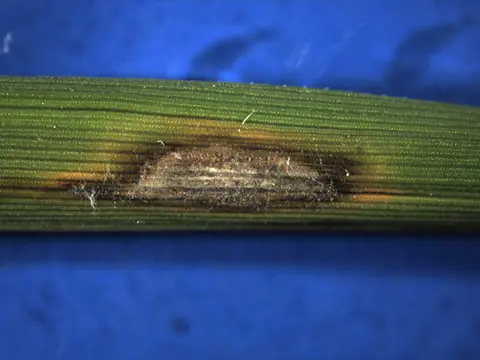
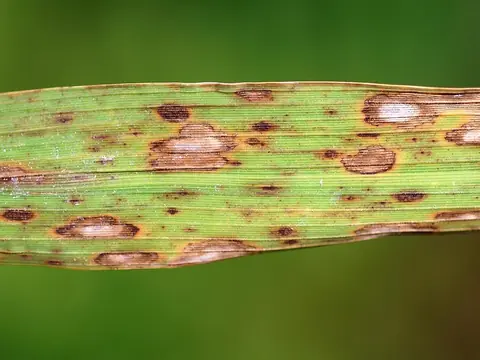
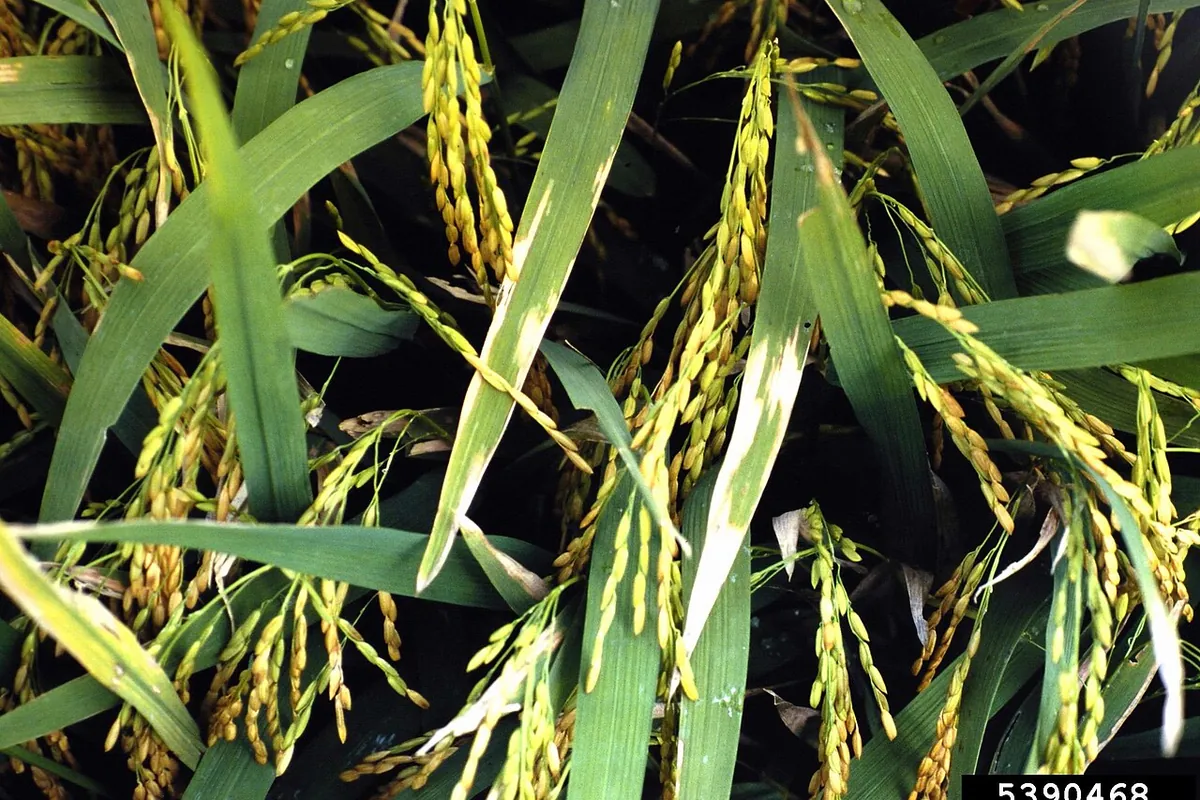
Look at the leaf tips and edges first. Lesions start as water soaked stripes that turn yellow to orange and run down the leaf with a wavy margin, later turning grayish white. Early in the morning, fresh lesions may carry a milky drop of ooze that dries into small yellow beads. To confirm, cut a young lesion, stand it in a clear glass of water and hold it to the light. After a few minutes, a cloudy stream flows from the cut end.
- Yellow to orange stripes that start at the leaf tip or edge and move down with a wavy margin.
- Milky drops of ooze on young lesions in the early morning, later dried into yellow beads.
- Old lesions that turn grayish white, often dotted black by molds growing on the dead tissue.
- Seedlings whose leaves roll up, turn grayish green to yellow and wilt until the plant dies, called kresek.
- A cloudy liquid streaming from a cut lesion placed in a glass of clear water.
Kresek can pass for early stem borer damage. Squeeze the base of a wilted seedling: kresek shows yellowish ooze from the cut end, and the plant does not pull out easily. Early on, bacterial leaf streak looks much the same, so watch how the lesions grow.
How Bacterial Leaf Blight Hurts Your Palay
The loss can reach 70 percent when susceptible varieties grow in weather that favors the disease. The earlier it starts, the bigger the loss. If infection comes only at booting, the yield holds, but grain quality drops and more kernels break at milling. Besides that, heavy nitrogen on a susceptible variety makes it severe.
There is only one spray line to know. Chemical control of BLB is neither economical nor effective as a routine. A copper based fungicide is kept for fields where about 30 percent or more of the crop is hit. So your real decisions happen before planting and in how you handle water and fertilizer. Our guide to fertilizer for rice shows how to keep nitrogen balanced. Excess nitrogen and too little phosphorus and potassium also raise infection.
How to Control Bacterial Leaf Blight
- Plant a resistant variety. It is the most efficient, reliable and cheapest control, and NSIC Rc242 is among the varieties resistant to BLB.
- Use certified seed of a resistant variety, or seed from healthy plants. Handle seedlings gently and do not cut their leaf tips at transplanting, since wounds let the bacteria in.
- Keep beds and fields from flooding. Keep a shallow water level of 2 to 3 cm, and drain seedbeds and fields well.
- When the infection is heavy and spread across the field, lower the water or drain the field. Never let irrigation water flow from a sick field into a healthy one.
- Apply fertilizer at proper rates and split the nitrogen into several doses, since excess nitrogen feeds the disease.
- Weed regularly, and remove weed hosts on the bunds along with ratoons and volunteer seedlings.
- After harvest, plow under the stubble and straw, then leave the field fallow and let it dry.
When a Spray Makes Sense
Chemicals to control bacterial leaf blight are neither economical nor effective as a routine, so prevention carries the load. There is one exception: a copper based fungicide, only if needed, once about 30 percent or more of the field is hit. Pick a product whose FPA label lists rice, follow the label, and ask your local agriculture office before you buy. Our guide on when to spray rice pests shows how this line compares with other rice problems.
Active Ingredients on Philippine Labels
| Active ingredient | FRAC group | On Philippine labels |
|---|---|---|
| Copper hydroxide | FRAC M01 | Older or broad chemistry: a last resort. 4 registered products name it on rice. |
| Bordeaux mixture | FRAC M01 | Older or broad chemistry: a last resort. 3 registered products name it on rice. |
| Cuprous oxide | FRAC M01 | Older or broad chemistry: a last resort. 2 registered products name it on rice. |
| Thiodiazole copper | FRAC M01 | Older or broad chemistry: a last resort. 2 registered products name it on rice. |
| Bacillus amyloliquefaciens | FRAC BM02 | Older or broad chemistry: a last resort. 1 registered product names it on rice. |
| Copper sulfate | FRAC M01 | Older or broad chemistry: a last resort. 1 registered product names it on rice. |
These are on Philippine labels for it, but we leave them off the list above, for the reasons below.
- Fosetyl aluminium: Made for water molds. It does not control this bacterium.
- Streptomycin plus oxytetracycline: Medical antibiotics: farm use breeds bacteria that resist them, and the blight sits inside the leaf veins.
Use only products registered with the Fertilizer and Pesticide Authority, and follow the label for the rate, the timing and the protective clothing. Switch to a different fungicide group next time, so the disease does not learn to survive it. Our guide to plant diseases explains how.
Keep It Out Next Season
- Plant a resistant variety, and change to another resistant variety if blight starts to break through.
- Use clean seed from a healthy crop, and do not cut or bruise seedlings at pulling and transplanting.
- Split nitrogen, never heavy, and keep potash enough. Lush, nitrogen rich rice is hit hardest.
- Drain the field when blight shows, and keep water from a sick field from flowing into yours.
- After harvest, plow under stubble, ratoons and volunteer rice, and keep grassy weeds off the bunds and canals.
- Use wider spacing where blight is common, so leaves dry faster after rain.
Natural Enemies and Biological Help
- Bacillus products help a little as prevention. They do not cure a sick crop.
Not Sure What You Are Seeing?
Take a clear photo of the spots or the damage up close, then the whole plant, then ask Anee, the smart farm technician in anee.io, in Tagalog or English. Anee tells you what it most likely is and what to do at the age of your crop. You can also put your scouting days on the cropping calendar, so the team knows when to walk the field.
anee.io keeps your scouting, spraying and harvest on one calendar, and Anee answers when something looks wrong.
- Scouting days dated from each lot's own planting day
- Photos and notes for every lot
- Anee, the smart farm technician, in Tagalog or English
Questions Farmers Ask About Bacterial Leaf Blight
What is kresek in rice?
Is there a spray that cures bacterial leaf blight?
How do I tell kresek from stem borer damage?
Which variety resists bacterial leaf blight?
Stop the spread of Bacterial Leaf Blight
With Libre + Anee, read the whole guide: how to tell it from look alikes, what makes it spread, and what to spray and when.
The account is free, no credit card.