Sheath Blight of Rice: Symptoms, Causes and Control
Sheath blight is a fungal disease of rice caused by Rhizoctonia solani. It starts as greenish gray spots on the leaf sheath near the water and climbs the plant until leaves and young tillers die. It thrives in dense, heavily fertilized palay in hot, humid weather, which is why it shows up often in irrigated and rainfed fields that get a lot of nitrogen.
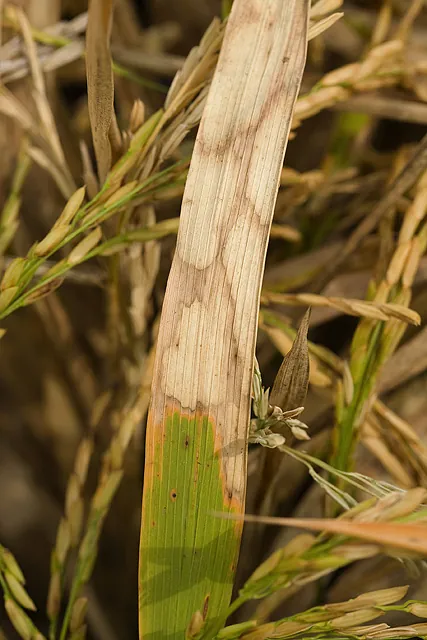
What causes sheath blight disease
The fungus Rhizoctonia solani lives in the soil and survives between crops, partly as sclerotia, small hard resting bodies that float on the paddy water. It does not spread through airborne spores. Instead, its threads grow along the plant from sheath to sheath, and from hill to hill wherever leaves touch.
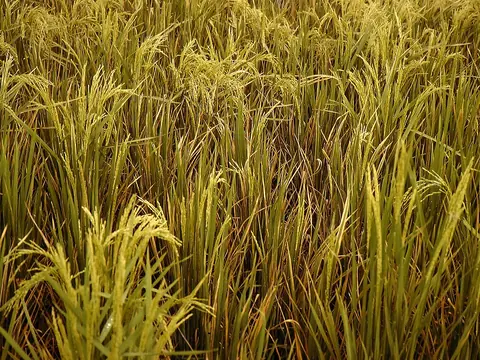
Sheath blight disease ranks as one of the most important rice diseases after blast, and a growing concern where farms plant denser and fertilize heavier. The possible yield loss is up to 50 percent. The disease shrinks the green leaf area of the canopy and kills young tillers, and those two losses are what cut the yield.
Sheath blight symptoms
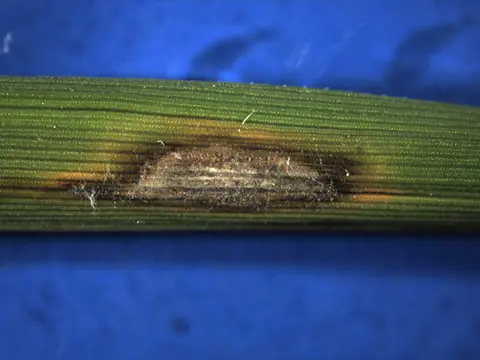
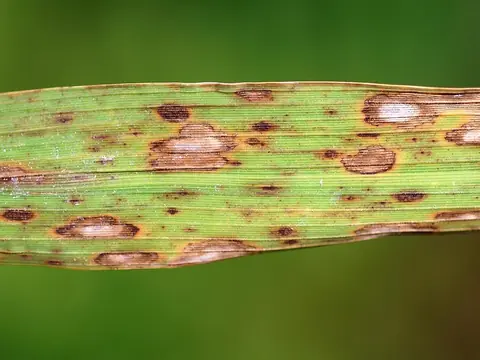
- Oval or elliptical greenish gray spots, about 1 to 3 centimeters long, on the leaf sheath just above the water line
- Spots that grow and join, with grayish white centers and brown borders
- Lesions that climb to the upper sheaths and the leaves, then move to the next hill
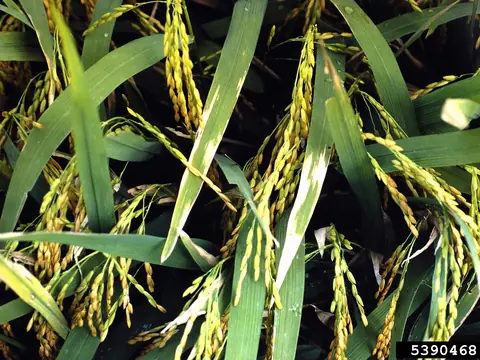
- Irregular, banded green and brown patches on the leaves, which later turn white
- Poor panicle exertion when the flag leaf gets infected
- Small sclerotia on and near the lesions
You usually see it from tillering to the milk stage. Stem rot and stem borer damage can look similar, so look for the typical lesions and the sclerotia before you decide. If you see white, empty panicles with no sheath lesions, read our guide to rice insects instead.
Why some fields get hit hard
- Hot weather, about 28 to 32 degrees Celsius
- Humidity of 85 to 100 percent inside the canopy
- High nitrogen, which builds a thick canopy
- High seeding rates or close spacing
- Fungus already in the soil from past crops
- Highly susceptible semi dwarf, high yielding varieties
- The rainy season, when plants are more vulnerable
The disease follows the same habits that push yields up. A farmer who adds extra urea and plants thick to chase a bigger harvest can build the perfect home for the fungus. Our guides to fertilizer for rice and urea fertilizer show how to split nitrogen instead of piling it on.
How to manage the disease
Cultural control
Use the right seeding rate
Follow the recommended amount of seed and avoid close spacing. Wider spacing lets air and light into the canopy.
Fit nitrogen to the season
Use a reasonable nitrogen rate for the season and split it. Too much nitrogen feeds the disease.
Clean the bunds
Control weeds in the paddy and on the bunds, especially the levees.
Drain at maximum tillering
When the crop reaches maximum tillering, let the field dry for a few days. Draining fairly early in the season also reduces epidemics.
Bury the stubble
After harvest, plow deep so the sick stubble and the weeds go under, and leave the soil open to the hot sun.
Resistant varieties
No resistant rice variety is available for cultivation yet, so do not count on the seed alone. Some varieties suffer less than others, though. Ask your Municipal Agriculture Office which ones held up in your area, and see our guide to rice varieties in the Philippines.
Biological control
Biological control uses friendly microbes against the disease. Philippine researchers have tested Trichoderma harzianum, a soil fungus that coils along the threads of Rhizoctonia solani and attacks them with enzymes. Most Trichoderma trials in the country ran in the laboratory or greenhouse and rarely in the field. A study also found an Aspergillus fungus from organically fertilized soil that slowed Rhizoctonia solani in small plots. It is still a research lead, though, and not yet a product you can buy.
Fungicide options for sheath blight
Apply a recommended fungicide only when you need it. Scout from maximum tillering and look low: part the hills and check the sheaths near the water. If lesions keep climbing the plants and spreading across hills in wet, humid weather, talk to your agricultural technician about a spray.
Common active ingredients against this disease include the triazoles difenoconazole and propiconazole and the strobilurin azoxystrobin. Two Syngenta products show how makers combine them. Armure 300 EC mixes difenoconazole and propiconazole, and its Philippine product page lists sheath blight on rice. Ortiva Top 325 SC mixes azoxystrobin and difenoconazole, and lists the same disease plus rice blast on rice.
Sheath blight starts low, so an Armure fungicide spray, or any other product, has to reach the lower sheaths. Follow the label for the rate, spray volume, timing and number of sprays. Use only FPA registered products, and rotate between fungicide groups so the fungus does not adapt. Our fungicides guide explains the groups.
Active Ingredients on Philippine Labels
| Active ingredient | FRAC group | On Philippine labels |
|---|---|---|
| Azoxystrobin plus difenoconazole | FRAC 11 plus 3 | A first choice. 31 registered products name it on rice. |
| Difenoconazole plus propiconazole | FRAC 3 plus 3 | A first choice. Registered products name it on rice and corn. |
| Tebuconazole plus trifloxystrobin | FRAC 3 plus 11 | A first choice. Registered products name it on rice and corn. |
| Difenoconazole | FRAC 3 | A sound second choice. 53 registered products name it on rice. |
| Azoxystrobin | FRAC 11 | A sound second choice. 20 registered products name it on corn. |
| Carbendazim plus tebuconazole | FRAC 1 plus 3 | A sound second choice. 5 registered products name it on rice. |
| Azoxystrobin plus propiconazole | FRAC 11 plus 3 | A sound second choice. 3 registered products name it on rice. |
| Tetraconazole plus carbendazim | FRAC 3 plus 1 | A sound second choice. 3 registered products name it on rice. |
| Epoxiconazole | FRAC 3 | A sound second choice. 2 registered products name it on rice. |
| Fluoxastrobin | FRAC 11 | A sound second choice. 2 registered products name it on corn. |
The table stops at the ten best. 14 more on Philippine labels for it are older or broad chemistry. The Disease Finder in anee.io lists every one, crop by crop, with the products sold here.
These are on Philippine labels for it, but we leave them off the list above, for the reasons below.
- Copper hydroxide, bordeaux mixture and copper oxychloride plus copper hydroxide: Copper does not control the sheath blight fungus.
- Mancozeb: A contact protectant that does not stop the sheath blight fungus spreading inside the canopy. Money wasted here.
- Thiram: A seed treatment. It does not stop sheath blight in the standing crop.
- Chlorothalonil: A contact protectant that does not control sheath blight. Money wasted here.
Resistance. The sheath blight fungus has learned to survive strobilurins (group 11) where they were sprayed alone, so far outside Asia. Use group 11 only in a mix, never twice in a row, and rotate with triazoles (3) or SDHIs (7).
It is a fungus, not an insect. If you sprayed an insecticide and the spots kept spreading, that is why. Keep your insecticide money for real pests like the brown planthopper.
anee.io can carry much of this for you. The growth stages view shows when each lot reaches maximum tillering, the time to drain and start checking the lower sheaths. The weekly forecast for each lot warns you of the hot, humid stretches the fungus likes. If you find odd spots, send a photo to Anee, the smart farm technician, who answers in Tagalog or English. And the farm inventory tracks the fungicide you bought and what each spray cost.
anee.io shows each lot's growth stage and the week's weather at your farm, and lets Anee read a photo of the spots on your palay.
Create a free accountSheath blight questions
What causes sheath blight in rice?
What does sheath blight look like?
Which fungicide works on sheath blight?
Can I prevent sheath blight without fungicide?
Is there a resistant variety?
Stop the spread of Sheath Blight
With Libre + Anee, read the whole guide: how to tell it from look alikes, what makes it spread, and what to spray and when.
The account is free, no credit card.