Rice Blast: How to Spot It and Stop It in Your Palay
Rice blast is the fungal disease many farmers call mata mata. It ranks among the most destructive diseases of palay (rice still in the husk). It spots the leaves, blackens the nodes and rots the neck of the panicle. A bad attack can leave few or no grains.
What Is Rice Blast?
Rice blast comes from the fungus Pyricularia oryzae, also called Magnaporthe oryzae. It can attack every part of the plant above the ground. That runs from the leaf and collar to the node, the neck and the panicle. It strikes where irrigation runs short and in upland fields. It does so most of all when the sky stays cloudy and rain keeps falling.
In Tagalog it is called mata mata, the word for its spots on the leaf. It is also called agupaw in Waray and taya taya in Cebuano areas of Mindanao. Blast hits twice. Early on it can kill seedlings and young plants. Later, neck blast cuts the panicle off right when the grain should fill. So the first defense is the seed you buy, and our guide to rice varieties in the Philippines can help you choose.
| Fact | Details |
|---|---|
| Name | Rice blast |
| Scientific name | Pyricularia oryzae (Magnaporthe oryzae) |
| Kind | Fungus (a fungal disease) |
| Crops it attacks | Rice |
| Local names | Mata mata (Tagalog and Bisaya), agupaw (Waray), taya taya (Cebuano in Mindanao) |
| Where it strikes | Leaves, stems and tillers, panicles and ears and seedlings |
| When it strikes | Blast can strike at any stage, but leaf blast hurts most from the seedbed to tillering, while node and neck blast hit as the panicles come out and fill, mostly in cloudy, rainy weeks. |
| How it spreads | The fungus survives on infected straw and stubble, and its spores travel through the air. When a spore lands on a wet leaf, it sprouts, enters the leaf and makes a spot that soon releases new spores. |
How to Identify Rice Blast
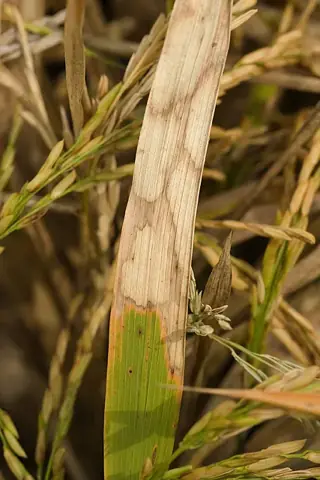
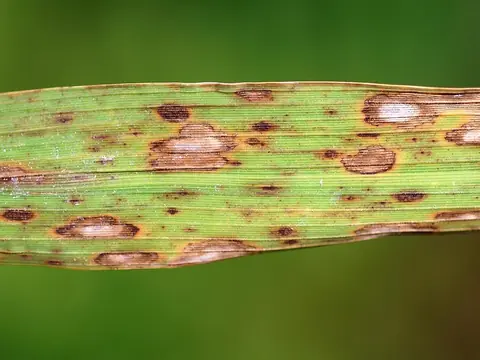
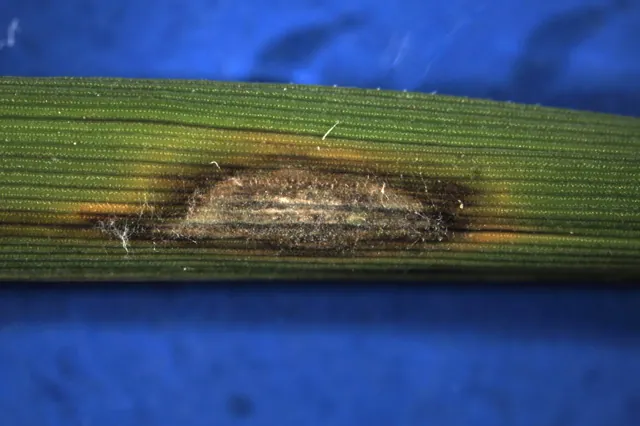
Start with the leaves. Young spots are white to gray green with dark green borders. Older spots turn spindle or diamond shaped, wide in the middle and pointed at both ends. They have a gray center and a reddish brown border. Next, check the collar where the flag leaf meets the sheath, then the nodes and the neck below the panicle. A blackened node or a grayish brown rot at the neck means the fungus has moved up the plant.
- Spindle or diamond shaped leaf spots with gray centers and reddish brown borders.
- Whole leaves that dry out after many spots grow together.
- A lesion at the base of the flag leaf, the collar, that makes the flag leaf dry up.
- Nodes that rot and turn black, so the stem breaks and everything above it dies.
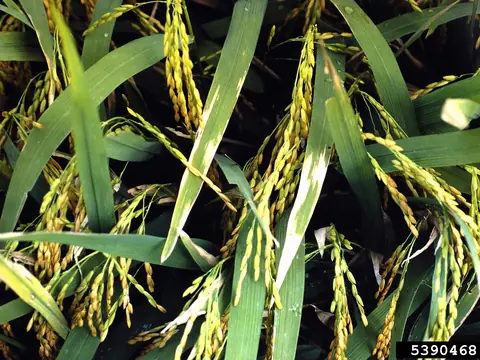
- A grayish brown rot at the base of the panicle, so the neck snaps or the panicle turns white.
- Discolored grains, or few to no filled grains when the neck was hit before the milky stage.
Brown spot is the usual mix up. Blast spots are long and pointed at both ends, while brown spot lesions are rounder, brown and ringed with yellow. White panicles from neck blast also look like stem borer whiteheads. But a stem hit by a borer pulls out easily and a blast hit stem does not.
How Rice Blast Hurts Your Palay
Few rice diseases do as much damage as blast. Leaf blast can kill seedlings, and young plants as late as tillering. On older plants, a severe attack shrinks the green leaf area that fills the grain. Neck and node blast hurt even more, because they hit the panicle directly. If the neck is infected before the milky stage, no grain forms at all.
There is no simple count that tells you when to spray. Instead, use a fungicide at heading only where the risk of yield loss is high. The disease also keeps building as long as blast spores stay in the air. So a field that had neck blast last season needs a plan before booting, and nitrogen is a big part of it. Our guide to fertilizer for rice shows how to split it.
How to Control Rice Blast
- Plant a resistant variety first. PSB Rc10, NSIC Rc122, Rc242 and Rc300 are among the varieties that hold up against blast, and your local agriculture office knows which suit your area.
- Sow clean, healthy seed early, soon after the rains begin. Transplant rather than broadcast, and use seedlings raised in a wet bed.
- Split your nitrogen into two or more applications and never pile it on. Nitrate nitrogen raises the risk more than ammonium nitrogen.
- Keep water on the field. Flood as often as you can, since irrigation cuts the attack, most of all in rainfed areas.
- Avoid close planting, and stay out of the field while the leaves are wet, since walking through a wet crop spreads the disease.
- On soils short of silicon, apply calcium silicate, or straw from high silicon rice that is free of blast.
When a Spray Makes Sense
A fungicide makes sense only in three cases: a susceptible variety meeting wet, cloudy weather near heading, a field that had neck blast before, or leaf blast that already showed up at tillering. Then give two sprays to protect the neck and the panicle: one as the panicles start to come out and another when about half have emerged. Use a fungicide only when it is needed, and follow the FPA registered label for the rate. Our guide on when to spray rice pests sets this timing next to other rice problems.
| Active ingredient | FRAC group | On Philippine labels |
|---|---|---|
| Isoprothiolane | FRAC 6 | A first choice. 2 registered products name it on rice. |
| Mancozeb plus tricyclazole | FRAC M03 plus 16.1 | A first choice. 1 registered product names it on rice. |
| Azoxystrobin plus difenoconazole | FRAC 11 plus 3 | A sound second choice. 31 registered products name it on rice. |
| Benomyl | FRAC 1 | A sound second choice. 26 registered products name it on rice. |
| Thiophanate methyl | FRAC 1 | A sound second choice. 19 registered products name it on rice. |
| Tebuconazole plus trifloxystrobin | FRAC 3 plus 11 | A sound second choice. 13 registered products name it on rice. |
| Fluoxastrobin plus tebuconazole | FRAC 11 plus 3 | A sound second choice. 1 registered product names it on rice. |
| Isotianil plus trifloxystrobin | FRAC P03 plus 11 | A sound second choice. 1 registered product names it on rice. |
| Plant essential oil plus difenoconazole | ? plus FRAC 3 | A sound second choice. 1 registered product names it on rice. |
| Mancozeb | FRAC M03 | Older or broad chemistry: a last resort. 85 registered products name it on rice. |
The table stops at the ten best. 7 more on Philippine labels for it are older or broad chemistry. The Disease Finder in anee.io lists every one, crop by crop, with the products sold here.
Resistance. Blast fungus in Japan and Vietnam already resists strobilurins (FRAC 11). Never spray group 11 alone or twice in a row. Rotate it with tricyclazole (16.1) or isoprothiolane (6), and pair it with a triazole (3).
Use only products registered with the Fertilizer and Pesticide Authority, and follow the label for the rate, the timing and the protective clothing. Switch to a different fungicide group next time, so the disease does not learn to survive it. Our guide to plant diseases explains how.
Keep It Out Next Season
- Plant a blast resistant variety, and sow clean, healthy seed early, soon after the rains begin.
- Split nitrogen into two or more doses and never pile it on.
- Keep water on the field. Fields that dry out, above all rainfed ones, get much more blast.
- Avoid close planting, and stay out of the crop while the leaves are wet.
- On soils short of silicon, add calcium silicate or clean, blast free straw.
- After a blast year, plow the stubble under at once, and rotate with mungo, corn or vegetables when you can.
Natural Enemies and Biological Help
- Bacillus and Trichoderma products give only mild help. Resistant seed and water do far more.
Not Sure What You Are Seeing?
Take a clear photo of the spots or the damage up close, then the whole plant, then ask Anee, the smart farm technician in anee.io, in Tagalog or English. Anee tells you what it most likely is and what to do at the age of your crop. You can also put your scouting days on the cropping calendar, so the team knows when to walk the field.
anee.io keeps your scouting, spraying and harvest on one calendar, and Anee answers when something looks wrong.
- Scouting days dated from each lot's own planting day
- Photos and notes for every lot
- Anee, the smart farm technician, in Tagalog or English
Questions Farmers Ask About Rice Blast
What is mata mata in rice?
How do I tell neck blast from stem borer damage?
When should I spray a fungicide for rice blast?
Are my round brown spots blast too?
Stop the spread of Rice Blast
With Libre + Anee, read the whole guide: how to tell it from look alikes, what makes it spread, and what to spray and when.
The account is free, no credit card.