Bacterial Leaf Streak: How to Spot It and Stop It in Your Palay
Bacterial leaf streak is a bacterial disease that draws narrow, brownish yellow lines between the veins of rice leaves. It looks a lot like bacterial leaf blight, so many farmers miss it until whole leaves turn yellow and dry.
What Is Bacterial Leaf Streak?
Bacterial leaf streak comes from the bacterium Xanthomonas oryzae pv. oryzicola. It is a close relative of the bacterium behind bacterial leaf blight, but it attacks the leaf tissue between the veins instead of entering through the leaf tip and edges. It affects rice in the Philippines, and the plant is most open to it from tillering to panicle initiation.
The disease is easy to confuse with other leaf problems. That is why farmers should learn the signs early, since no spray cures a bacterial disease once the leaf is dead. The best protection is clean seed, balanced nutrition and a field kept free of weeds that carry the bacterium.
| Fact | Details |
|---|---|
| Name | Bacterial leaf streak |
| Scientific name | Xanthomonas oryzae pv. oryzicola |
| Kind | Bacterium (a bacterial disease) |
| Crops it attacks | Rice |
| Local names | None recorded |
| Where it strikes | Leaves |
| When it strikes | It shows from tillering to panicle initiation, and it spreads fastest in warm, humid, rainy weather. |
| How it spreads | The bacterium lives in infected seed, stubble and weeds. Rain splash and wind carry it into the leaf through the stomata and small wounds, then it moves between the veins. |
How to Identify Bacterial Leaf Streak
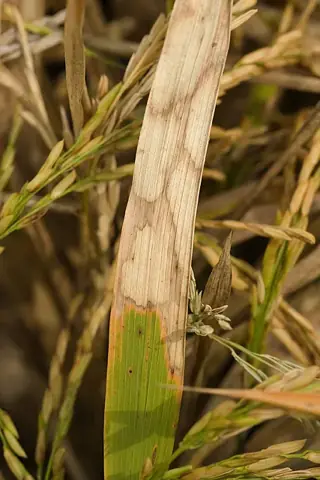
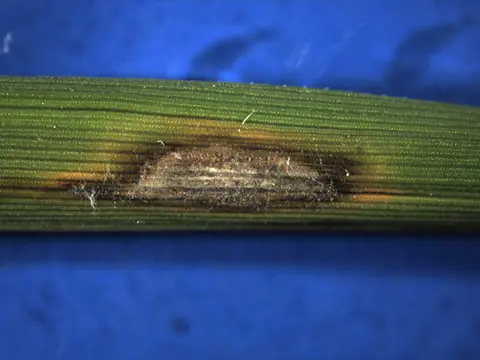
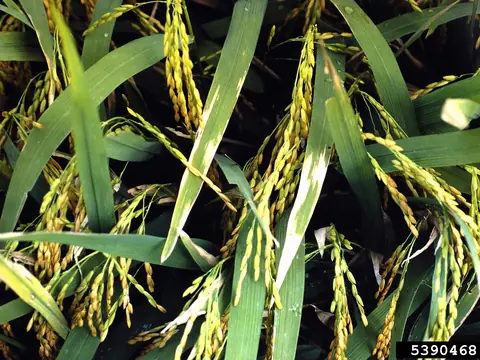
Look at the leaf against the light. Young lesions are thin, water soaked streaks between the veins, about 0.5 to 5 millimeters wide, and they turn brownish yellow and translucent. Under humid weather, small yellow beads of bacterial ooze sit on the streaks. As the streaks join, they form dirty white patches, and in a bad attack the whole leaf turns yellow. A quick test confirms it. Cut a leaf at the edge of a streak and place it in clear water, then watch for a cloudy stream of bacteria after a few minutes.
- Narrow, water soaked streaks run between the veins of the leaf, with straight sides.
- The streaks turn brownish yellow and look translucent when you hold the leaf to the light.
- Tiny yellow droplets of ooze appear on the streaks in humid weather, and they dry into bead shaped specks.
- Many streaks join into large dirty white or light brown patches on the leaf.
- A yellow ring may circle the lesion on a susceptible variety, and the whole leaf may later turn yellow.
The streak is often taken for bacterial leaf blight, but leaf blight starts at the tip and the edges and moves down. Leaf streak stays between the veins and begins in the middle of the blade. It also looks like narrow brown leaf spot, which has narrow brown lines but shows no yellow ooze.
How Bacterial Leaf Streak Hurts Your Palay
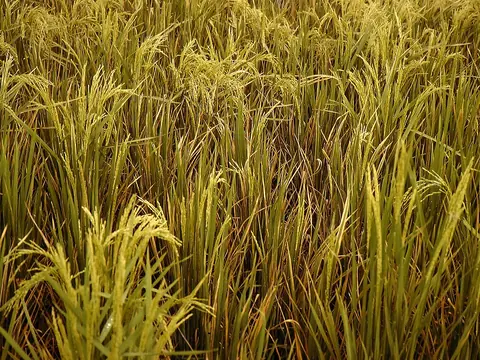
Bacterial leaf streak browns and dries the leaves, and a severe attack can lower grain weight. Mature plants often recover with little yield loss, so the worry is greatest in young, heavily hit crops. The loss depends on the variety and on how early and how wet the attack is. We did not find an official action threshold for the Philippines, so the safest plan is to prevent it. A field that had streak last season, and a variety known to be susceptible, both call for extra scouting during tillering.
Balanced feeding matters here. Too much nitrogen softens the leaves and helps the bacteria. The streaks often start where strong wind has wounded the leaf. Rainy weeks, heavy fertilizer and a field kept flooded all the time make them worse. Our guide to fertilizer for rice shows how to split the dose. If the same field also loses leaves to rice brown spot, the combined damage can be heavy.
How to Control Bacterial Leaf Streak
- Sow certified seed of a variety that has held up against leaf streak in your area, and never save seed from a field that had the disease.
- Pull out weeds around the field and in the bunds, because the bacterium lives on them between crops.
- Pull out and destroy plants that show symptoms early, and do it according to the advice of your local agriculture office.
- Split your nitrogen into small doses, because a heavy dose makes stems and leaves soft and easy to wound. Add potash so the leaves stay firm. An extra amount of potash, given in split doses, helps too.
- Drain the field as soon as you see infection, and do not move water from sick fields to healthy ones.
- After harvest, plow under or remove stubble so the bacteria have less to live on.
When a Spray Makes Sense
No product cures bacterial leaf streak, and sprays on a field that is already sick give little help. A copper based fungicide is allowed only when it is really needed, after draining and the steps above. Pick one whose FPA label lists rice, and ask your local agriculture office first. Our guide on when to spray rice pests explains the timing for rice problems.
Active Ingredients on Philippine Labels
| Active ingredient | FRAC group | On Philippine labels |
|---|---|---|
| Copper hydroxide | FRAC M01 | Older or broad chemistry: a last resort. 10 registered products name it on rice. |
| Cuprous oxide | FRAC M01 | Older or broad chemistry: a last resort. 2 registered products name it on rice. |
| Copper oxychloride plus copper hydroxide | FRAC M01 plus M01 | Older or broad chemistry: a last resort. 1 registered product names it on rice. |
Use only products registered with the Fertilizer and Pesticide Authority, and follow the label for the rate, the timing and the protective clothing. Switch to a different fungicide group next time, so the disease does not learn to survive it. Our guide to plant diseases explains how.
Keep It Out Next Season
- Sow certified seed of a variety that has held up in your area, and never save seed from a field that had streak.
- Pull out grassy weeds around the field and in the bunds. The bacterium lives on them between crops.
- Split nitrogen into small doses and add potash in splits, so leaves stay firm and harder to wound.
- Drain the field when streak shows, and do not let water from sick fields flow into healthy ones.
- After harvest, plow under or remove the stubble, and rotate with another crop when you can.
Not Sure What You Are Seeing?
Take a clear photo of the spots or the damage up close, then the whole plant, then ask Anee, the smart farm technician in anee.io, in Tagalog or English. Anee tells you what it most likely is and what to do at the age of your crop. You can also put your scouting days on the cropping calendar, so the team knows when to walk the field.
anee.io keeps your scouting, spraying and harvest on one calendar, and Anee answers when something looks wrong.
- Scouting days dated from each lot's own planting day
- Photos and notes for every lot
- Anee, the smart farm technician, in Tagalog or English
Questions Farmers Ask About Bacterial Leaf Streak
How do I tell bacterial leaf streak from bacterial leaf blight?
Can the disease spread from one field to another?
Will a spray save a sick crop?
Stop the spread of Bacterial Leaf Streak
With Libre + Anee, read the whole guide: how to tell it from look alikes, what makes it spread, and what to spray and when.
The account is free, no credit card.