Rice Black Bug: Outbreaks, Bugburn and How to Manage It
The rice black bug, Scotinophara coarctata, is a dark stink bug that hides at the base of the rice hill by day and sucks sap from the stems. Its Tagalog name is itim na atangya, and Tagalog dictionaries give alitangya. A heavy attack burns whole patches of palay reddish brown, so it pays to catch it early.
What the rice black bug looks like
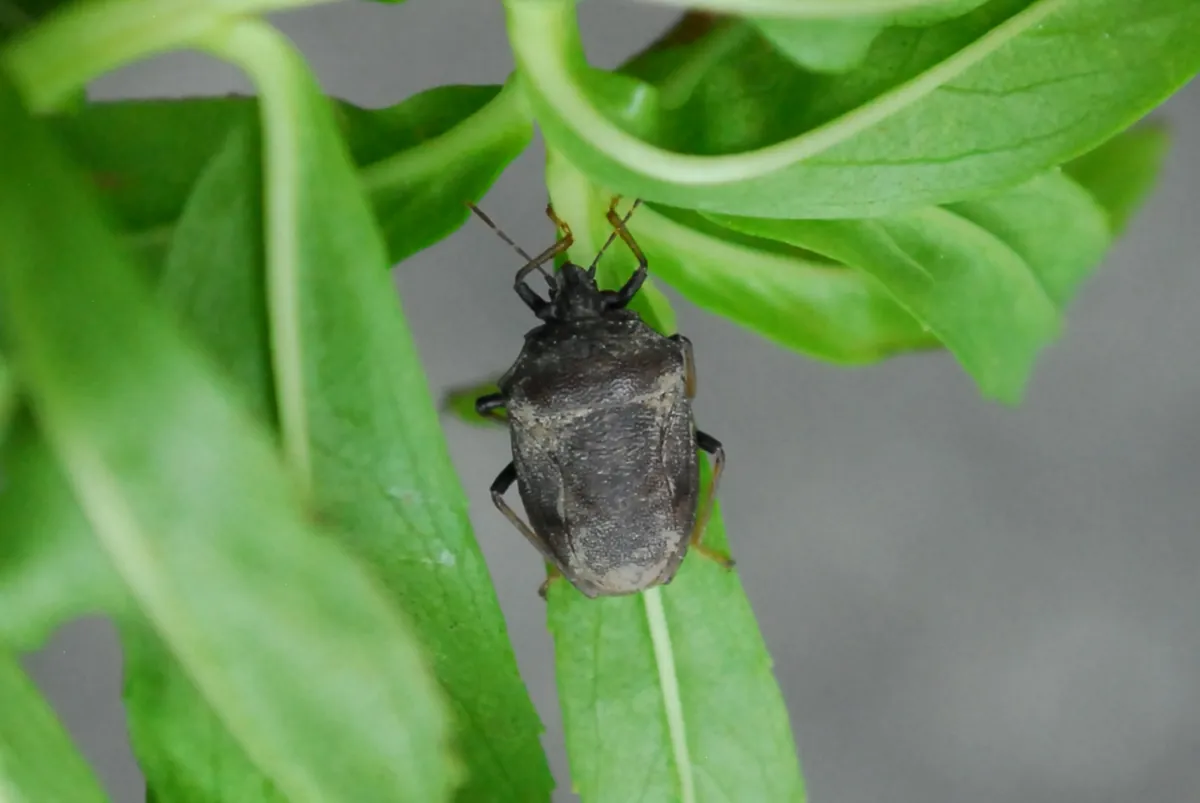
The adult is an oval, dark, almost black stink bug about 8 to 9 millimeters long. Some reports call it the black rice bug or the Malayan black bug. By day, adults and nymphs crowd at the base of the plant just above the water. At night or on cloudy days they climb up the plant to feed higher. Disturb them and they give off a foul smell.
Do not confuse it with the rice bug, the slender, long legged atangya that feeds on milky grains in the panicle. The black bug insect is broad and oval, and it works lower down, on the stems and leaf sheaths.
Life cycle and hosts
A female lays about 200 eggs in her life, in masses of 40 to 60 on the lower leaves or the base of the plant near the water. She stands guard over them until they hatch. The eggs start greenish and turn pink as they mature, and they hatch in about a week or less. Nymphs molt four or five times and reach adulthood in roughly a month to six weeks, depending on the source.
Rice is its main host, but it also lives on corn, gabi, grasses, sedges and broadleaf weeds. The adult is a weak flier, yet ships and other transport have carried it over long distances.
How the black bug spread across the Philippines
The first attack was recorded in Bonobono, Bataraza, in southern Palawan in September 1979. A major outbreak followed from March to June 1982 and spread to central and northern Palawan, covering 4,500 hectares. A provincial Task Force Black Bug sprayed heavily, but the bugs kept spreading. The spraying may have wiped out the native natural enemies, and the bug may have survived on plants other than rice.
In 1989 an interagency task force slowed it with the tolerant variety IR1314, releases of parasitic wasps and strict quarantine. Mindanao followed in 1992, then the Visayas.
| Year | Where |
|---|---|
| 1979 | Bonobono, Bataraza, southern Palawan, the first report |
| 1982 | Outbreak across central and northern Palawan, 4,500 hectares |
| 1992 | Curuan, Zamboanga City, about 2,070 hectares damaged by year end |
| 1995 | A serious pest in the Zamboanga region and the Autonomous Region in Muslim Mindanao |
| 1996 to 1997 | Cotabato, Sultan Kudarat, South Cotabato and Sarangani, with outbreaks in 1997 |
| 1998 to 1999 | Kabankalan in Negros Occidental, then Siquijor and Bohol |
| 2000 | Caraga: Surigao del Norte, Agusan del Norte and Agusan del Sur |
In 2013 black bug attacks were also reported in some Central Luzon fields. In Mindanao, numbers only began to fall in the mid 1990s, where farmers planted at the same time.
Symptoms: deadheart, whiteheads and bugburn
- Deadheart at tillering: the center leaves of a tiller turn brown and die.
- Whiteheads and empty panicles at booting: panicles come out partly or not at all, and the grains stay unfilled.
- Bugburn in heavy attacks: leaves turn reddish brown and whole patches dry up.
- Stunting and fewer tillers, with yellowing or reddish brown leaves.
Two checks help you name the culprit. Stem borers also cause deadhearts, but a stem borer deadheart usually pulls out easily and shows a tunnel with a caterpillar inside. With black bugs you find the dark bugs at the base of the plant instead. Bugburn also looks like hopperburn from the brown planthopper. Yet you can confirm hopperburn by the sooty mold at the base of the plant, and bugburn does not bring it.
With ten adult black bugs on each hill, a field can lose as much as 35 percent of its harvest. A report from Agusan del Sur gives 10 to 23 percent at 10 bugs per hill. In outbreaks, black bug attacks can cut the yield by up to 80 percent, and bugburn can wipe out the whole crop. Severe damage usually shows only after heading, so do not wait for bugburn before you act.
What makes rice black bugs multiply
- Rice after rice in irrigated areas, and poorly drained fields
- Staggered planting, so a young crop is always nearby
- Too much nitrogen fertilizer
- Weeds and other hosts that feed the bugs between crops
- Dry season crops, which suffer more than wet season crops
The moon matters too. The full moon cycle affects black bug flight, and more adults fly to lights around the full moon.
How to manage the rice black bug
Before and during planting
- Plant in sync. Plant varieties of the same maturity within a month of your barangay's regular planting time, ideally over a radius of about 1 kilometer. This breaks the bug's life cycle.
- Use tolerant varieties. IR1314 and IR44526 are tolerant, because they replace lost tillers. Plant IR1314 only where tungro is not a problem, since it is highly susceptible to tungro. See rice varieties in the Philippines and ask your Municipal Agriculture Office for current choices.
- Consider direct seeding. Direct seeded rice makes fewer tillers per hill, which leaves the bugs exposed to sun and predators.
- Keep weeds down in the field and on the bunds, because weeds feed the bugs between crops.
- Go easy on nitrogen. Excess urea fertilizer favors the pest, so apply the recommended rate in splits.
During the season
- Count at the base. Pick 20 hills at random across the field and count the eggs, nymphs and adults at the base of the plants. Then check the table below.
- Raise the water. Bring it to 8 to 10 centimeters for one to two days. This keeps the bugs off the base of the plants and stops eggs from hatching. Eggs kept under water for 24 hours do not hatch.
- Check the eggs first. Put about 5 egg masses in a container covered with nylon mesh and wait a week. If wasps come out, the eggs are parasitized, and flooding would kill those helpful wasps too.
- Let ducks in. Ducks eat black bugs. Herd them into insecticide free fields with standing water from about a month after transplanting up to heading.
- Protect natural enemies. The tiny wasp Telenomus triptus lays its own eggs inside the bug's eggs, and the fungus Metarhizium anisopliae kills both young and grown bugs. Crickets, spiders, ground beetles, lady beetles and red ants help too.
When to act on the rice black bug
| Bugs per hill | What to do |
|---|---|
| 5 or fewer | No insecticide. Spray Metarhizium anisopliae, a fungus that kills the bugs, and keep the field flooded from tillering to ripening to drown the eggs |
| More than 5 | A recommended insecticide may be used. Raise the water to about 15 cm so the bugs climb the leaves, then spray in the cool hours |
| Heavy attack | Bright light traps, and plow under at once a field the bugs have destroyed |
Our guide on when to spray rice pests lines these counts up with the other rice pests.
Light traps and the full moon
Black bugs are strongly attracted to bright light. Run light traps from two days before to three days after the full moon, where the population is not yet alarming. During outbreaks, set the lights every night, using 2,000 to 3,000 watt lamps. The effective time is 8 PM to midnight. Bury the bugs you catch. Set a strong light on the newly harvested field the night after harvest too, because the adults leave harvested fields in search of food.
Keep the limits in mind. Light traps catch mostly females that have already laid their eggs. So a big catch tells you the bugs are flying in your barangay, not how many sit in your own field. Use the trap as a community warning and the 20 hill count to decide.
In anee.io you can add the light trap nights around each full moon as tasks on your cropping calendar, so the whole team sees them. Anee, the smart farm technician, can also look at a photo of the bugs at the base of your hills and answer in Tagalog or English.
After harvest
Plow the field right away and keep the stubble under water until it rots. This buries the adults, nymphs and eggs that hide in the stubble.
Insecticides
Insecticides alone give only temporary relief, cost a lot and harm other organisms. The Palawan campaign proved it. If your technician still advises a spray, pick an FPA registered product whose label lists black bug on rice.
Two Syngenta examples list black bug on rice on their Philippine product pages: Karate 2.5 EC, with lambda cyhalothrin, and Virtako 40 WG, with chlorantraniliprole and thiamethoxam. Use them only as examples, follow the label, and read our guide to Alika, Virtako and Chess.
Active Ingredients on Philippine Labels
| Active ingredient | IRAC group | On Philippine labels |
|---|---|---|
| Clothianidin | IRAC 4A | A first choice. 53 registered products name it on rice. |
| Lambda cyhalothrin | IRAC 3A | A sound second choice. 91 registered products name it on rice. |
| Deltamethrin | IRAC 3A | Older or broad chemistry: a last resort. 4 registered products name it on rice. |
| Beta cyfluthrin | IRAC 3A | Older or broad chemistry: a last resort. 3 registered products name it on rice. |
| Esfenvalerate | IRAC 3A | Older or broad chemistry: a last resort. 2 registered products name it on rice. |
| Bifenthrin | IRAC 3A | Older or broad chemistry: a last resort. 1 registered product names it on rice. |
| Bifenthrin plus clothianidin | IRAC 3A plus 4A | Older or broad chemistry: a last resort. 1 registered product names it on rice. |
These are on Philippine labels for it, but we leave them off the list above, for the reasons below.
- Pymetrozine: Made for hoppers. It does little against stink bugs such as the black bug.
Synchronous planting, light traps and plowing after harvest work best when the whole area does them together. Raise it at your irrigators association or barangay meeting before the season starts.
anee.io puts every lot's day count, growth stage and weather on one calendar, and Anee reads a photo of the bug for you in Tagalog or English.
Create a free accountRice black bug questions
What is the rice black bug called in Tagalog?
Why do black bugs swarm around lights at full moon?
How do I tell bugburn from hopperburn?
Can I control rice black bugs without insecticide?
Stop Rice Black Bug from costing you the harvest
With Libre + Anee, read the whole guide: how to be sure it is this pest, when it pays to act, and what to spray, by active ingredient.
The account is free, no credit card.