Direct Seeded Rice Land Preparation: Wet and Dry Seeding
Direct seeded rice land preparation has one job that transplanting does not: give a seed that sits on the soil, with no seedling head start, a flat and weed poor bed. Get the leveling, the drainage and the weeds right before sowing, and direct seeding saves a lot of labor. This guide covers both wet and dry seeding.
Why farmers choose direct seeding
Direct seeding means you sow the seed in the field instead of growing seedlings and transplanting them. It needs only 1 to 2 man days per hectare for crop establishment, against 20 to 25 man days for transplanting. It also uses 12 to 35 percent less water for crop establishment and irrigation under efficient water management.
Still, only 31 to 43 percent of Filipino rice farmers used it in a 2016 and 2017 survey. The reasons: risks in crop establishment, more weeds, insects and disease, and higher seed use. Land preparation answers most of them, so it deserves your care.
If you transplant instead, read rice land preparation. For the general picture, see land preparation in the Philippines.
Two kinds of direct seeding
| Wet direct seeding | Dry direct seeding | |
|---|---|---|
| Seed | Pre germinated seed | Dry or pre germinated seed |
| Soil | Puddled, leveled, wet mud | Dry or moist soil, tilled or not tilled |
| Main land preparation | Puddling and leveling, plus canals | Dry tillage or no tillage, leveling, weed kill |
In short, direct seeding is sowing dry or pregerminated seed into dry or puddled soil.
Direct seeded rice land preparation for wet seeding
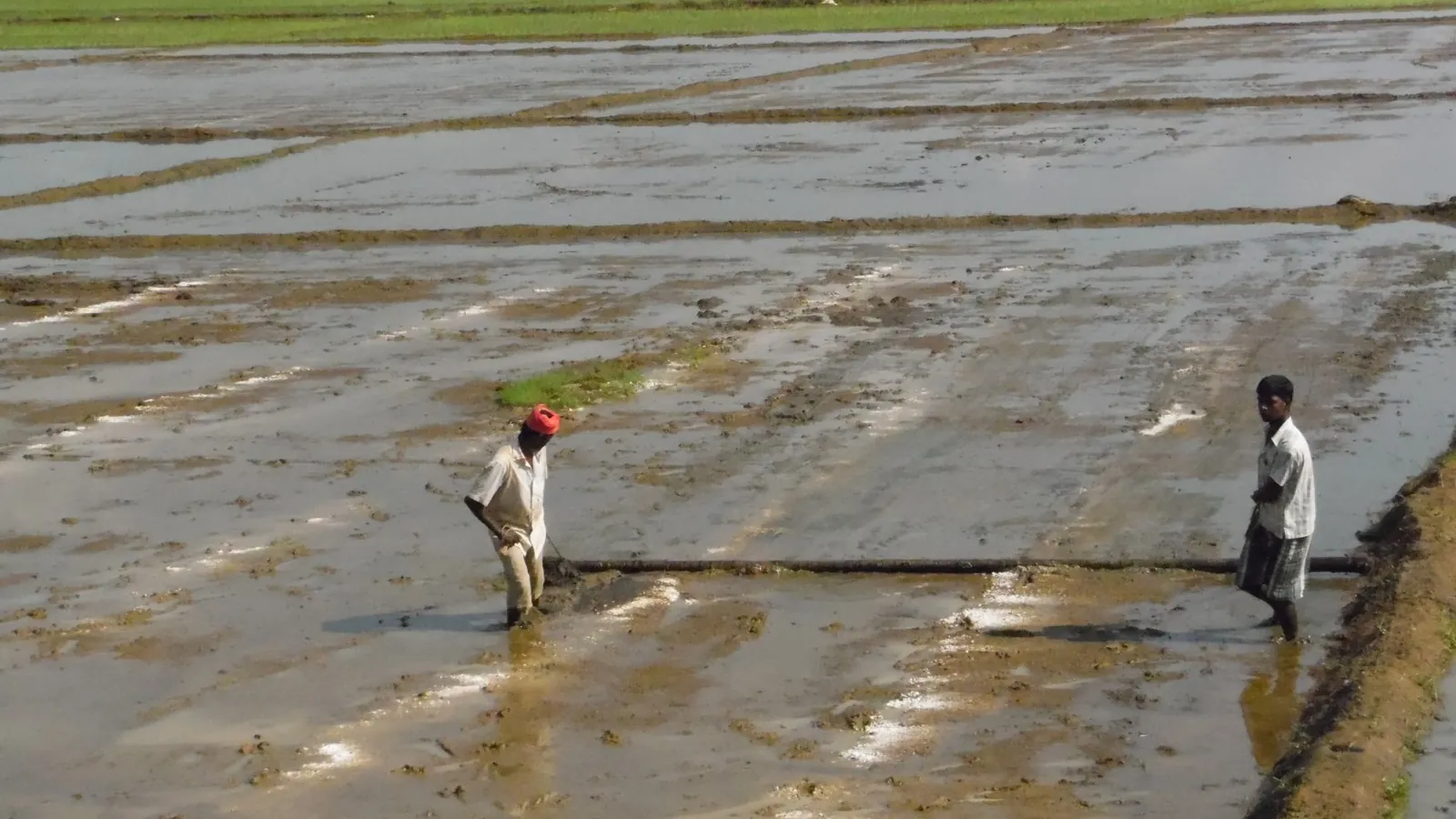
For wet direct seeding, prepare the field with the same land preparation and leveling steps as transplanted rice. That means plowing or rotovating 21 to 30 days before sowing, then letting the soil soften for about a week. Next you harrow three times, 5 to 7 days apart: lengthwise, crosswise, then a final pass, and you level with a board under about 5 cm of water. For broadcast seed, finish that last harrowing and leveling one day before sowing.
The leveling matters even more here, because a seed on the surface has no way to survive a pool. Water that is too deep drowns the seed, and bare high spots dry out and let weeds in. The test is simple. After final leveling, no part of the field should have water deeper than 5 cm, and no soil mound should show above the water.
Dig small drainage canals
For wet direct seeding, dig small canals, 25 cm wide and 5 cm deep, around the field near the dikes and through the middle of the field. They give excess water a path out. They also help you collect snails and work in the field for replanting and weeding.
A 2025 study of Philippine farmers in Frontiers in Sustainable Food Systems reports one more danger. Wet direct seeding is hard when heavy rain falls right after sowing, because the seeds wash away easily. Good canals let you drain the field quickly.
Soak the seed, then sow
Soak the seed in clean water for 24 hours. Then lift it out and keep it covered for another 24 hours in a shaded, airy place. Sow once most seeds show a small sprout, and air them briefly first so they spread evenly instead of clumping. Broadcast by hand, or use a drum seeder, a seed spreader or a drone if you have one.
From that day on, guard the seed against rats, birds, snails and weeds. Our pages on rice field rats and the golden apple snail cover the first weeks.
Seeding rate and water after sowing
- Row seeding with a drum seeder: 40 to 60 kg of seed per hectare.
- Broadcasting pre germinated seed: 60 to 80 kg per hectare.
- Set aside 1 kg more of pre germinated seed by the field, ready to fill any gaps.
- Replant bald areas wider than a 10 cm radius within 7 to 10 days after sowing so the crop matures evenly.
- Keep standing water off for the first 10 to 14 days after sowing, unless severe drought symptoms appear. From about day 10, bring the water to 2 to 3 cm and replant bare spots at the same time.
Dry seeding: tilled or not tilled
Dry seeding has two options. They were worked out for eastern India, but they work as a model here. In conventional tillage, you cultivate the soil 5 to 10 cm deep to get a fine seedbed with good seed to soil contact. In zero tillage, you sow into the untilled stubble after killing the weeds with a non selective herbicide such as glyphosate, and you follow the FPA label.
Sow shallow, at 1 to 2 cm and never deeper than 3 cm. Do not grow dry seeded rice on sands or loamy sands, because the crop does better on soils from sandy loam to heavy clay. Best results need an accurately leveled field, and laser guided leveling is the best way to get it.
The stale seedbed: kill the weeds before the rice
Weeds are the biggest threat in direct seeding. In dry seeded rice the weeds are most often the hardest job, and left alone they can wipe out the whole harvest. So land preparation should exhaust the weed seeds in the soil.
The stale seedbed does exactly that. First, prepare the field and give it water so the weed seeds sprout. Then kill the seedlings before you sow the rice.
Prepare and wet the field
Level the field. Give one or two irrigations about a month before sowing so weeds germinate.
Let the weeds sprout
Wait until the weed seedlings are actively growing. Irrigate first if the soil is dry, because herbicide works only on actively growing weeds.
Kill the weeds
Use shallow tillage, or a non selective herbicide such as glyphosate. Follow the FPA label for the rate and safety. Tilling deep only lifts more buried weed seed up to where it can sprout.
Sow the rice
Sow the seed soon after, with minimal soil disturbance, and keep the water plan that matches your method.
Weed control in the first days after sowing
The stale seedbed lowers the weed load, but it does not end it. Apply a pre emergence herbicide 0 to 3 days after sowing, chosen and applied by its label. If many weeds still come up, an early post emergence herbicide can follow 6 to 9 days after sowing, and you pull the rest by hand. Our guide to herbicides for rice weeds lists the active ingredients.
Skip dry seeding on fields that have been badly overrun by weeds in past seasons. If your field has a weedy rice or sedge problem, read the weed management in rice guide first and consider transplanting.
A direct seeding checklist for the wall
- 30 to 21 days before sowing: repair the dikes and canals, then plow.
- 14 days before: first harrowing, lengthwise.
- 7 to 9 days before: second harrowing, crosswise.
- 2 days before: soak the seed in clean water for 24 hours.
- 1 day before: last harrowing and leveling under about 5 cm of water. Dig the small drainage canals once the field is level, and keep the soaked seed covered.
- Sowing day: sow the sprouted seed by hand or by machine.
- 0 to 3 days after: a pre emergence herbicide, by the label.
- 6 to 9 days after: an early post emergence herbicide, only if weeds are many.
- About 10 days after: water at 2 to 3 cm, and replant bare spots.
The list counts from plowing 21 days ahead. You can also skip the counting, because anee.io dates every step back from your planting day for each lot.
Land preparation days go on the cropping calendar, dated back from sowing. Set day zero for your lot, and see the stale seedbed, sowing and the first weeding on one calendar.
See the cropping calendarDry season and wet season
More farmers direct seed in the dry months than in the rainy ones. In the dry season, you control the water, so wet seeding with canals works well. In the wet season, hard rains can wash seed away and flood the field, so drainage matters more.
For soil problems, see acidic soil preparation and saline soil preparation. Anee, the smart farm technician, can also read your lot and the weather before you pick a sowing date.
Common mistakes in direct seeded rice land preparation
- Skipping the leveling, so the seed drowns in low spots and the high spots grow weeds.
- No drainage canals, so heavy rain washes the seed away.
- Sowing straight after plowing, with no stale seedbed to deplete the weeds.
- Sowing deeper than 3 cm in dry seeding.
- Forgetting a reserve of seed for replanting bald patches.
Questions about direct seeded rice land preparation
Do I need to puddle for direct seeded rice?
How wide and deep should the drainage canals be?
How much seed do I need per hectare?
What is a stale seedbed?
Get every step of direct seeded rice land preparation right
Register for free to read every step, then date each one on your own calendar with the Land Prep Planner, counted back from your planting day.
Free to register. No credit card. Works on any phone.