Sugarcane Nutrient Deficiency: Signs, Causes and the Fertilizer That Fixes It
Sugarcane nutrient deficiency is one of the first things to check when the leaves of your tubo (sugarcane) turn yellow, purple or burnt at the edges. On Philippine farms the usual ones are nitrogen, potassium, phosphorus, sulfur, zinc, magnesium, calcium, iron, manganese and silicon. This guide shows where each one starts, how to be sure, and the fertilizer that fixes it.
Start with one question: did the change begin on the old leaves or on the young ones? Nitrogen, potassium, phosphorus and magnesium move inside the plant, so a shortage shows on the old, lower leaves first. But sulfur, zinc, calcium, iron, manganese and silicon stay where the plant first put them, so the young leaves and the growing tip show it first. After that, the color and the pattern narrow down which sugarcane nutrient deficiency you have, and a soil test confirms it. Each one below has its signs, its causes and its fix.
Sugarcane nutrient deficiency signs, old leaves and young leaves
Shows first on the old leaves
| Nutrient | Where it starts | What you see | Fix with |
|---|---|---|---|
| Nitrogen | old, lower leaves, the whole plant | The whole field looks pale yellow green, the lower leaves dry early and the stalks stay thin. | Urea 46 0 0, Ammonium sulfate 21 0 0 |
| Potassium | old, lower leaves, leaf edges and tips | Old leaves turn yellow orange with scorched edges and red midribs, while the young leaves stay dark green. | Muriate of potash 0 0 60, Sulfate of potash 0 0 50 |
| Phosphorus | old, lower leaves, the whole plant | Leaves look dark bluish green with purple tips and edges, tillers are few and the stalks stay short. | 16 20 0, Ammonium phosphate 18 46 0 |
| Magnesium | old, lower leaves | Older leaves look rusty, covered with small orange brown freckles. | Magnesium sulfate (Epsom salt), Kieserite |
Shows first on the young leaves
| Nutrient | Where it starts | What you see | Fix with |
|---|---|---|---|
| Sulfur | young leaves and the tip, the whole plant | The top young leaves turn yellow green with purple edges, while the old leaves stay greener. | Ammonium sulfate 21 0 0, Gypsum |
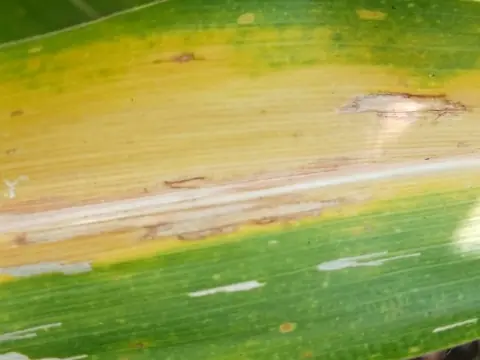
| Zinc | young leaves and the tip, between the veins | Young leaves show a broad yellow band across the middle of the blade, while the midrib and edges stay green. | Zinc sulfate |
| Calcium | old, lower leaves, young leaves and the tip | Older leaves get tiny dead spots and a rusty look, and in bad cases the spindle tip dies. | Agricultural lime, Dolomite |
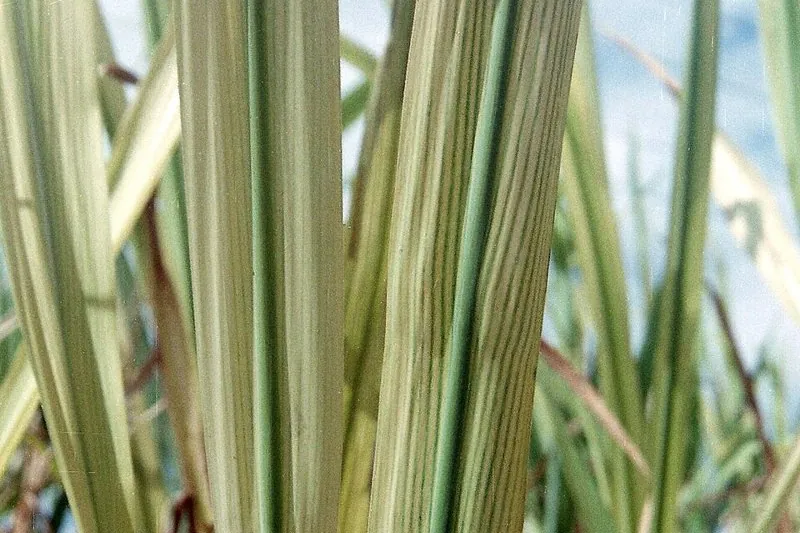
| Iron | young leaves and the tip, between the veins | Young leaves show pale stripes from base to tip and can turn almost white. | Ferrous sulfate, Urea 46 0 0 |
| Manganese | young leaves and the tip, between the veins | Pale stripes on the young leaves start in the middle of the blade and run to the tip. The leaves split in the wind. | Manganese sulfate |
| Silicon | old, lower leaves, the whole plant | Older leaves dotted with tiny pale or white freckles on the sunny side, and ratoons that grow weaker each year. | Calcium silicate, Silicate slag |
Before you buy fertilizer for a sugarcane nutrient deficiency
So use the table to pick the likeliest sugarcane nutrient deficiency, then read its section below. Also keep in mind that dry soil, standing water, cold nights, a pest or a disease can look the same. That is why it pays to check the roots and the whole field first.
Nitrogen deficiency in sugarcane
The older, lower leaves turn pale first, then the whole stool becomes yellowish green. Old leaves dry from the tips and die early, and leaf sheaths pull away from the stalk too soon. Stalks are thin, internodes stay short and the cane grows slowly. Young leaves stay pale green instead of turning dark green. You see it most at this stage: tillering and the grand growth period, when cane takes up nitrogen fastest. Ratoons that got no fertilizer after harvest show it early.
Why nitrogen deficiency happens in tubo
Soils low in organic matter, skipped or late side dressing, and heavy rain that washes nitrogen out of light soils. Urea left on the soil surface also loses nitrogen to the air.
How to tell it apart
Sulfur deficiency also makes cane pale, but it starts on the youngest top leaves and does not dry the tips of old leaves. Yellow leaf virus starts as a yellow midrib on the underside of leaves 3 to 6 from the top, not as a pale lower canopy. To be sure, send the top visible dewlap leaf blade (the highest leaf with a visible collar) to a lab during the grand growth period. Below 1.8 percent N is deficient and 2.0 to 2.6 percent is the target. Have the soil tested at a lab before planting and before each ratoon.
What to apply for nitrogen deficiency
Side dress Urea 46 0 0 or Ammonium sulfate 21 0 0 now, placed beside the row and covered with soil so it is not lost to the air. Split the nitrogen into two or more doses through tillering and early grand growth rather than one big dose. Base the total on a soil test, since the right rate changes from field to field. For a quick boost, give a 1 to 2 percent urea spray (10 to 20 g urea per liter of water, 160 to 320 g in a 16 liter sprayer) twice, one week apart. A usual dose is 3 to 5 bags of Urea 46 0 0 per hectare, split at 1 and 3 months after planting or ratooning.
- Urea 46 0 0
- Ammonium sulfate 21 0 0
- Complete 14 14 14
Sold here with nitrogen: Atlas Granular Urea (46 0 0) by Atlas Fertilizer, Amigo Planters Ammonium Chloride by La Filipina (25 0 0), Agripower 46 0 0 (Locally Blended) Coated by Green Acres Agri Tech and Calcipro by Ramgo (15.5 0 0 with 18.8 percent calcium). Check the FPA registration on the bag and follow the label rate. For the how and when, see our guide to urea fertilizer, and the page on nitrogen deficiency in every crop. In anee.io, Anee, the smart farm technician, reads a photo of the leaf and tells you which nutrient is short.
To keep it away, fertilize every crop, including each ratoon, from a soil analysis. Return cane trash and add mill mud or compost to build organic matter.
Potassium deficiency in sugarcane
Older, lower leaves show yellow to orange patches with many small spots that turn brown with dead centers. The edges and tips dry as if scorched. The upper side of the midrib turns red. Young leaves stay dark green, stalks are slender and growth slows. In long deficiency the top bunches into a fan shape and roots stay weak. You see it most at this stage: grand growth and ripening, when the cane takes up the most potassium. It gets worse ratoon after ratoon when no potash is given.
Why potassium deficiency happens in tubo
Sandy or light soils, acid soils low in exchangeable potassium, and fields cropped for many ratoons without potash. A 100 ton cane crop takes about 150 to 200 kg of potassium out of each hectare.
How to tell it apart
Magnesium deficiency also starts on old leaves but shows small rusty freckles, not scorched edges. Salt burn and some leaf diseases can also scorch tips or redden midribs, so confirm with a leaf test when in doubt. To be sure, send the top visible dewlap leaf blade to a lab: below 0.9 percent K is deficient and 1.0 to 1.6 percent is the target. A soil test for exchangeable potassium before planting shows how much potash the field needs.
What to apply for potassium deficiency
Apply Muriate of potash 0 0 60 at the rate the soil test gives, split between planting and the side dressing. For a quick fix on a standing crop, give a 1 percent potassium chloride spray (10 g per liter, 160 g in a 16 liter sprayer) twice, two weeks apart. Do not overdo it: cane takes up more potash than it needs. Extra potassium raises ash in the juice and lowers sugar recovery. A usual dose is 2 to 4 bags of Muriate of potash 0 0 60 per hectare, half at planting and half at hilling up.
- Muriate of potash 0 0 60
- Sulfate of potash 0 0 50
- Complete 14 14 14
Sold here with potassium: Atlas Muriate of Potash (MOP) by Atlas Fertilizer (0 0 60), Simplot Sulfate 0 0 50 by Nutranta, Potassium Nitrate by Parafield (13 0 46) and Qrop Mix Production 14 0 23 plus 13 Cao by Farmtech Agriland (14 0 23 with 9.3 percent calcium). Check the FPA registration on the bag and follow the label rate. For the how and when, see our guide to potash fertilizer, and the page on potassium deficiency in every crop.
To keep it away, test the soil at every new planting and keep cane trash in the field instead of burning it. Keep organic matter up with compost, manure or crop residues.
Phosphorus deficiency in sugarcane
Leaves turn dark green to bluish green and stay short and narrow, with red to purple tips and margins. Older leaves yellow and die back from the tip. The cane makes few tillers, roots are poor, and stalks are short and thin, tapering fast toward the top. You see it most at this stage: germination to tillering. A shortage at planting is hard to make up later in the crop.
Why phosphorus deficiency happens in tubo
Acid soils that lock up phosphorus and fields that never got phosphate. Many sugarcane farms on medium acid soils test very low in phosphorus.
How to tell it apart
Nitrogen deficiency makes leaves pale yellow, not dark bluish green. Potassium deficiency reddens the midrib rather than the leaf tips and edges, and it scorches the old leaves. To be sure, send the top visible dewlap leaf blade to a lab: below 0.19 percent P is deficient and 0.22 to 0.30 percent is the target. Soil test before planting. On acid soil the lab will also give a lime need.
What to apply for phosphorus deficiency
Phosphorus works best placed in the planting furrow at planting, using Ammonium phosphate 16 20 0, Ammonium phosphate 18 46 0 or Superphosphate 0 18 0 at the soil test rate. On a standing crop, give a 2 percent DAP spray (20 g of 18 46 0 per liter) twice, two weeks apart, to carry the cane until the next crop. Lime acid fields so the phosphate stays available. A usual basal dose is 3 to 5 bags of Complete 14 14 14 or 1 to 2 bags of Diammonium phosphate 18 46 0 per hectare in the furrow at planting.
- 16 20 0
- Ammonium phosphate 18 46 0
- Superphosphate 0 18 0
- Agricultural lime
Sold here with phosphorus: Philphos 18 46 0 (Di Ammonium Phosphate), Atlas Super Gro (16 20 0) by Atlas Fertilizer, Amigo Planters Granular Single Super Phosphate by La Filipina (0 18 0 with 11 percent sulfur) and Triple Super Phosphate by Newman Chemicals (0 46 0). Check the FPA registration on the bag and follow the label rate. For the how and when, see our guide to 16 20 0 fertilizer, and the page on phosphorus deficiency in every crop.
To keep it away, lime acid fields to the soil test rate and put all the phosphate in the furrow at planting.
Sulfur deficiency in sugarcane
The youngest leaves at the top turn pale yellowish green first. As it gets worse, purple bands show along both leaf margins. Leaves become shorter and narrower, and stalks are thin and bend easily at the tip. You see it most at this stage: young cane and fast growth, often after several crops fed with urea only.
Why sulfur deficiency happens in tubo
Soils low in organic matter, sandy leached soils, and years of urea and other fertilizers that carry no sulfur.
How to tell it apart
Nitrogen deficiency starts on the old leaves and dries their tips. Sulfur deficiency starts at the top and does not dry the tips. To be sure, send the top visible dewlap leaf blade to a lab: below 0.13 percent S is low. Ask for sulfate sulfur on the soil test. A test row given ammonium sulfate should turn green again.
What to apply for sulfur deficiency
Use Ammonium sulfate 21 0 0 for part of the nitrogen, since it carries sulfur as well. Gypsum or sulfur dust also add sulfur. Give sulfur dust at about 25 kg per hectare. For a quick fix give a 1 percent potassium sulfate spray (10 g per liter, 160 g in a 16 liter sprayer) twice, two weeks apart.
- Ammonium sulfate 21 0 0
- Gypsum
- Sulfate of potash 0 0 50
Sold here with sulfur: Atlas Ammosul 21 0 0 by Atlas Fertilizer (21 0 0 with 24 percent sulfur), Philphos Gypsum (22.2 percent calcium and 17.4 percent sulfur), Harvester Sulphate of Potash by Universal Harvester (0 0 50 with 17.5 percent sulfur) and Agsmart Kieserite Granule (20 percent sulfur and 16.3 percent magnesium). Check the FPA registration on the bag and follow the label rate. For the how and when, see our guide to ammonium sulfate fertilizer, and the page on sulfur deficiency in every crop.
To keep it away, use ammonium sulfate for at least one nitrogen dose each crop and keep trash and organic matter in the field. Test the soil every two or three years.
Zinc deficiency in sugarcane
Young, newly opened leaves turn light green to yellow in broad bands. But the midrib and leaf edges stay green until it is severe. The yellow tissue can get red spots, then dries and collapses between the veins. Leaves come out shorter and broader in their middle part, the internodes stay short and the cane is stunted. You see it most at this stage: young cane and early tillering.
Why zinc deficiency happens in tubo
Liming that raises the soil pH, land leveling that exposes low zinc subsoil, sandy soils, and heavy phosphate use.
How to tell it apart
Iron deficiency stripes the whole length of the leaf from base to tip and can bleach it white. Manganese stripes begin halfway along the blade and reach to the tip, and the blades tear in the wind. To be sure, send the top visible dewlap leaf blade to a lab: below 15 mg/kg Zn is deficient and 17 to 32 mg/kg is the target. Test soil zinc and pH. Spray zinc sulfate on a few stools and watch whether the new leaves come out green.
What to apply for zinc deficiency
Spray Zinc sulfate at 0.5 percent (5 g per liter of water, 80 g in a 16 liter sprayer) on the leaves. Repeat if new leaves still show bands. For the next planting, mix Zinc sulfate into the soil. Give about 20 kg per hectare. Do not put zinc in the same application as phosphate fertilizer. Give the soil dose at planting or when the rains begin, and sprays on young growth.
- Zinc sulfate
Sold here with zinc: Harvester Zinc Sulphate Heptahydrate by Universal Harvester (22 percent zinc), Petbowe Zinc Sulphate Monohydrate (33 percent zinc), Tierramino ZN by Unilox Far East Resources (7 0 0 with 10 percent zinc) and Liquid Chelate Zinc with Sulfur by Sagrex (10 percent zinc and 5 percent sulfur). Check the FPA registration on the bag and follow the label rate. For the how and when, see our guide to fertilizer with zinc, and the page on zinc deficiency in every crop.
To keep it away, lime only to the soil test, and add zinc sulfate at planting on fields that showed bands before.
Magnesium deficiency in sugarcane
Older leaves get small yellow spots that turn reddish brown, giving the leaf a rusty, freckled look. It can spread to all the leaves, and old leaves drop early. In severe cases stalks are stunted and the inside of the stalk turns brown. You see it most at this stage: grand growth, mostly in ratoons on acid, sandy soils.
Why magnesium deficiency happens in tubo
Acid sandy soils low in magnesium, and heavy potash that blocks magnesium uptake.
How to tell it apart
Brown rust and orange rust also give orange brown spots. Rust spots are raised pustules that leave colored powder on your finger, while nutrient freckles do not. To be sure, send the top visible dewlap leaf blade to a lab: below 0.13 percent Mg is deficient and 0.15 to 0.32 percent is the target. A soil test shows exchangeable magnesium and the balance with potassium.
What to apply for magnesium deficiency
Apply magnesium sulfate (Epsom salt or kieserite) to the soil. Give 25 kg per hectare, or a 2 percent magnesium sulfate spray (20 g per liter, 320 g in a 16 liter sprayer) twice, two weeks apart. On acid soils, Dolomite raises the pH and adds magnesium. Use not to apply magnesium and potassium fertilizers together.
- Magnesium sulfate (Epsom salt)
- Kieserite
- Dolomite
Sold here with magnesium: Dolomite by A6 Agrisource (24 percent calcium and 11 percent magnesium), Agsmart Kieserite Granule (20 percent sulfur and 16.3 percent magnesium), Magnesium Sulphate Anhydrous by Newman Chemicals (20 percent magnesium) and Zetryl MAG 9 by Zetryl Chem (9 percent magnesium). Check the FPA registration on the bag and follow the label rate. For the how and when, see our guide to complete fertilizer, and the page on magnesium deficiency in every crop.
To keep it away, use dolomite rather than plain lime when acid fields need liming. Do not apply much more potash than the soil test asks.
Calcium deficiency in sugarcane
Older leaves show mottling and tiny yellow spots with dead centers that turn dark reddish brown, giving a rusty look, and they die early. Plants are weak with thin, soft stalks. In acute cases the tips and edges of the spindle leaves die and young leaves come out twisted. You see it most at this stage: any stage on very acid soils, most visible in young cane.
Why calcium deficiency happens in tubo
Very acid soils, below about pH 5.2, where aluminum is high and calcium is low. It is uncommon on soils that are limed. Heavy potash or ammonium fertilizer, salty soil and dry spells keep calcium from reaching fruit and young leaves.
How to tell it apart
Magnesium deficiency also gives rusty spots on old leaves. A soil test for calcium, magnesium and pH tells them apart. To be sure, send the top visible dewlap leaf blade to a lab: below 0.20 percent Ca is low. Test soil pH and exchangeable calcium. A pH below 5.2 means the field needs lime.
What to apply for calcium deficiency
Lime acid fields with Agricultural lime or Dolomite at the soil test rate, worked in before planting. On fields where the pH is fine, give Gypsum at 100 kg per hectare. The lime a cane field needs can run from 1.6 to 7 tons per hectare. So always follow the soil test.
- Agricultural lime
- Dolomite
- Gypsum
Sold here with calcium: Planters Products Lifelime (36.2 percent calcium), Dolomite by A6 Agrisource (24 percent calcium and 11 percent magnesium), Calcipro by Ramgo (15.5 0 0 with 18.8 percent calcium) and Philphos Gypsum (22.2 percent calcium and 17.4 percent sulfur). Check the FPA registration on the bag and follow the label rate. For the how and when, see our guide to fertilizer for tomatoes, and the page on calcium deficiency in every crop.
To keep it away, check soil pH at every planting and lime before it falls below about 5.2. Keep potash in balance with magnesium and calcium.
Iron deficiency in sugarcane
The youngest leaves show pale yellow stripes between the veins that run the full length of the leaf, from base to tip. In bad cases the whole leaf, even the veins and midrib, turns white. Roots stay short and the cane is stunted with short internodes. It often shows in patches beside healthy cane, and young plants may grow out of it as roots go deeper. You see it most at this stage: young cane and ratoon regrowth.
Why iron deficiency happens in tubo
High pH soils, limestone and other calcareous soils, and over liming. It is rare on the usual acid sugarcane soils.
How to tell it apart
Manganese shortage stripes begin halfway along the blade and reach the tip, never from the base. Grassy shoot disease also gives white leaves, but the stool throws many thin, grassy tillers. To be sure, check soil pH first, since iron shortage is mostly a high pH problem. Below 50 mg/kg Fe in the top visible dewlap leaf is low. A test spray on a few stools that turns the new leaves green confirms it.
What to apply for iron deficiency
Spray Ferrous sulfate at 2.5 to 5 g per liter (40 to 80 g in a 16 liter sprayer) (250 to 500 g per 100 liters), or 5 kg ferrous sulfate plus 2.5 kg urea in 500 liters per hectare. Repeat every 7 to 10 days until new leaves are green. You can also give 25 kg ferrous sulfate per hectare to the soil, or 100 kg mixed with 12.5 tons of farm manure. Stop liming the field. Spray the young leaves in the cool of the day, soon after sunrise or near sunset.
- Ferrous sulfate
- Urea 46 0 0
Sold here with iron: DDDD Planter's Choice Ferrous Sulphate Heptahydrate by Modern Time (19 percent iron), Ferrous Sulfate Monohydrate by Zetryl Chem (30 percent iron), Ferrous Sulphate Monohydrate by Newman Chemicals (30 percent iron) and Liquid Chelate Iron with Sulfur by Sagrex (5 percent iron and 3 percent sulfur). Check the FPA registration on the bag and follow the label rate. For the how and when, see our guide to foliar fertilizer, and the page on iron deficiency in every crop.
To keep it away, lime only to the soil test and add manure or mill mud on calcareous fields.
Manganese deficiency in sugarcane
Young leaves get pale stripes between the veins, starting halfway along the blade and heading for the tip. The blades may split and fray in the wind, and the edges can curl upward. In severe cases the whole leaf bleaches and a grey purplish shine shows on the upper surface. You see it most at this stage: young cane and early grand growth.
Why manganese deficiency happens in tubo
High pH or over limed soils, and some very weathered tropical soils.
How to tell it apart
Iron shortage stripes cover the whole blade, base to tip. Zinc deficiency gives a broad yellow band with green edges and midrib. To be sure, send the top visible dewlap leaf blade to a lab: below 16 mg/kg Mn is deficient and 20 to 100 mg/kg is the target. Check soil pH. Spray a few stools and watch the new leaves.
What to apply for manganese deficiency
Spray Manganese sulfate on the leaves. Give 1 to 2 percent (10 to 20 g per liter, 160 to 320 g in a 16 liter sprayer), or a milder 5 g per liter (80 g in a 16 liter sprayer). So start with the lower rate on a few stools to check for leaf burn. Stop liming until the pH comes down. Spray the young leaves in the cool of the day, soon after sunrise or near sunset.
- Manganese sulfate
Sold here with manganese: Manganese Sulfate by Zetryl Chem (31 percent manganese), Tierramino MN by Unilox Far East Resources (7 0 0 with 12 percent manganese), Multimate by Agway (4 0 0 with 4.5 percent sulfur, 2.8 percent zinc and 1.8 percent manganese) and Nutri Tabble Meta Foliar by NS Northern Organic Fertilizer (12 percent zinc, 9 percent sulfur, 2 percent magnesium and 1.2 percent manganese). Check the FPA registration on the bag and follow the label rate. For the how and when, see our guide to foliar fertilizer, and the page on manganese deficiency in every crop.
To keep it away, lime only to the rate the soil test gives.
Silicon deficiency in sugarcane
Older leaves show many tiny pale to white dots, mostly on the side that faces the sun, and they dry early. Stalks are shorter and thinner, borers and leaf diseases do more damage, and each ratoon crop is weaker than the last. You see it most at this stage: grand growth, and the later ratoons.
Why silicon deficiency happens in tubo
Old, leached and acid soils low in silicon, sandy soils, and fields ratooned for many years with the trash burned. Lime raises the pH but adds no silicon.
How to tell it apart
Eyespot and rust also mark the leaves, but their spots have a colored ring or an orange powder. Freckling from silicon shortage is many small, even pale dots with no ring and no powder. To be sure, A leaf test of the top visible dewlap leaf: less than about 1 percent silicon is low. A soil test for available silicon confirms it.
What to apply for silicon deficiency
Spread 1 to 3 tons of a calcium silicate or silicate slag per hectare in the furrow at planting, or along the rows after harvest before the ratoon grows. It also lowers soil acidity the way lime does.
- Calcium silicate
- Silicate slag
- Mill mud and boiler ash
Sold here with silicon: Primera Assist by Donato C. Cruz (9.3 percent silicon, 0.25 percent zinc and 0.001 percent molybdenum), Wokozim Xtrude Granules by Biostadt (0.1 0 0 with 11.7 percent silicon, 5.7 percent calcium, 3 percent magnesium and 0.05 percent zinc), Agrisil 200 by Agfrontier (0 0 10 with 9.3 percent silicon) and Potassium Silicate by Newman Chemicals (0 0 10 with 9.3 percent silicon). Check the FPA registration on the bag and follow the label rate. For the how and when, see our guide to fertilizer for rice, and the page on silicon deficiency in every crop.
To keep it away, keep the cane trash on the field instead of burning it, return mill mud and boiler ash. Test the soil before you replant.
A soil test is the surest check for any sugarcane nutrient deficiency. Before you buy, ask your Municipal Agriculture Office where to send a soil sample. The DA regional soil laboratories test soil, and the result says how much of each fertilizer your tubo needs. That saves money, because extra fertilizer is money lost.
Open the Nutrient Deficiency Finder, pick tubo, say where the leaves changed first and what you see, and get the fertilizers sold here that fix it.
- Anee, the smart farm technician, reads a photo of the leaf
- The cropping calendar dates every fertilizer application of your season
Sugarcane nutrient deficiency questions
Why are my tubo leaves turning yellow?
What fertilizer fixes nitrogen deficiency in sugarcane?
What fertilizer fixes potassium deficiency in sugarcane?
What fertilizer fixes phosphorus deficiency in sugarcane?
How do I know which nutrient my tubo lacks?
- SASRI Information Sheet 7.5: Potassium management
- Yara: Reddening of sugarcane leaves and crop nutrition
- Labajo and Pabiona 2022: Physical and chemical properties of soil on selected sugarcane farms in Mt. Nebo, Valencia City, Bukidnon
- Yara: Yellowing of young leaves in sugarcane and crop nutrition
- Yara: Preventing pale stripes on sugarcane leaves and crop nutrition
Find the missing nutrient and fix it
With Libre + Anee, read the whole guide: how to tell the deficiency from look alikes, how to be sure, what to apply, and the fertilizers sold here that supply it.
The account is free, no credit card.