Complete Fertilizer 14 14 14: What Triple 14 Does and When to Use It
Complete fertilizer 14 14 14 is a common basal abono for palay and mais in the Philippines. Farmers call it triple 14. It holds equal parts nitrogen, phosphate and potash, so one bag feeds all three main nutrients at planting. Below, we explain the numbers, compare it with 16 16 16 and 20 20 20, and show when to apply it.
At the agri supply, many farmers just ask for 'complete'. The word means the bag carries all three major nutrients: nitrogen, phosphorus and potassium. It does not mean the bag has everything a crop needs. Zinc, for one, only comes in if the label says so.
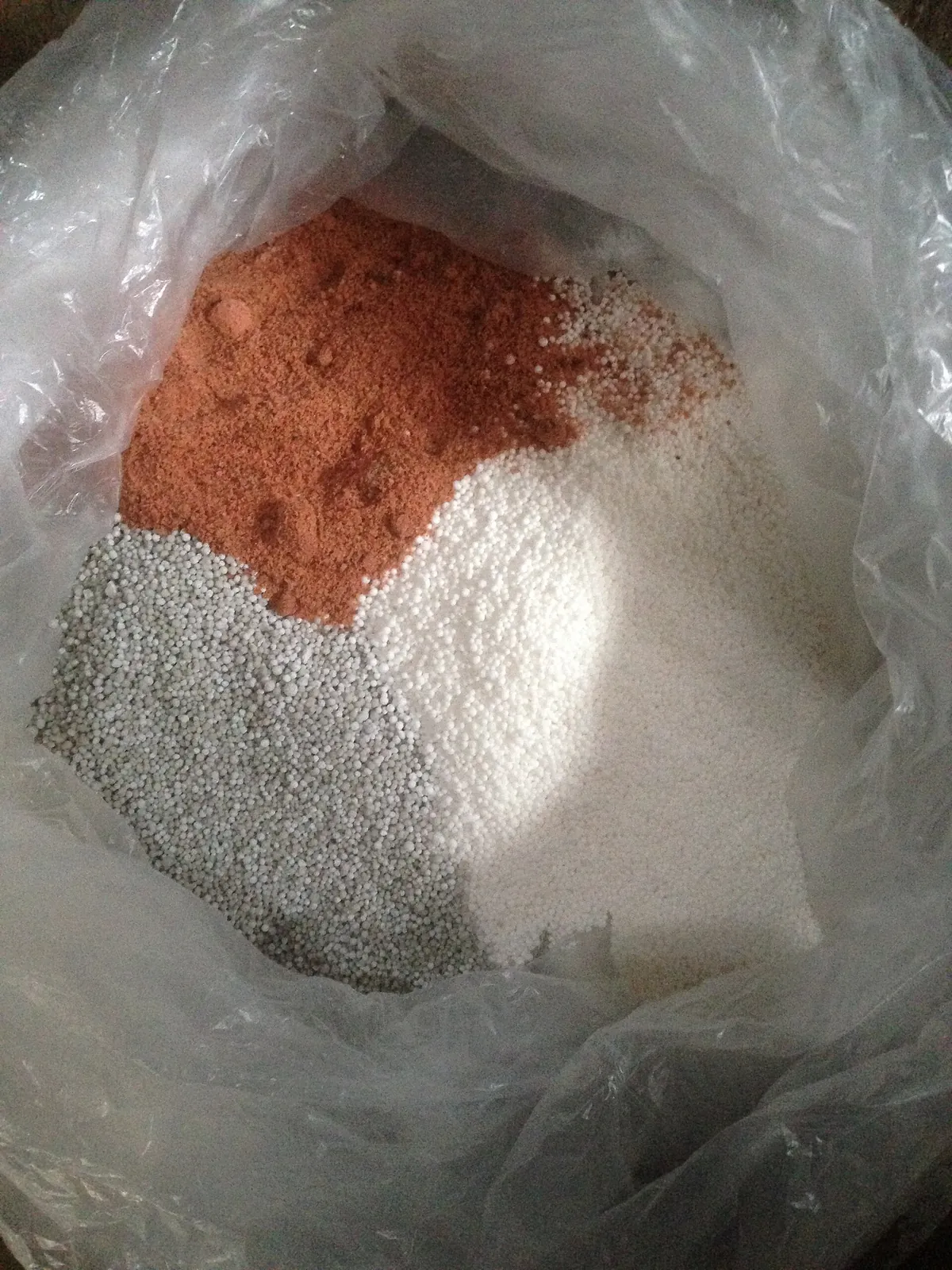
The fertilizer picture at the top of this page shows three kinds of fertilizer granules lying side by side in one sack. A complete fertilizer saves you that mixing. It puts all three nutrients into one bag at a fixed grade, so every handful carries the same balance.
What the numbers on complete fertilizer 14 14 14 mean
The three numbers are the grade. They give the percent of nitrogen (N), phosphate (P2O5) and potash (K2O), always in that order. So 14 14 14 fertilizer is 14 percent of each.
In a 50 kg bag, that means 7 kg of nitrogen, 7 kg of phosphate and 7 kg of potash. The other 29 kg is the material that carries them, plus any extra nutrients on the label. Many brands on the FPA list of registered fertilizers also declare sulfur, often 8 or 11 percent. A 14 14 14 with 12 percent sulfur normally gives rice enough sulfur.
Some brands make compound granules, where each granule carries N, P and K. Others blend separate granules in one bag. The grade on the label holds either way, but a blend can separate in the bag, so mix it well before you spread.
Why triple 14 fertilizer goes on at planting
Phosphorus and potassium work early. Phosphorus drives root growth, tillering, early flowering and ripening. So mix all the phosphorus into the soil before the last puddling, or within 10 to 15 days after direct seeding.
The usual window for phosphorus is 0 to 14 days after transplanting (DAT), or 7 to 10 days after sowing (DAS). Most of the potassium and the first nitrogen dose fall in the same window. That is why a balanced bag like 14 14 14 makes a good basal fertilizer. The later nitrogen then comes from urea, the 46 0 0 fertilizer.
When to use complete fertilizer on rice, corn and vegetables
Palay
Every Abonong Swak plan uses complete fertilizer as the basal dose. For a target of 3 to 4 tons per hectare, it calls for 1 bag of 14 14 14 per hectare at 0 to 14 DAT, or 10 to 14 DAS. For 5 to 6 tons and for 7 to 8 tons, it calls for 2 bags in the same window. Urea and muriate of potash follow later, timed to the maturity of the variety.
Those plans also add rice straw and 10 bags of chicken manure or compost. Treat the numbers as a guide and adjust them to a soil test. Our fertilizer for rice page lays out the whole season.
Mais
For corn, put all the phosphorus and potassium, plus half the nitrogen, in the furrow at planting. It goes in a band about 5 cm beside and 5 cm below the seed. Complete fertilizer suits that job. The rest of the nitrogen goes on as a side dress 21 to 30 days after planting, during hilling up. See pagtatanim ng mais for the full crop.
Vegetables
Vegetables take a balanced grade at planting too, but their needs shift as they flower. Yara, for example, recommends its 16 16 16 for early crop growth. For flowering and fruiting vegetables, it offers a grade higher in potassium. Follow the crop guide for your vegetable and a soil test. Our guide to vegetables in the Philippines covers the common crops.
Complete fertilizer 14 14 14 vs 16 16 16 vs 20 20 20
| Grade | N, P2O5 and K2O in a 50 kg bag | Usual form | Where it fits |
|---|---|---|---|
| 14 14 14 | 7 kg each | Granules, often with sulfur | Basal on palay, mais and vegetables |
| 16 16 16 | 8 kg each | Granules | Basal and early growth |
| 20 20 20 | Sold mostly in small packs | Water soluble powder or foliar feed | Spraying or drip, as a supplement |
Fertilizer 16 16 16 simply packs more of each nutrient into a bag. So compare the price per kilo of nutrient, not per bag. A 16 16 16 bag carries 24 kg of nutrients against 21 kg for triple 14.
Fertilizer 20 20 20 is a different kind of product. Many 20 20 20 grades on the FPA list are water soluble or foliar feeds, like Peters Professional WSF. You dissolve them in water and spray them or run them through drip lines. A spray carries far less nutrient than a basal bag, so use it to top up a crop, not to replace the basal dose. More on sprays is in our guide to foliar fertilizer.
Brands you will see: Atlas and Yara
Atlas Fertilizer Corporation is a Philippine maker. Its Atlas Perfect Gro 14 14 14 appears on the FPA list with 8 percent sulfur and 10 percent chloride. Atlas also sells Super Gro 16 20 0, urea and basal grades made for rice.
Yara Philippines sells compound fertilizer under the YaraMila name. YaraMila Unik 16 is its 16 16 16. The Yara Winner fertilizer, sold as YaraMila Winner, is a 15 9 20 with magnesium, sulfur, manganese, boron and zinc, and Yara pitches it for flowering and fruiting vegetables.
We do not favor any brand. Compare the grade, the extra nutrients, the price per kilo of nutrient and the FPA registration. Our guide to fertilizer brands and dealers helps with that.
Price and how many bags to buy
The national dealer survey for September 14 to 18, 2026 put the national average for complete fertilizer at PHP 1,902.92 per 50 kg bag. In the week of January 5 to 9, 2026 it was PHP 1,655.71. Prices change every week and differ by province, so check the FPA list before you buy.
The math is simple. The Abonong Swak plan for 5 to 6 tons per hectare uses 2 bags of 14 14 14. At the September average, that basal dose costs about PHP 3,805.84 per hectare. For a 1.5 hectare farm, buy 3 bags. Our fertilizer calculation guide shows how to do this for any grade.
Keep your basal dose on schedule with anee.io
The basal window is short, 0 to 14 DAT. In anee.io, the cropping calendar dates the basal task from each lot's own day zero, so you see the deadline on the board. The farm inventory counts your complete fertilizer in 50 kg bags. Tick the task done and the bags leave stock, with their cost going to your expense report.
Unsure how many bags each lot needs? Ask Anee, the smart farm technician. She reads your lot sizes and crop first, then works out a fertilizer plan in Tagalog or English.
Sign up free and let anee.io date every fertilizer task and count every bag in your shed.
Start free