Coffee Berry Borer: How to Spot It and Protect Your Beans
The coffee berry borer, Hypothenemus hampei, is a tiny black beetle that bores into coffee berries and breeds inside the bean. Even a light attack lowers the quality and the price of your coffee. This page shows how to spot it and how to break its life cycle.
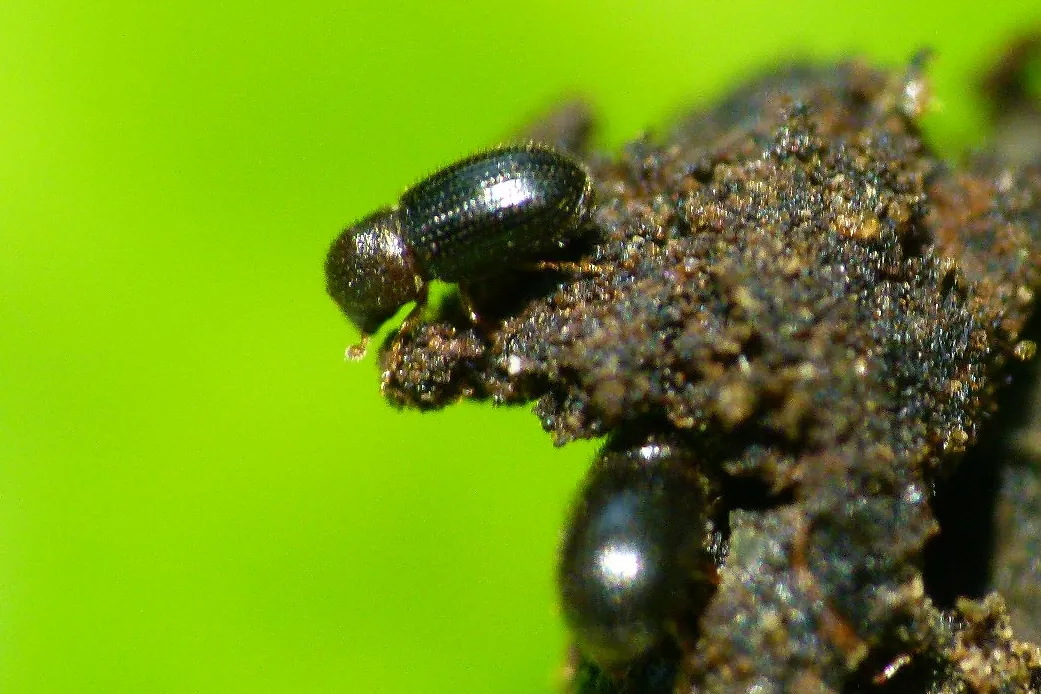
What Is Coffee Berry Borer?
The adult female is only about 1.5 to 1.9 mm long and black, covered in short stiff hairs. A female flies to ripening berries and bores a hole in one. Males have reduced wings and stay inside the berry. Females far outnumber males, and studies give ratios from 5 to 1 up to hundreds to 1.
The beetle lives worldwide, in Asia, Africa, the Americas and Oceania. Because it breeds inside the bean, spray does not reach it easily. Cultural work at harvest is the main tool for the Filipino coffee farmer. The berry borer, with coffee leaf rust, is the problem that has hampered coffee production the most in the country.
| Fact | Details |
|---|---|
| Name | Coffee berry borer |
| Scientific name | Hypothenemus hampei |
| Kind | Insect |
| Crops it attacks | Coffee |
| Local names | None recorded |
| Where it strikes | Fruits, pods and nuts |
| When it strikes | It attacks ripening berries, and it survives between seasons in old berries left on the tree and on the ground. |
| Life cycle | The fertilized female bores into a ripening berry and lays eggs inside the bean over several weeks. Pacific Pests gives 30 to 50 eggs, and a review of the global pest says a female can lay more than 100. Development takes about 4 weeks, and females fly to new berries, sometimes carried far by air currents. |
How to Identify Coffee Berry Borer
Look at the berries for a small round hole with brown frass around it. Cut open some berries and look for the tiny black beetles, white grubs or damaged beans. Check the fallen and dried berries on the ground too, because that is where the beetles wait for the next crop. Berry drop from other causes shows no entry hole.
- A small round entry hole shows on the berry, with brown frass over it.
- Berries drop early after decay organisms enter the hole.
- Beans inside are partly or fully eaten.
- Tiny black beetles and white grubs live inside the bean.
- Dried berries left on the tree or on the ground hold live beetles.
Berries that drop from drought or from anthracnose show no entry hole. A round hole with brown frass points to the borer.
How Coffee Berry Borer Hurts Your Crop
Even a small attack lowers bean quality and makes the coffee harder to sell. The beetle can attack up to all of the berries in a badly infested field. Damage plus decay organisms cause early berry drop.
Because one beetle starts a colony inside the bean, it takes only a few weeks for the numbers to rise. Compare it with the pests of other trees, such as the cacao pod borer, which also hides inside the fruit. Clean and frequent harvest mostly controls it. Heavy attacks on robusta have affected 30 to 80 percent of the berries.
How to Control Coffee Berry Borer
- Pick the berries as they ripen. In affected areas, harvest early in the season every 2 to 3 weeks.
- Collect fallen and blackened berries from the ground and destroy them, so the beetles have nowhere to wait.
- After the main harvest, strip every berry from the tree, green, ripe, over ripe and dried, for about 3 months to break the life cycle. A review of the global pest calls strip picking the most important part of integrated management. Leave no old berries on the tree.
- Keep the trees healthy with proper fertilizing and pruning, since a healthy tree gives clean berries.
- Use the fungus Beauveria bassiana, but expect a mixed result. The Pacific fact sheet reports about 80 percent of adults killed in high humidity places, while a global review gives field results from under 1 percent to about 70 percent. It works best early in the season when females are boring in.
- Where you can get them, protect or release the tiny wasps that parasitize the borer (Cephalonomia stephanoderis, Prorops nasuta and Phymastichus coffea), but expect only a small effect: in one review, Prorops worked only after many releases.
- Trap the adults. A study in Atok, Benguet caught the most beetles with 4 lure traps per 50 coffee trees, set during the months when few berries are on the trees.
When a Spray Makes Sense
The Pacific fact sheet recommends a spray only when monitoring shows more than 2 percent of berries infested. The global review suggests a threshold between 1.5 and 2.5 percent. It must go on early. Once the female enters the bean, a spray does little. Follow the label and the FPA registration.
| Active ingredient | IRAC group | On Philippine labels |
|---|---|---|
| Carbaryl | IRAC 1A | Older or broad chemistry: a last resort. 27 registered products name it on coffee. |
| Dimethoate | IRAC 1B | Older or broad chemistry: a last resort. 6 registered products name it on coffee. |
These are on Philippine labels for it, but we leave them off the list above, for the reasons below.
- Copper hydroxide and bordeaux mixture: A copper fungicide for leaf rust and berry disease. It does nothing to the berry borer.
Resistance. The berry borer once resisted endosulfan in New Caledonia after years of one product. With few registered choices here, keep sprays rare and let picking and sanitation do the work.
Use only products registered with the Fertilizer and Pesticide Authority, and follow the label for the rate, the timing and the protective clothing. Switch to a different insecticide group next time, so the pest does not learn to survive it. Our guide to integrated pest management explains how.
Keep It Out Next Season
- Pick ripe berries every 2 to 3 weeks through the season, and do not leave over ripe berries on the tree.
- Gather fallen and black berries from the ground and destroy them. Borers wait in them for the next crop.
- After the main harvest, strip every berry left on the tree, green, ripe or dry, to break the borer's cycle.
- Dry harvested beans fast and well, and store them in sealed sacks, so borers in them die and cannot fly back.
- Hang lure traps with a methanol and ethanol mix when few berries are on the trees. About 4 traps per 50 trees caught the most in one highland trial.
- Prune and fertilize on time. Open, healthy trees are easier to pick clean and dry faster.
Natural Enemies and Biological Help
- Spray Beauveria bassiana early in the season when females are boring in. It kills many in humid places, fewer in dry ones.
- Small parasitic wasps attack the borer inside the berry. They help a little where they are present.
Not Sure What You Are Seeing?
Take a clear photo of the insect, the damage and the whole plant, then ask Anee, the smart farm technician in anee.io, in Tagalog or English. Anee tells you what it most likely is and what to do at the age of your crop. You can also put your scouting days on the cropping calendar, so the team knows when to walk the field.
anee.io keeps your scouting, spraying and harvest on one calendar, and Anee answers when something looks wrong.
- Scouting days dated from each lot's own planting day
- Photos and notes for every lot
- Anee, the smart farm technician, in Tagalog or English
Questions Farmers Ask About Coffee Berry Borer
How big is the coffee berry borer?
When do I spray?
What is stripping?
Does Beauveria help?
Stop Coffee Berry Borer from costing you the harvest
With Libre + Anee, read the whole guide: how to be sure it is this pest, when it pays to act, and what to spray, by active ingredient.
The account is free, no credit card.