Cacao Nutrient Deficiency: Signs, Causes and the Fertilizer That Fixes It
Cacao nutrient deficiency is one of the first things to check when the leaves of your kakaw (cacao) turn yellow, purple or burnt at the edges. On Philippine farms the usual ones are nitrogen, phosphorus, potassium, zinc, magnesium, boron, calcium, iron and sulfur. This guide shows where each one starts, how to be sure, and the fertilizer that fixes it.
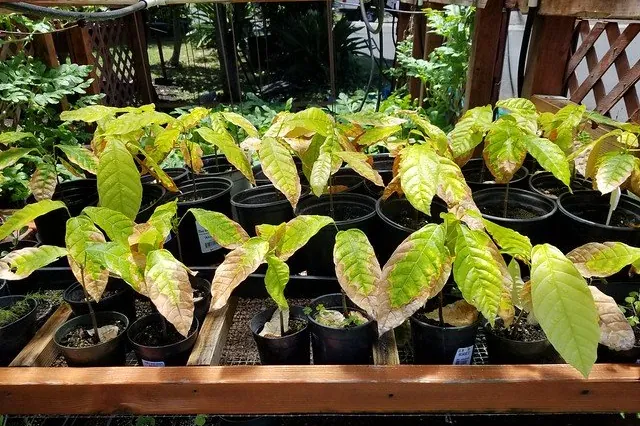
Start with one question: did the change begin on the old leaves or on the young ones? Nitrogen, phosphorus, potassium and magnesium move inside the plant, so a shortage shows on the old, lower leaves first. But zinc, boron, calcium, iron and sulfur stay where the plant first put them, so the young leaves and the growing tip show it first. After that, the color and the pattern narrow down which cacao nutrient deficiency you have, and a soil test confirms it. Each one below has its signs, its causes and its fix.
Cacao nutrient deficiency signs, old leaves and young leaves
Shows first on the old leaves
| Nutrient | Where it starts | What you see | Fix with |
|---|---|---|---|
| Nitrogen | the whole plant, old, lower leaves | Small, evenly soft yellow green leaves on a slow tree. New leaves come out almost white. | Ammonium sulfate 21 0 0, Urea 46 0 0 |
| Phosphorus | old, lower leaves, leaf edges and tips | Old leaves blotchy pale between the veins, then die back from the tip with a sharp edge. New leaves small and narrow. | Superphosphate 0 20 0, Complete 14 14 14 |
| Potassium | old, lower leaves, leaf edges and tips | Old leaves get reddish yellow patches between the side veins that die from the tip and edge, with a wavy yellow border. | Muriate of potash 0 0 60, Complete 14 14 14 |
| Magnesium | old, lower leaves, between the veins | Old leaves get tiny black pinpoints with yellow halos between the veins, then a marbled dead edge. | Dolomite, Magnesium sulfate (Epsom salt) |
Shows first on the young leaves
| Nutrient | Where it starts | What you see | Fix with |
|---|---|---|---|
| Zinc | young leaves and the tip, between the veins | Sickle leaf: new leaves narrow, curved and lopsided, with wavy edges and pale bands between prominent veins. | Zinc sulfate |
| Boron | young leaves and the tip, fruit, grain or tubers | Many chupons, new leaves twisted and falling before they harden, brittle old leaves with dead tips. | Borax, Solubor |
| Calcium | young leaves and the tip, leaf edges and tips | Small yellow green leaves with tiny white spots seen against the light, and dead tips and edges. | Dolomite, Agricultural lime |
| Iron | young leaves and the tip, between the veins | Leaves dull yellow green with sharp green veins and a bumpy surface between them. | Ferrous sulfate |
| Sulfur | young leaves and the tip, the whole plant | The newest mature leaves evenly yellow green on a very short last flush. | Ammonium sulfate 21 0 0, Gypsum |
Before you buy fertilizer for a cacao nutrient deficiency
So use the table to pick the likeliest cacao nutrient deficiency, then read its section below. Also keep in mind that dry soil, standing water, cold nights, a pest or a disease can look the same. That is why it pays to check the roots and the whole field first.
Nitrogen deficiency in cacao
Growth slows and the leaves harden early, so they stay small. Full grown leaves turn an even soft yellow green, and the oldest leaves of each flush die back from the tip. New leaves come out yellow to almost white. Internodes are short and the leaf stalks stand at a sharp angle to the stem. Fewer flushes mean fewer flowers and pods. You see it most at this stage: young trees in the first years after planting, bearing trees that get no fertilizer, and trees grown without shade. Nitrogen is needed most when the rains begin and again three months after.
Why nitrogen deficiency happens in kakaw
Trees that get little or no fertilizer, cacao grown in full sun (proper shade lowers the nutrient need), low organic matter, and leaching rains. Nitrogen shortage is very common on small cacao farms that get little fertilizer.
How to tell it apart
Vascular streak dieback also yellows leaves, but it shows scattered green spots on a yellow leaf on one or two leaves about a meter behind the shoot tip, the leaves drop. Three small dark dots show in the leaf scar with a brown streak inside the twig. To be sure, leaf test: from the newest flush that is just hardening, pick its 2nd or 3rd leaf, four or five leaves from all around the canopy of at least 10 trees, leaving out damaged ones. A soil test for organic matter helps. New flushes that come out green after ammonium sulfate confirm it.
What to apply for nitrogen deficiency
Apply Ammonium sulfate 21 0 0 or Urea 46 0 0 in a ring under the canopy after weeding, in two splits at the start and end of the rainy season. A mature planting of 1,241 trees per hectare yielding 1 tonne of dry beans needs about 108 grams of Ammonium sulfate per tree per year. Some schedules give much more, 100 grams of nitrogen per tree per year, doubled for trees bearing over 50 pods. Use the soil and leaf test to choose.
- Ammonium sulfate 21 0 0
- Urea 46 0 0
- Complete 14 14 14
Sold here with nitrogen: Atlas Granular Urea (46 0 0) by Atlas Fertilizer, Amigo Planters Ammonium Chloride by La Filipina (25 0 0), Agripower 46 0 0 (Locally Blended) Coated by Green Acres Agri Tech and Calcipro by Ramgo (15.5 0 0 with 18.8 percent calcium). Check the FPA registration on the bag and follow the label rate. For the how and when, see our guide to urea fertilizer, and the page on nitrogen deficiency in every crop. In anee.io, Anee, the smart farm technician, reads a photo of the leaf and tells you which nutrient is short.
To keep it away, fertilize every year in splits, mulch with prunings and composted pod husks. Follow the usual schedule of Complete 14 14 14 for young trees. Let a soil test and the crop's color set the season's nitrogen.
Phosphorus deficiency in cacao
Growth slows early. New leaves keep a normal color but come out smaller and narrower. Older leaves of the previous flush lose color between the veins in blotches, then die from the tip toward the base, with a sharp line between dead and living tissue. Some leaves turn greyish purple before the dead patch forms. Badly hit leaves fall, and flowering and pod setting drop. You see it most at this stage: young trees after planting, and bearing trees as the rains begin, when phosphorus matters most for flowering.
Why phosphorus deficiency happens in kakaw
Acid soils low in organic matter. Phosphorus is often short on cacao farms with moderately to slightly acid soils low in organic matter.
How to tell it apart
Potassium deficiency starts the same way, but at the advanced stage the dead patch has a wavy, zigzag yellow border instead of a sharp edge. Magnesium deficiency shows small blackish pinpoints with yellow halos first. To be sure, soil test for available phosphorus and pH. A leaf test of the 2nd or 3rd leaf of the newest flush that is hardening.
What to apply for phosphorus deficiency
Apply a phosphorus fertilizer in the ring under the canopy, following the soil test. Give about 49 grams of Solophos superphosphate per mature tree per year for a 1 tonne per hectare crop. Complete 14 14 14 for young trees. On low phosphorus soils, rates up to 200 kg P2O5 per hectare raise yields. Phosphorus works best when the trees also have enough nitrogen.
- Superphosphate 0 20 0
- Complete 14 14 14
- 16 20 0
- Ammonium phosphate 18 46 0
Sold here with phosphorus: Philphos 18 46 0 (Di Ammonium Phosphate), Atlas Super Gro (16 20 0) by Atlas Fertilizer, Amigo Planters Granular Single Super Phosphate by La Filipina (0 18 0 with 11 percent sulfur) and Triple Super Phosphate by Newman Chemicals (0 46 0). Check the FPA registration on the bag and follow the label rate. For the how and when, see our guide to 16 20 0 fertilizer, and the page on phosphorus deficiency in every crop.
To keep it away, put phosphorus in the planting hole, add compost or composted pod husks every year, and lime very acid soils.
Potassium deficiency in cacao
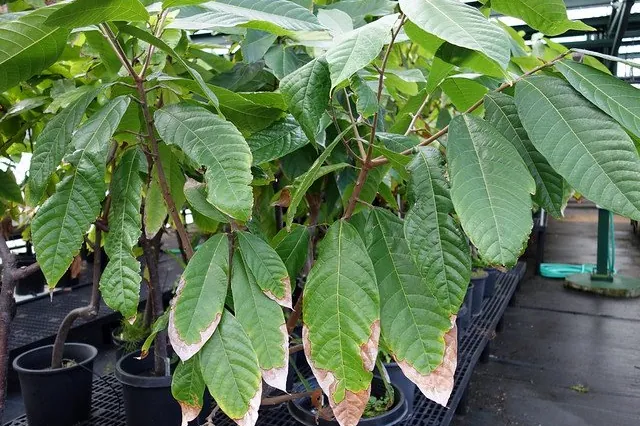
Older leaves show it first. A dull reddish yellow color runs along the midrib, wider at the base, or larger reddish yellow patches form between the side veins near the edge. The patches join and die, usually starting at the tip and edge, and the dead part has a wavy, zigzag yellow border. Leaves fall early. New leaves come out long and narrow. You see it most at this stage: bearing trees under heavy pod loads. Potash is most needed before flowering and while pods grow.
Why potassium deficiency happens in kakaw
Every harvest carries potash away, mostly in the pod husks: about 72 kg of potassium leaves the farm per tonne of dry beans, 63 kg of it in the husks. Sandy, leached soils and husks that are never returned bring it on.
How to tell it apart
Phosphorus deficiency looks the same at first, but its dead patches have a sharp edge. Magnesium deficiency begins with blackish pinpoints between the veins. To be sure, leaf test of the 2nd or 3rd leaf of the newest flush that is hardening, from at least 10 trees, plus a soil test for potash, calcium and magnesium.
What to apply for potassium deficiency
Apply Muriate of potash 0 0 60 in the ring in two splits. Give about 86 grams per mature tree per year for a 1 tonne per hectare crop. For yields under 1 tonne of beans, 70 to 100 kg K2O per hectare is enough. Give 140 grams of K2O per tree per year, doubled for trees bearing over 50 pods.
- Muriate of potash 0 0 60
- Complete 14 14 14
- Sulfate of potash 0 0 50
Sold here with potassium: Atlas Muriate of Potash (MOP) by Atlas Fertilizer (0 0 60), Simplot Sulfate 0 0 50 by Nutranta, Potassium Nitrate by Parafield (13 0 46) and Qrop Mix Production 14 0 23 plus 13 Cao by Farmtech Agriland (14 0 23 with 9.3 percent calcium). Check the FPA registration on the bag and follow the label rate. For the how and when, see our guide to potash fertilizer, and the page on potassium deficiency in every crop.
To keep it away, return composted pod husks to the trees, give potash every year in splits, and keep potash and magnesium in balance. Test the soil every two or three years.
Zinc deficiency in cacao
On young leaves the small veins stand out sharply and the tissue between them is pale, which is easy to see against the light. Leaves grow long and narrow with wavy, fluted edges and may twist. Many show a waist near the base or grow more on one side of the midrib, so they curve like a sickle. In bad cases leaves stay tiny, internodes shorten into rosettes, leaves fall early and shoot tips die back, with many small side twigs. You see it most at this stage: young trees in the field and new flushes, often after a drought.
Why zinc deficiency happens in kakaw
Old, leached, sandy soils low in zinc, high pH, heavy phosphate. Roots damaged by drought or waterlogging, which take up less zinc.
How to tell it apart
Boron deficiency can also give sickle leaves. But it also brings brittle leaves with dead tips, a dying top and cracks on the trunk. To be sure, leaf test of the 2nd or 3rd leaf of the newest flush that is hardening. Spray zinc on a few trees: leaves that have already hardened stay misshapen, but the next flush comes out normal. In a soil test, less than 0.8 ppm of zinc is low.
What to apply for zinc deficiency
Give a foliar spray of Zinc sulfate at 0.3 to 0.5 percent (3 to 5 grams per liter, 48 to 80 grams in a 16 liter sprayer) every two weeks, three times. Young trees sprayed every ten days can recover almost fully in about seven months. Trees left unsprayed stay sick. Give 50 to 100 grams of Zinc sulfate a young tree and 100 to 250 grams a bearing tree a year under the canopy.
- Zinc sulfate
Sold here with zinc: Harvester Zinc Sulphate Heptahydrate by Universal Harvester (22 percent zinc), Tierramino ZN by Unilox Far East Resources (7 0 0 with 10 percent zinc), Liquid Chelate Zinc with Sulfur by Sagrex (10 percent zinc and 5 percent sulfur) and Nemes Foliar by SCL Filipinas (4.8 0 0 with 10 percent zinc, 4.9 percent boron and 4.8 percent magnesium). Check the FPA registration on the bag and follow the label rate. For the how and when, see our guide to fertilizer with zinc, and the page on zinc deficiency in every crop.
To keep it away, avoid overliming and heavy phosphate, mulch to protect roots in the dry season, and include zinc where leaf tests run low. Test the soil every two or three years.
Magnesium deficiency in cacao
Older leaves first show a faint yellowing between the side veins with small blackish pinpoints. Yellow spots form around the pinpoints, join toward the tip and edge, and the tissue dies, giving a blotchy, marbled leaf. A bright yellow zone borders the dead parts. In bad cases the dead tissue turns almost white with the green veins standing out like ribs, and leaves fall early. You see it most at this stage: bearing trees, after years of potash without magnesium. Calcium and magnesium are needed most as the rains begin.
Why magnesium deficiency happens in kakaw
Acid, leached soils and heavy potash. Most cacao farms have enough magnesium, but in some areas nearly two thirds of farms run short.
How to tell it apart
Potassium deficiency also kills old leaf edges, but without the black pinpoints, and with a wavy yellow border. Calcium deficiency shows white spots, seen against the light, on the newest full grown leaves. To be sure, leaf test of the 2nd or 3rd leaf of the newest flush that is hardening. A soil test for magnesium, potash and calcium together.
What to apply for magnesium deficiency
Give Dolomite at 100 grams per tree per year from the third year after planting. Use about 40 grams of Dolomite a mature tree for each ton of dried beans the farm harvests per hectare. Where soil pH is fine, use Magnesium sulfate or Kieserite, following the soil test. Do not put magnesium and potash down on the same day. Put the soil dose in before planting or when the rains begin. Sprays show results in 10 to 14 days.
- Dolomite
- Magnesium sulfate (Epsom salt)
- Kieserite
Sold here with magnesium: Dolomite by A6 Agrisource (24 percent calcium and 11 percent magnesium), Agsmart Kieserite Granule (20 percent sulfur and 16.3 percent magnesium), DDDD Planter's Choice Magnesium Sulphate Monohydrate by Modern Time (15.1 percent magnesium) and Zetryl MAG 9 by Zetryl Chem (9 percent magnesium). Check the FPA registration on the bag and follow the label rate. For the how and when, see our guide to complete fertilizer, and the page on magnesium deficiency in every crop.
To keep it away, lime with Dolomite instead of plain lime and keep potash and magnesium in balance.
Boron deficiency in cacao
Early signs are many chupons (water shoots) and a few curled leaves. New leaves come out pale, twisted and bent backward, harden while still small and often fall before they mature. Some curve into a sickle. Older leaves turn brittle and rough with dead tips, the most typical sign. The tip bud and then side shoots die so the tree turns bushy, and the trunk and branches may crack and bleed. Flower cushions swell, and pods can be misshapen with brown streaks inside. You see it most at this stage: new flushes and flowering, often after a dry spell.
Why boron deficiency happens in kakaw
Drought and shallow roots. Fast growing, high yielding trees show it sooner.
How to tell it apart
Zinc deficiency also gives sickle leaves, but without brittle dead tipped leaves, a dying top or trunk cracks. Sucking bugs can also deform pods, so check the leaves and shoots too. To be sure, leaf test of the 2nd or 3rd leaf of the newest flush that is hardening, and a soil test for boron. In a soil test, less than 0.5 ppm of boron is low.
What to apply for boron deficiency
Boron given with calcium helps more flowers set and fewer pods drop. Spray Solubor or apply Borax to the soil at the label rate, then retest. Boron is toxic in excess. Give 25 to 50 grams of Borax a young tree and 50 to 100 grams a bearing tree a year, spread evenly under the canopy. A spray of Borax or Solubor at 0.1 to 0.2 percent (16 to 32 grams in a 16 liter sprayer) before flowering also works. Use the soil dose or the spray, not both.
- Borax
- Solubor
Sold here with boron: Etifert 11 (Borax Decahydrate) by Zetryl Chem (11 percent boron), Fertibagra 15G by Unilox Far East Resources (14.6 percent boron), B17 (Boric Acid) by Newman Chemicals (17 percent boron) and Better Yield by Bacphil Planters Fertilizer (0 0 0.9 with 10 percent boron). Check the FPA registration on the bag and follow the label rate. For the how and when, see our guide to foliar fertilizer, and the page on boron deficiency in every crop.
To keep it away, mulch and keep the soil moist in the dry season. Keep a small boron dose in the program on soils that tested low. Test the soil every two or three years.
Calcium deficiency in cacao
Growth nearly stops and leaves stay small and strong yellow green. Full grown leaves of the last flush show many small white spots near the tip and edge when held against the light, and the tip dies. The spots turn reddish yellow, join, and the tip and edge die further, sometimes leaving an oak leaf shape of green tissue. Dead patches near the edge that join into a dead margin on older leaves. You see it most at this stage: young trees on acid soils. Calcium and magnesium are needed most as the rains begin.
Why calcium deficiency happens in kakaw
Acid, leached soils and heavy potash. Many cacao soils here are moderately to slightly acid, below pH 6.5.
How to tell it apart
Magnesium deficiency also kills leaf edges, but it starts with blackish pinpoints on older leaves. Potassium deficiency gives reddish yellow patches with a wavy border. To be sure, soil test for pH and calcium, and a leaf test of the 2nd or 3rd leaf of the newest flush that is hardening.
What to apply for calcium deficiency
Give Dolomite at 100 grams per tree per year from the third year. On very acid soils apply Agricultural lime or Dolomite following the soil test. On soils that are not acid use Gypsum. Superphosphate also supplies calcium. Lime 2 to 4 weeks before planting. Calcium sprays go on young fruit from fruit set.
- Dolomite
- Agricultural lime
- Gypsum
- Superphosphate 0 20 0
Sold here with calcium: Planters Products Lifelime (36.2 percent calcium), Dolomite by A6 Agrisource (24 percent calcium and 11 percent magnesium), Calcipro by Ramgo (15.5 0 0 with 18.8 percent calcium) and Philphos Gypsum (22.2 percent calcium and 17.4 percent sulfur). Check the FPA registration on the bag and follow the label rate. For the how and when, see our guide to fertilizer for tomatoes, and the page on calcium deficiency in every crop.
To keep it away, lime acid soils based on a soil test and keep potash in balance.
Iron deficiency in cacao
Leaves turn a dull yellow green while the veins stay green and sharply outlined. The blade between the side veins bulges up, so the leaf looks bumpy, and the edge can look slightly toothed. Look for it on young leaves, which turn pale yellow, with stunted growth. You see it most at this stage: young trees and new flushes, mostly on wet or limed spots.
Why iron deficiency happens in kakaw
High pH or overlimed soils and waterlogged soils. Low leaf iron is common on cacao farms, but the level that counts as short is not certain.
How to tell it apart
Zinc deficiency also gives a bumpy leaf, but much stronger, and leaves are narrow, waisted or sickle shaped. Nitrogen deficiency yellows the whole leaf including the veins. To be sure, soil test for pH and check drainage. Since leaf iron numbers are hard to read, a test spray of ferrous sulfate on a few trees is the best check. In a soil test, less than 4.5 ppm of iron is low.
What to apply for iron deficiency
Give a foliar spray of Ferrous sulfate at 0.5 percent (5 grams per liter, 80 grams in a 16 liter sprayer) every two weeks. Fix drainage and stop liming where pH is high.
- Ferrous sulfate
Sold here with iron: DDDD Planter's Choice Ferrous Sulphate Heptahydrate by Modern Time (19 percent iron), Ferrous Sulfate Monohydrate by Zetryl Chem (30 percent iron), Ferrous Sulphate Monohydrate by Newman Chemicals (30 percent iron) and Liquid Chelate Iron with Sulfur by Sagrex (5 percent iron and 3 percent sulfur). Check the FPA registration on the bag and follow the label rate. For the how and when, see our guide to foliar fertilizer, and the page on iron deficiency in every crop.
To keep it away, drain wet spots and do not overlime. Test the soil every two or three years. Keep organic matter up with compost, manure or crop residues.
Sulfur deficiency in cacao
It comes on slowly. The last three mature leaves turn evenly yellow green and the internode of the last flush stays very short. Older leaves look patchy from yellowing between the veins, and some yellow at the tip or edge. You see it most at this stage: young trees, after a long time without any sulfur source.
Why sulfur deficiency happens in kakaw
Soils low in organic matter and fertilizer programs that use only urea and muriate of potash.
How to tell it apart
Nitrogen deficiency also yellows leaves evenly, but it hits the whole tree and the old leaves die back from the tip. Iron deficiency keeps the veins sharply green. To be sure, leaf test of the 2nd or 3rd leaf of the newest flush that is hardening for sulfur. Trees that green up after ammonium sulfate confirm it. In a soil test, less than 10 ppm of sulfate sulfur is low.
What to apply for sulfur deficiency
Use Ammonium sulfate 21 0 0 as the nitrogen source, or add Gypsum, following the soil test. Give 200 to 500 grams of Ammonium sulfate 21 0 0 or Gypsum a tree a year, spread under the canopy. Give it at planting or with the first side dress.
- Ammonium sulfate 21 0 0
- Gypsum
Sold here with sulfur: Atlas Ammosul 21 0 0 by Atlas Fertilizer (21 0 0 with 24 percent sulfur), Philphos Gypsum (22.2 percent calcium and 17.4 percent sulfur), Harvester Sulphate of Potash by Universal Harvester (0 0 50 with 17.5 percent sulfur) and Agsmart Kieserite Granule (20 percent sulfur and 16.3 percent magnesium). Check the FPA registration on the bag and follow the label rate. For the how and when, see our guide to ammonium sulfate fertilizer, and the page on sulfur deficiency in every crop.
To keep it away, keep a sulfur source in the yearly program and build organic matter.
A soil test is the surest check for any cacao nutrient deficiency. Before you buy, ask your Municipal Agriculture Office where to send a soil sample. The DA regional soil laboratories test soil, and the result says how much of each fertilizer your kakaw needs. That saves money, because extra fertilizer is money lost.
Open the Nutrient Deficiency Finder, pick kakaw, say where the leaves changed first and what you see, and get the fertilizers sold here that fix it.
- Anee, the smart farm technician, reads a photo of the leaf
- The cropping calendar dates every fertilizer application of your season
Cacao nutrient deficiency questions
Why are my kakaw leaves turning yellow?
What fertilizer fixes nitrogen deficiency in cacao?
What fertilizer fixes phosphorus deficiency in cacao?
What fertilizer fixes potassium deficiency in cacao?
How do I know which nutrient my kakaw lacks?
- Muller 1979, Deficiency symptoms in cacao seedlings observed in pot experiments (Netherlands Journal of Agricultural Science)
- Nelson and others 2010, Nutrient status of cocoa in Papua New Guinea: results from a survey (JCU)
- Yara: Cocoa nutrient analysis (leaf sampling)
- Pacific Pests, Pathogens and Weeds fact sheet: Cocoa vascular streak dieback
- Villason and Olguera 2020, Physico chemical characteristics of soils under cacao production system in Davao de Oro, Philippines
- Yara: How to increase number of cocoa pods and bean yield
- Schroo 1959, Acute zinc deficiency observed in cacao on certain soil types in Netherlands New Guinea (Netherlands Journal of Agricultural Science)
- U.S. Borax crop guide: Boron deficiency in cocoa
Find the missing nutrient and fix it
With Libre + Anee, read the whole guide: how to tell the deficiency from look alikes, how to be sure, what to apply, and the fertilizers sold here that supply it.
The account is free, no credit card.