What Fertilizer Should I Use for Fruit Trees Like Mango and Calamansi?
The right fertilizer for fruit trees depends on the tree's age. Young trees get small, split doses of urea or ammonium sulfate to grow their frame. Bearing trees get complete fertilizer 14 14 14 plus compost, more each year, in a ring under the edge of the canopy. Each year's dose is split between the start and end of the rains, while older calamansi gets three doses, the last after harvest. anee.io, a farm app built for Filipino farmers, keeps every orchard dose on a dated calendar.
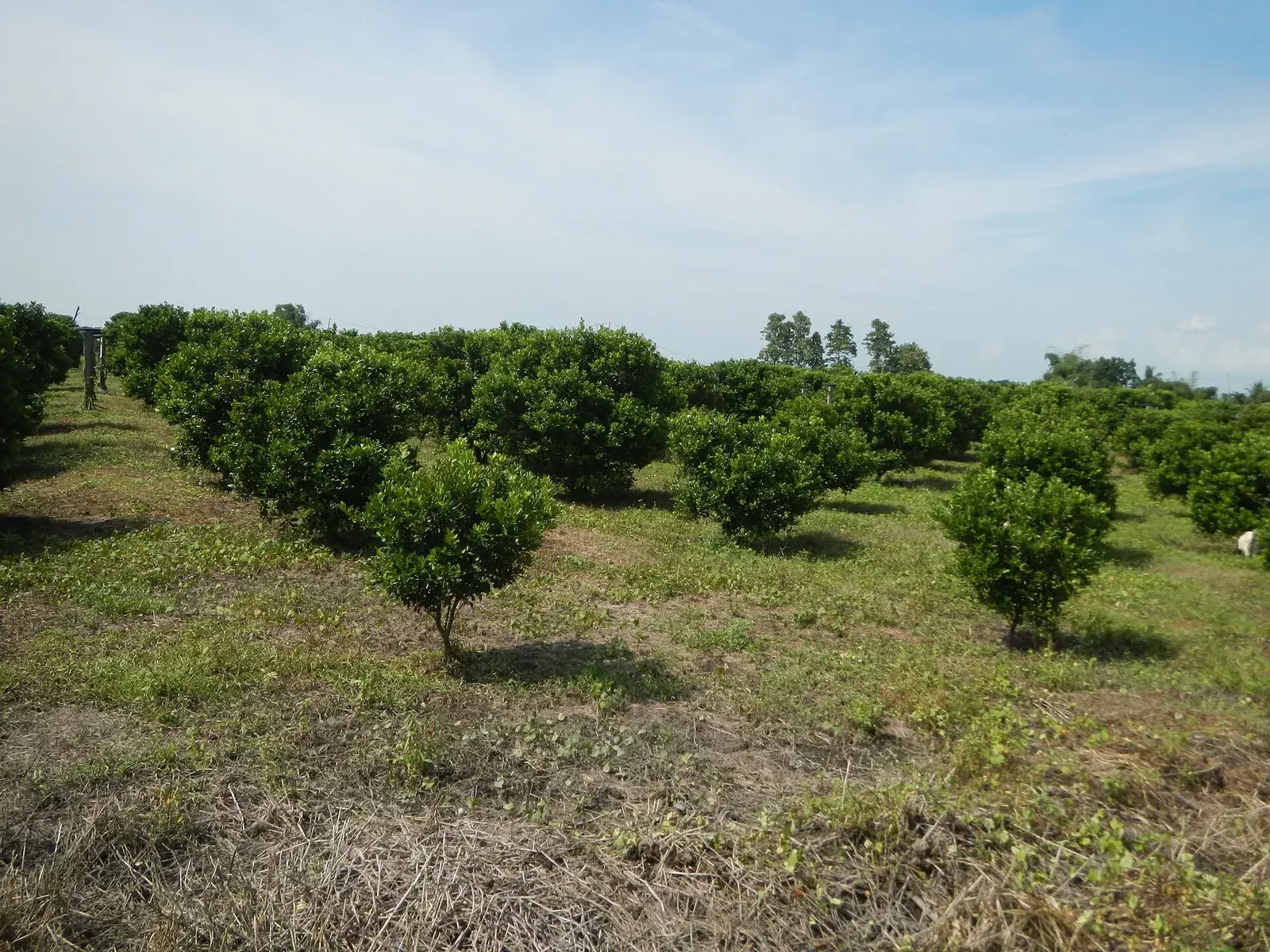
A mango or calamansi tree feeds from the same ground for decades, and its needs change as it grows. So young trees and bearing trees are fed differently.
The rates below are for orchards without a soil test. If you can, send soil and leaf samples to a DA soils laboratory or the Bureau of Soils and Water Management first.
- Young trees: small, split doses of nitrogen, such as 100 to 200 grams of urea a year for a mango one or two years old.
- Bearing trees: complete fertilizer 14 14 14 plus compost, rising with age, up to 10 kg a year for a mango over 20 years old.
- Timing: one half when the rains begin, the other half as they end. Older calamansi gets three doses a year, the last after harvest.
- Placement: in a ring under the outer edge of the canopy, moving outward as the tree grows.
- Banana and coconut follow their own programs: potash first for banana, salt for coconut.
How is fertilizer for fruit bearing trees different from young trees?
A young tree mostly needs nitrogen to grow leaves, shoots and roots. Once it bears, it also needs phosphorus and potassium to flower and fill fruit. So bearing trees switch to complete fertilizer. For mango, the full schedule by age is below.
| Age of tree | Inorganic only | Or organic fertilizer plus inorganic |
|---|---|---|
| 1 year | 100 g urea | 200 g organic plus 100 g urea |
| 2 years | 200 g urea | 500 g organic plus 200 g urea |
| 3 years | 300 g complete | 1 to 2 kg organic plus 300 g complete |
| 4 years | 400 g complete | 2 to 3 kg organic plus 400 g complete |
| 5 to 6 years | 0.5 to 1 kg complete | 3 to 4 kg organic plus 0.5 to 1 kg complete |
| 7 to 8 years | 2 kg complete | 4 to 5 kg organic plus 2 kg complete |
| 9 to 10 years | 3 kg complete | 5 to 6 kg organic plus 3 kg complete |
| 11 to 15 years | 5 kg complete | 10 kg organic alone |
| 16 to 20 years | Not given | 12 kg organic plus 6 to 7 kg complete |
| Over 20 years | Not given | 15 to 20 kg organic plus 10 kg complete |
Feeding a newly planted tree
The first dose goes in at planting. For mangosteen, for example, put 200 to 250 grams of complete fertilizer three inches below the roots and five inches to the side. For digging and early care, read our Tagalog guide to pagtatanim ng puno and our fruit tree land preparation guide.
Where do I put fertilizer for fruit trees?
Put it in a ring under the outer edge of the canopy, where rain drips off the leaves. For young mango, start the ring about 10 cm from the base and move it out to about 50 cm by year four. For trees 10 years and older, use a shallow canal or 6 to 8 holes, 2 to 4 meters from the trunk. Cover it, so it does not escape into the air or wash away in heavy rain.
Weed the ring first
Clear the weeds under the canopy before each application. For durian, ring weeding is a rule before every fertilizer run.
Find the edge of the canopy
Mark the circle where the outermost leaves end. It moves outward every year, and so should your fertilizer.
Dig holes or a shallow trench
For mangosteen, dig 4 to 6 holes along the circle. For an old mango, dig 6 to 8 holes or a canal 15 to 30 cm deep.
Fill and cover
Divide the dose among the holes, mix it with soil, and cover it.
Mulch the ring
Cover the soil around the tree with dry leaves to keep moisture in.
Spread fertilizer washes downhill. On hilly land, divide coconut fertilizer among 8 to 10 small holes. For banana, apply it on the uphill side of the plant.
When should I fertilize mango, around flowering or after harvest?
Feed mango with the rains. Give half of the year's fertilizer when the rains begin and the rest as the rainy months close. Pruning comes after harvest, and flowering gets its own support. At 18 to 25 days after flower induction, before bagging, add a foliar fertilizer with zinc, boron, magnesium and calcium.
For flower induction itself, nitrate products such as potassium nitrate are sprayed at 1 to 3 percent. The applicator must hold an FPA license, and potassium nitrate also needs a special permit from the PNP. So follow the product label and the FPA registration.
What is the best fertilizer for calamansi?
Calamansi gets nitrogen while young and complete fertilizer once it bears.
- One month after planting: 50 to 100 g of ammonium sulfate or urea around each tree, repeated every four months.
- Second year: 200 to 300 g per tree every four months.
- From the fourth year, when it bears: complete fertilizer, or ammophos with potash, 500 g per tree.
- At 8 to 10 years: 2 to 3 kg per tree, three times a year: in the rains before flowering, two months after flowering, and after harvest.
Mix each dose into the soil and keep weeding. Also drain the orchard well, since calamansi cannot stand waterlogged soil. We have no rate sheet for dalandan, dayap or pomelo. So ask your DA office before you copy the calamansi rates to other citrus.
What about banana, coconut and mangosteen?
| Crop | What to use |
|---|---|
| Mangosteen | Bearing trees: 1.5 to 3 kg of complete 14 14 14 or 12 24 12 plus 200 to 300 g muriate of potash a year, in two doses |
| Banana | A general rate of 90 30 120 NPK without a soil test, best given monthly on moist soil |
| Coconut | Common salt for chlorine, often with a nitrogen fertilizer. 1.5 kg of salt per palm a year from five years old |
Banana is the hungriest for potassium. A 30 ton harvest removes 175 to 225 kg of potash per hectare, so read our banana farming guide before you buy. Coconut is the odd one out, because at least 40 provinces are severely short of chlorine. Our coconut fertilizer guide has the rates by age.
How does anee.io help you feed an orchard on time?
Orchard doses come months apart, so they are easy to forget. In anee.io, each block of trees becomes a lot, and you can trace it on the farm maps. Then the cropping calendar dates each split dose of fertilizer for fruit trees. The growth stages cover 85 Philippine crops, fruit trees among them.
The NPK Plus calculator adds up the N, P and K in your mix. If leaves yellow or fruit drops, send a photo to Anee, the smart farm technician inside anee.io. She answers in Tagalog or English and uses credits.
Sign up free, add your orchard as a lot, and let anee.io date every fertilizer run.
Start free