Banana Farming in the Philippines: Varieties, Spacing, Fertilizer and Disease
Banana farming in the Philippines runs from export Cavendish plantations in Davao to a few mats of saba behind the house. Bananas fruit all year and sell fresh, cooked or as chips. But the crop also faces one of the most damaging banana diseases, Fusarium wilt TR4. Here is how to choose a variety, plant it, feed it and protect it.
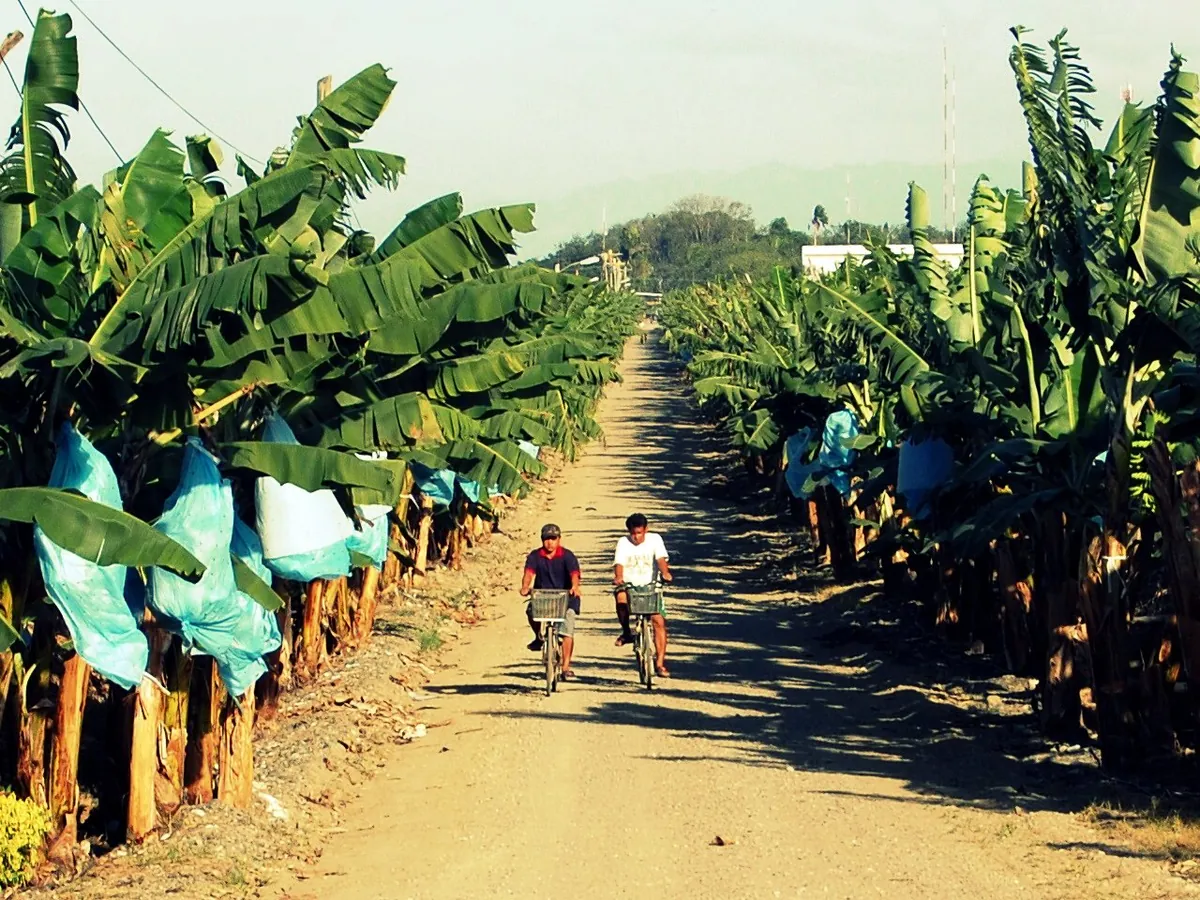
Mindanao grows most of the country's bananas. In the third quarter of 2017, Davao Region had 38.6 percent of national production, followed by Northern Mindanao at 21.5 percent and SOCCSKSARGEN at 12.2 percent. Cavendish made up 51.7 percent of all bananas, saba 28.0 percent and lakatan 10.5 percent.
But banana farming in the Philippines is not only for plantations. Saba and lakatan grow well on small farms, under coconuts and along farm boundaries.
Banana farming, Philippines style, runs on two scales: export Cavendish plantations in Mindanao, and Lakatan, Latundan and Saba grown on small farms across the islands.
Banana farming in the Philippines starts with the variety
| Variety | Main use | Bunch | Weeks from shooting to harvest |
|---|---|---|---|
| Cavendish | Export and supermarket dessert banana | 7 to 14 hands, up to 60 kg | 13 to 15 |
| Lakatan | Premium local dessert banana, orange pulp | 10 to 12 hands | 12 to 14 |
| Latundan | Table banana, white pulp | 5 to 9 hands | 9 to 11 |
| Saba or cardaba | Cooking, turon, banana cue and chips | 10 to 16 hands | 20 to 24 |
Choose by market. Cavendish needs packing houses and buyers who export, so it suits contract growers. Lakatan is the premium dessert banana in local markets. Saba is the hardy one. It resists the major leaf diseases, but it is prone to bugtok.
Planting material and spacing
Start clean, because most banana diseases arrive with the planting material. Use disease free tissue culture plantlets or sword leaf suckers. For saba, use suckers 3 to 4 feet tall from healthy clumps. Their roots should be free of nematode knots and borer damage.
Dig holes 50 to 60 cm across and 60 to 80 cm deep. Where your area has a clear dry season, plant when the rains begin. Lay out the rows east to west so every row gets even sunlight. Avoid spots hit often by strong winds, because banana plants are sensitive to them and need windbreaks where storms are common.
| Variety | Spacing | Mats or suckers per hectare |
|---|---|---|
| Lakatan, close | 2.0 m by 2.5 m | 2,000 |
| Lakatan, wide | 3.0 m by 3.0 m | 1,111 |
| Saba, common | 4 m by 4 m | 625 |
| Cardaba, wide | 5 m by 7 m | 286 |
After the first harvest, remove the excess suckers. That keeps the plant population right and stops the mother and her suckers from fighting for water and food.
Fertilizer for bananas: potash comes first
Bananas take out far more potassium than any other nutrient. A field that yields 30 tons per hectare removes 175 to 225 kg of potassium (as K2O), but only 50 to 75 kg of nitrogen and 15 to 20 kg of phosphorus. That is why the key input is a fertilizer with high potassium.
The usual choice is muriate of potash, 0 0 60, the most common potash fertilizer in farm stores. Without a soil test, the general rate is 90 30 120 of nitrogen, phosphorus and potassium, so potassium gets the biggest share. Monthly application gives the crop steady nutrition. Apply on moist soil, and on the uphill side of the plant in rolling areas.
For one hectare of saba in its first year, mix 3.5 bags of complete fertilizer (14 14 14), 3 bags of urea and 10 bags of muriate of potash. Apply 440 grams of the mix per hill every 4 months, and double the rate from the second year. Read more about potash fertilizer.
Bananas under coconut
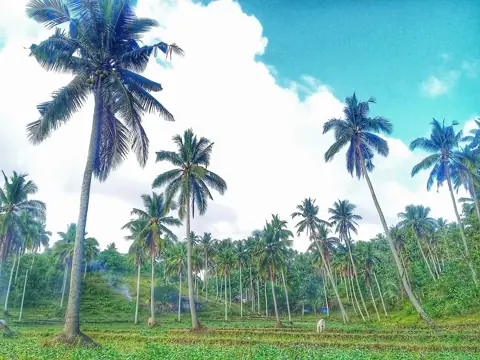
Bananas make a good intercrop under coconuts one to three years old, and under old palms of 25 years and above. Space lakatan and latundan at 3 by 3 meters and saba at 5 by 5 meters. The coconut palms get their own fertilizer for coconut, ammonium sulfate and salt, on a schedule separate from the bananas. See our coconut fertilizer guide for those rates.
Fusarium wilt TR4, or Panama disease
A soil fungus, Fusarium oxysporum f. sp. cubense, causes Fusarium wilt. Researchers have found its Tropical Race 4 strain, TR4, in Mindanao since 2009. A 2019 study found it on about 15,500 hectares in Davao Region by 2015, 32 percent of the Cavendish area there. The wilt also strikes latundan, lakatan and pitogo.
Watch for these signs: dead leaves hanging down the trunk like a skirt, a dying heart leaf, and a pseudostem split near the ground. Cut the corm and you see yellow, red or brown streaks in the vascular strands.
There is no cure. No fungicide controls TR4, and the fungus survives more than 30 years in the soil. It spreads through infected suckers, soil, surface water and farm tools. So prevention is everything. Read our full page on Fusarium wilt.
- Plant only disease free tissue culture plantlets, and follow quarantine rules on moving planting material.
- Put foot baths with disinfectant at the farm gate and tire dips at vehicle entrances.
- Clean every tool and machine that comes from another farm.
- If you suspect TR4, call your DA or municipal agriculture office right away.
- Remove the sick plant and the mats within 2.5 meters of it within 24 hours of confirmation, then burn them with rice hull.
- Fence the spot, fallow it for 6 months, and replant with clean, preferably tolerant, plantlets.
Research is moving. Two Cavendish somaclones, GCTCV 218 and GCTCV 219, did well against TR4 in Mindanao trials. GCTCV 219 was highly resistant but formed poor hands, while GCTCV 218 gave better bunches. The DA also formed a Task Force Fusarium with banana companies and local governments.
Sigatoka, bunchy top and bugtok
Sigatoka
Sigatoka (Mycosphaerella musicola) and the stronger black leaf streak (Mycosphaerella fijiensis) start as small streaks on the third or fourth leaf. Later they kill whole leaves. Remove diseased leaves, drain waterlogged spots and feed the plant well. If you need to spray, use a contact or systemic fungicide every 10 to 15 days, covering the rolled candle leaf and the leaves that have opened. Use only a product registered with the FPA for banana, and follow its label for rate and interval. Keep 8 to 15 working leaves per plant.
Bunchy top
Banana bunchy top is a virus spread by the banana aphid, Pentalonia nigronervosa. Early signs are dark green dashes at the base of new leaves. Later the leaves bunch into a rosette at the top and the plant stops growing. There is no cure. First spray the aphids on plants within 6 meters, then dig out and chop the sick plant. Replant with clean material 3 to 5 days later. See our page on aphids.
Bugtok
Bugtok is a bacterial disease of saba and cardaba that browns the flower and leaves the fruit hard and discolored inside. Control it with clean mats, early removal of the male bud, and bagging the bunch.
Harvest
Count the weeks from shooting, when the bunch comes out, using the table above. The fingers also turn from angular to rounded as they fill. Chip makers want saba green mature, at least 118 to 125 days after the male bud comes off.
Harvest with two people. One cuts the pseudostem partway so the bunch comes down slowly, while the other catches it on his shoulder. Then leave 2 to 3 meters of the trunk standing to feed the growing suckers.
Banana is one of the 85 crops in anee.io, so banana farming in the Philippines fits right in. Log each block as a lot and schedule the monthly fertilizer and Sigatoka sprays. On the paid plans, you can also pay the harvest crew by day and record buyers and prices in your reports.
See the cropping calendarNot sure if the yellow leaves are Sigatoka, wilt or hunger? Send a photo to Anee, the anee.io smart farm technician. Anee answers in Tagalog or English after reading your lot's stage and the weather. On the paid plans, the farm reports cover labor and sales and show profit per season.