Fusarium Wilt: Panama Disease in Banana and Wilt in Tomato
Fusarium wilt is a soil fungus disease that plugs a plant's water pipes from the inside. In banana, farmers know it as Panama disease, and its Tropical Race 4 strain has hit Cavendish farms in Mindanao. In tomato it shows up as plants that yellow and wilt on one side. Once a plant has fusarium wilt, nothing cures it, so the work is to spot it early and keep it off your farm.
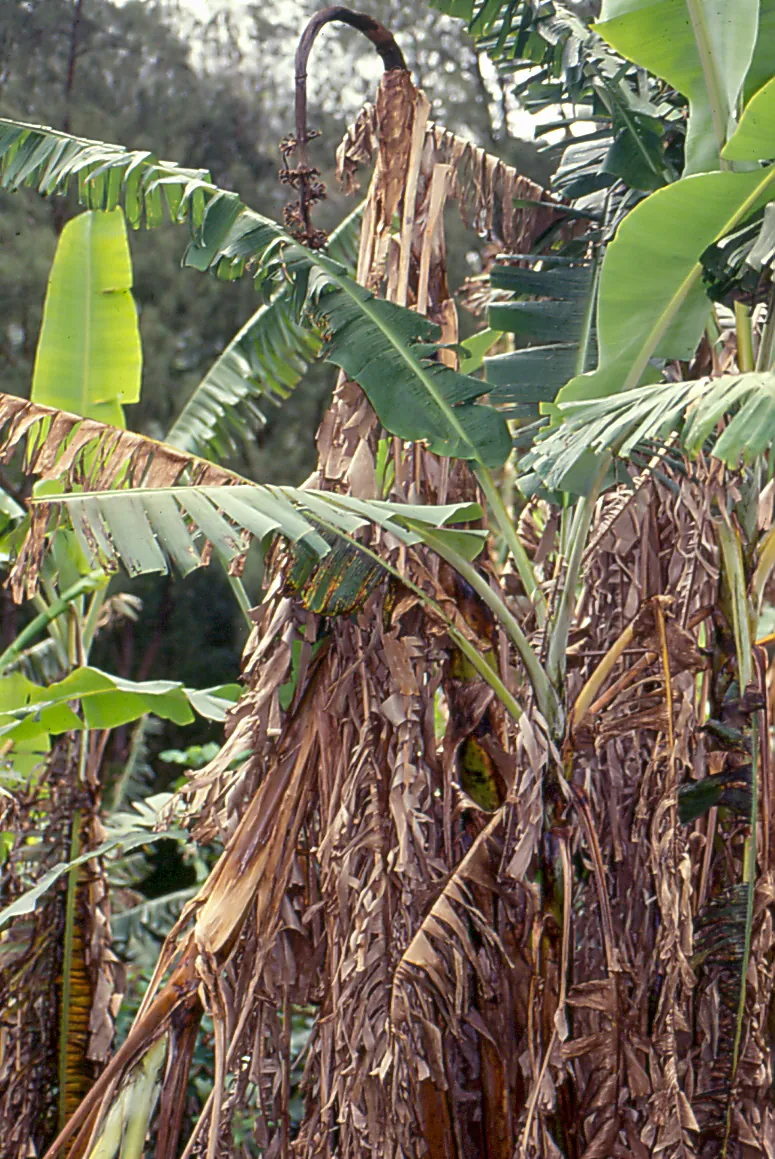
People suspected Tropical Race 4, or TR4, in the country as early as the 1970s, but researchers confirmed it in Philippine Cavendish only in 2008. Cases on the farms they surveyed rose from 700 in 2005 to 15,000 in 2007. In 2012, TR4 ravaged 635 hectares of banana plantation in Davao and threatened Bukidnon, North Cotabato and Agusan del Sur.
Tomato growers face their own form of the same fungus. The disease moves with soil, water and planting material, so a farm that controls those three has a real chance of keeping it out.
What causes fusarium wilt
Fusarium oxysporum lives in the soil. It enters through the roots, grows into the xylem, the pipes that carry water up the plant, and blocks them. So the plant wilts even when the soil is wet.
The fungus comes in forms that each attack a narrow range of crops. Fusarium oxysporum f. sp. cubense, or Foc, attacks banana. Fusarium oxysporum f. sp. lycopersici attacks tomato. The banana form is not the one that wilts tomatoes, but both forms behave the same way in the soil.
What makes it worse is how long it lasts. The fungus forms thick walled resting spores that can survive in soil for more than 20 years.
Fusarium wilt of banana, or Panama disease
Look at the oldest leaves first. These are the signs of Panama disease:
- Yellowing that starts at the edges of the older leaves and moves to the younger ones. At first it can look like potassium deficiency.
- Leaves that bend at the leaf stalk and hang down around the trunk like a skirt.
- A pseudostem, the soft trunk, that splits lengthwise near the base.
- New leaves that come out pale, small and crumpled.
- Inside the corm or pseudostem, yellow, red or brown strands where the water tubes run.
- No symptoms on the fruit itself.
A sick plant rarely recovers. The mother plant often sends up many infected suckers before it dies, and those suckers can look healthy for months. That is how planting material carries the disease from farm to farm.
Panama disease or Moko?
Moko, a bacterial wilt, also kills bananas here, and the two get mixed up. Fusarium wilt yellows the old leaves first, spares the young buds, leaves no ooze on a cut surface and does not touch the fruit. Moko often starts on the younger leaves, can kill young shoots, leaks bacterial ooze from cut surfaces and rots the fruit inside.
Fusarium wilt of tomato and other vegetables
In tomato, the lower leaves turn yellow first, often on one branch or one side of the plant. The plant droops in the midday heat, and later it stays wilted. Cut the stem near the soil line and you will see dark brown streaks running up inside.
Tomato has three known races of the fungus. Seed companies breed varieties that resist one, two or all three, and the seed packet or catalog lists the resistance. Ask your seed supplier which resistant varieties grow well in your area. Watermelon and other crops have their own forms of the fungus, and the same rules apply.
Fusarium wilt or bacterial wilt?
Bacterial wilt also attacks tomato and eggplant, and it often wilts the whole plant fast while the leaves stay green. Try the water test. Cut a piece of stem about as long as your finger, low down on a wilting plant, and hang it in a clear glass of water. If milky threads stream out within a few minutes, it is bacterial wilt. If nothing comes out and the inside of the stem is brown, suspect fusarium wilt.
How fusarium wilt spreads
- Planting material. Suckers, corms and seedlings from a sick farm are the fastest way to carry the fungus to new land.
- Soil. Mud on boots, hoes, bolos, tractor tires and the roots of transplants.
- Water. Runoff, floods and irrigation canals that pass through infested blocks.
- Feet and hooves. Anyone, or any carabao, that walks from a sick block to a clean one with mud on them.
Quarantine and sanitation: keep the fungus out
Plant clean
Use tissue culture banana plantlets from a trusted, accredited lab or nursery instead of suckers from another farm. For tomato, raise seedlings in clean media or buy them from a clean nursery.
Scrape first, then disinfect
Scrape mud off boots and tools before they go into a foot bath. A study on Davao farms found that soil weakens disinfectants, and that fusarium built up in foot bath water as the day went on. The project behind that study suggests low cost boot scrapers made of wire mesh. Change the foot bath liquid often and follow the product label for the mix.
Isolate a sick plant
Do not cut a sick banana and drag it across the field. Mark the spot, keep people and animals out, and ask your municipal agriculturist or the BPI regional office how to destroy it where it stands. Many growers inject such plants with herbicide so they dry and die in place.
Keep the water apart
Stop drainage from a sick block from running into clean blocks. Also avoid irrigating with water that has passed through infested fields.
Report a suspect case
If you see Cavendish wilting in an area without TR4, report it to the DA or BPI so a lab can confirm it. Early action keeps one sick mat from becoming a sick block.
Philippine researchers note that there is no proven chemical control for fusarium wilt of banana, and an infected plant rarely recovers. Be wary of any product sold as a cure. Spend the money on clean planting material and resistant varieties instead. Our fungicides guide covers the diseases where sprays do work, such as anthracnose.
Resistant varieties are the best defense
Because nothing cures the disease, the lasting answer is a variety the fungus cannot kill. For Cavendish, breeders in Taiwan selected Giant Cavendish tissue culture variants, called GCTCV, that hold up against TR4. Seven of them went through trials in Mindanao.
Farmer cooperators preferred GCTCV 218 and GCTCV 219. GCTCV 218 had a sturdy pseudostem, even hands and bunches comparable to Grand Nain, while GCTCV 219 proved highly resistant to TR4. A project in Davao del Norte found GCTCV 218 the only way smallholders with TR4 could keep growing bananas. The project also helped set up tissue culture labs to supply them. The Mindanao program, for its part, worked out biological control and soil amendment steps to use alongside these plants.
Resistant does not mean immune. How well these varieties hold up depends on the farm, its soil management, soil acidity and how much fungus is already in the soil. GCTCV 219 also gave malformed fingers in the same study. So keep every sanitation step even with the new plants. For tomato, pick a variety whose seed packet lists resistance to Fusarium. For the full crop guide, read our page on banana farming in the Philippines, and for vegetables see pagtatanim ng gulay.
How anee.io helps you watch for fusarium wilt
The disease spreads quietly, so a good record is half the fight. In anee.io, each lot has its own map, so you can draw the infested block on your farm map and keep workers from walking through it.
When a plant yellows, take a photo and ask Anee, the smart farm technician. Anee can look at a picture of a yellowing banana or a wilting tomato and walk you through the checks on this page in Tagalog or English. You can also put 'clean boots at the foot bath' on the cropping calendar as a daily task, so it shows up in the 6 AM morning email with the rest of the day's plan.
Sign up for anee.io, map your lots, and show Anee a photo the day you see a plant wilt. You get answers in Tagalog or English, and a record you can use next season.
Sign up for anee.ioFusarium wilt questions farmers ask
Is there a fungicide that cures fusarium wilt?
Is Panama disease the same as fusarium wilt?
Can I replant banana where Panama disease killed my plants?
How do I tell fusarium wilt from bacterial wilt in tomato?
Does Panama disease damage the banana fruit?
Stop the spread of Fusarium Wilt
With Libre + Anee, read the whole guide: how to tell it from look alikes, what makes it spread, and what to spray and when.
The account is free, no credit card.