Banana Aphid: The Small Insect That Carries Bunchy Top
The banana aphid, Pentalonia nigronervosa, is a tiny dark insect that lives in colonies on banana and abaca. Its feeding is bad enough, but the real danger is the virus it carries. This page shows how to spot it and how to cut its numbers.
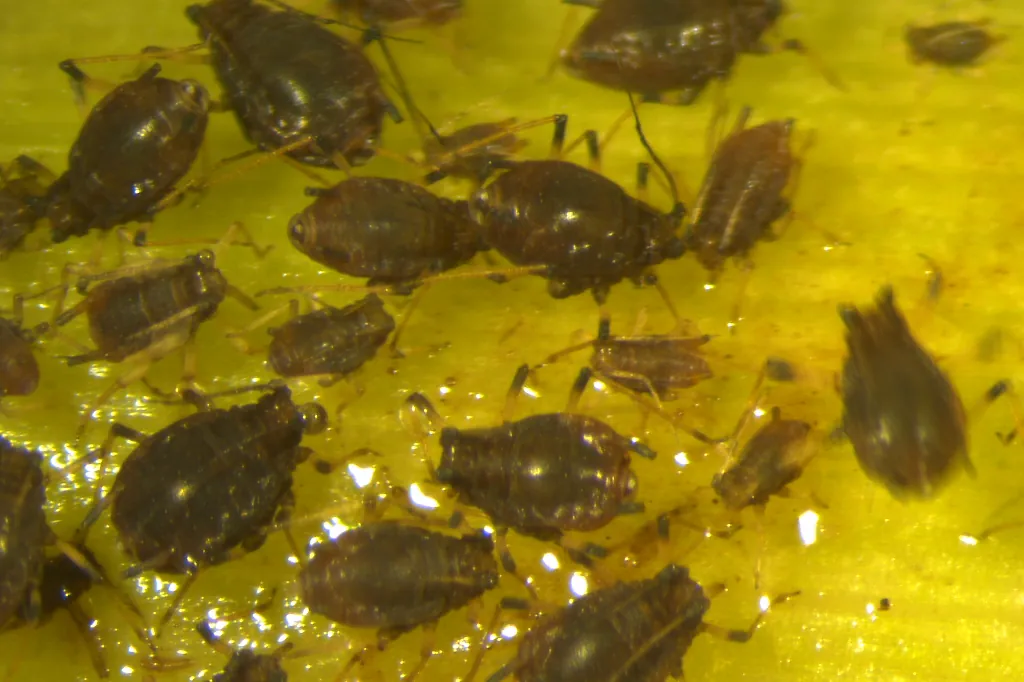
What Is Banana Aphid?
The banana aphid is shiny red brown to almost black, and an adult is up to 1.5 mm long. Most adults have no wings. The colonies sit on the underside of leaves, on leaf sheaths, on fruit and near the soil.
Banana and other Musa plants are the main hosts. It also lives on heliconia, canna, ginger, taro and related plants. In the Philippines, researchers found it in every banana plantation they visited, and it spreads bunchy top in abaca too. So it is the vector, the insect that carries a disease, that makes it a serious pest.
| Fact | Details |
|---|---|
| Name | Banana aphid |
| Scientific name | Pentalonia nigronervosa |
| Kind | Insect |
| Crops it attacks | Banana and abaca |
| Local names | None recorded |
| Where it strikes | Leaves and the whole plant |
| When it strikes | It is most abundant in the wet season, and it prefers young growth such as new suckers and the heart of the plant. |
| Life cycle | Females give birth to live young without mating, two to four each day. A winged adult appears after 7 to 10 generations and starts new colonies. |
How to Identify Banana Aphid
Part the leaf sheaths at the heart of the plant, and check the leaf undersides near the midrib. You will see dark, soft bodied insects in clusters. Plants with aphids may show stunted, yellowing leaves with pale margins, and upright leaves bunched together. Short dark and light streaks along the veins, like dots and dashes, and veins that hook downward, point to the disease they carry.
- Dark red brown aphids sit in colonies on leaf undersides, sheaths and young suckers.
- Leaves turn yellow with pale margins and the plant looks stunted.
- Leaves stand upright and bunch up in the throat of the plant.
- Dark and light dots and dashes appear along the veins on the underside.
- Colonies also sit on fruit and near the soil at the base of the plant.
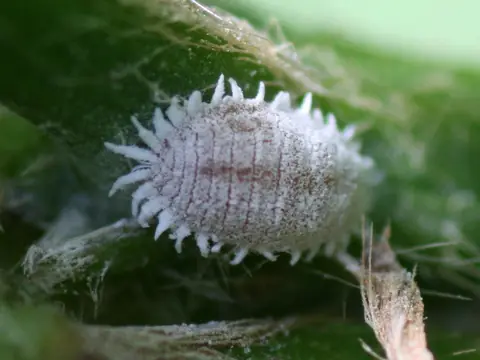
Banana aphids are small and dark. They are not mealybugs, which are covered in white wax. Yellow and stunted plants can also come from weak soil, so look for the aphids and for the dots and dashes on the veins.
How Banana Aphid Hurts Your Crop
Aphids damage the plant by taking sap, by leaving honeydew that grows sooty mold, and by spreading viruses. The aphid picks up banana bunchy top virus after about 18 hours of feeding on an infected plant and keeps it for 15 to 20 days. Nymphs spread the virus best, and winged adults start new infections in new fields.
A plant with the virus ends up with a bunched top and bears no fruit. Read the page on banana bunchy top for the disease itself. There is no cure for the virus, so keeping the aphid down and removing sick plants is how you protect the farm.
How to Control Banana Aphid
- Remove and destroy plants that show bunchy top. A sick plant is a source for new infections.
- Control weeds and remove other host plants, such as heliconia and canna, around the banana.
- Prune unwanted suckers, because the aphids prefer young growth.
- Plant clean, disease free material, such as tissue cultured plants.
- Protect natural enemies. Ladybird beetles, braconid wasps, lacewings and syrphid fly larvae eat the aphids, and a Philippine study found 28 spider species on infested plants.
- Use soaps, horticultural oils or plant based sprays on small colonies before you think of anything stronger.
When a Spray Makes Sense
Gentle options come first. The Pacific fact sheet lists derris, pyrethrum, soaps and horticultural oils, and synthetic pyrethroids as well. Strong sprays also kill the natural enemies, so use them only when needed. Follow the label and the FPA registration.
| Active ingredient | IRAC group | On Philippine labels |
|---|---|---|
| Imidacloprid | IRAC 4A | A sound second choice. 5 registered products name it on banana. |
| Potassium salts of fatty acids | Not grouped | A sound second choice. 2 registered products name it on banana. |
| Beauveria bassiana | IRAC UNF | A sound second choice. 1 registered product names it on banana. |
| Clothianidin | IRAC 4A | A sound second choice. 1 registered product names it on banana. |
| Mineral oil | Not grouped | A sound second choice. 1 registered product names it on banana. |
| Malathion | IRAC 1B | Older or broad chemistry: a last resort. 40 registered products name it on banana. |
| Chlorpyrifos | IRAC 1B | Older or broad chemistry: a last resort. 15 registered products name it on banana. |
| Fenitrothion | IRAC 1B | Older or broad chemistry: a last resort. 4 registered products name it on banana. |
| Bifenthrin | IRAC 3A | Older or broad chemistry: a last resort. 1 registered product names it on banana. |
| Lambda cyhalothrin | IRAC 3A | Older or broad chemistry: a last resort. 1 registered product names it on banana. |
These are on Philippine labels for it, but we leave them off the list above, for the reasons below.
- Buprofezin: Does not work on aphids. It is made for hoppers, whiteflies and mealybugs.
- Bifenthrin plus buprofezin: A treated bunch bag. Banana aphids live on the plant base and suckers, so the bag does not reach them.
- Deltamethrin: Banned on banana.
Use only products registered with the Fertilizer and Pesticide Authority, and follow the label for the rate, the timing and the protective clothing. Switch to a different insecticide group next time, so the pest does not learn to survive it. Our guide to integrated pest management explains how.
Keep It Out Next Season
- Plant only clean, virus free planting material such as tissue cultured plantlets from a trusted nursery.
- Kill the aphids on a bunchy top plant first, then kill the plant and its suckers and chop it where it stands.
- Never move suckers out of a field or town with bunchy top.
- Clear volunteer bananas, heliconia and canna near the farm. They shelter the aphids.
- Desucker often. Aphids crowd on young suckers and new growth.
- Check every 2 weeks and rogue sick plants at once, together with the neighbors, since the aphids fly between farms.
Natural Enemies and Biological Help
- Lady beetles, lacewings, hoverfly larvae, small wasps and many spiders feed on banana aphids. Avoid broad sprays.
- Ants tend the aphids at the plant base. Keeping ants down lets the predators work.
- Beauveria bassiana and Lecanicillium infect aphid colonies in humid weather.
Not Sure What You Are Seeing?
Take a clear photo of the insect, the damage and the whole plant, then ask Anee, the smart farm technician in anee.io, in Tagalog or English. Anee tells you what it most likely is and what to do at the age of your crop. You can also put your scouting days on the cropping calendar, so the team knows when to walk the field.
anee.io keeps your scouting, spraying and harvest on one calendar, and Anee answers when something looks wrong.
- Scouting days dated from each lot's own planting day
- Photos and notes for every lot
- Anee, the smart farm technician, in Tagalog or English
Questions Farmers Ask About Banana Aphid
How long does the aphid take to pick up the virus?
When are banana aphids most common?
Can I cure a plant with bunchy top?
Stop Banana Aphid from costing you the harvest
With Libre + Anee, read the whole guide: how to be sure it is this pest, when it pays to act, and what to spray, by active ingredient.
The account is free, no credit card.