Peanut Nutrient Deficiency: Signs, Causes and the Fertilizer That Fixes It
Peanut nutrient deficiency is one of the first things to check when the leaves of your mani (peanut) turn yellow, purple or burnt at the edges. On Philippine farms the usual ones are calcium, nitrogen, potassium, boron, sulfur, iron, zinc, manganese and molybdenum. This guide shows where each one starts, how to be sure, and the fertilizer that fixes it.
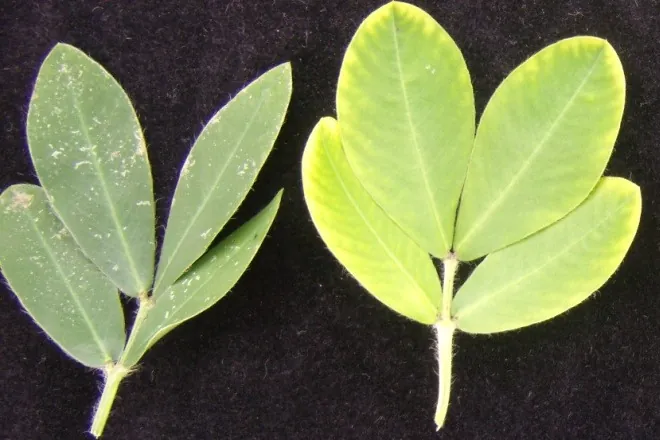
Start with one question: did the change begin on the old leaves or on the young ones? Nitrogen, potassium and molybdenum move inside the plant, so a shortage shows on the old, lower leaves first. But calcium, boron, sulfur, iron, zinc and manganese stay where the plant first put them, so the young leaves and the growing tip show it first. After that, the color and the pattern narrow down which peanut nutrient deficiency you have, and a soil test confirms it. Each one below has its signs, its causes and its fix.
Peanut nutrient deficiency signs, old leaves and young leaves
Shows first on the old leaves
| Nutrient | Where it starts | What you see | Fix with |
|---|---|---|---|
| Nitrogen | old, lower leaves, the whole plant | Pale yellow, stunted plants, sometimes with reddish stems, and few nodules on the roots. | Rhizobium inoculant for peanut, Urea 46 0 0 |
| Potassium | old, lower leaves, leaf edges and tips | Lower leaves pale slightly between the veins, then the leaf edges turn yellow and dry. | Muriate of potash 0 0 60 |
| Molybdenum | old, lower leaves, the whole plant | Pale yellow plants that look short of nitrogen on acid soil, with small nodules that are white or green inside. | Sodium molybdate, Agricultural lime |
Shows first on the young leaves
| Nutrient | Where it starts | What you see | Fix with |
|---|---|---|---|
| Calcium | fruit, grain or tubers | The plants look fine, but many pods are empty (pops) or the kernels are shrunken and dark. | Gypsum, Agricultural lime |
| Boron | young leaves and the tip, fruit, grain or tubers | Young leaves stay small in a rosette, and kernels have a hollow, dark heart. | Borax, Gypsum |
| Sulfur | the whole plant, young leaves and the tip | The whole plant is evenly light green, thin stemmed and spindly. | Gypsum |
| Iron | young leaves and the tip, between the veins | Young leaves suddenly turn yellow between green veins and stay small, on limey soil. | Ferrous sulfate |
| Zinc | young leaves and the tip, between the veins | Light yellow stripes along the veins of the leaves, and the bud at the top stops growing. | Zinc sulfate |
| Manganese | young leaves and the tip, between the veins | Leaves pale between the veins and plants stay short, often after heavy liming. | Manganese sulfate |
Before you buy fertilizer for a peanut nutrient deficiency
So use the table to pick the likeliest peanut nutrient deficiency, then read its section below. Also keep in mind that dry soil, standing water, cold nights, a pest or a disease can look the same. That is why it pays to check the roots and the whole field first.
Calcium deficiency in peanut
Leaves rarely show it. Pods form but stay empty (pops), kernels are shrunken or misshapen with a dark germ, and more pods rot. Seed from such pods sprouts poorly. In bad cases the buds at branch tips blacken and the leaves there are small and twisted. You see it most at this stage: pegging and pod filling, about 20 to 80 days after the pegs enter the soil.
Why calcium deficiency happens in mani
Pods take calcium straight from the soil around them, not through the roots. So a dry or calcium poor pegging zone causes it. Acid sandy soil, heavy potash and dry spells at pod fill make it worse.
How to tell it apart
Boron deficiency gives hollow, discolored hearts in the kernels and stubby branches. Drought and poor pollination also leave empty pods. To be sure, crack open pods from a test row: many pops point to calcium. Test the top 8 cm of soil next to the row soon after emergence. A soil test for calcium and pH, and a leaf test, confirm it.
What to apply for calcium deficiency
Spread Gypsum over the rows at early flowering, 30 to 45 days after planting. Give 200 kg gypsum per hectare at 45 days. Give about 1,100 kg per hectare for seed crops and on soils that test low. Gypsum after 100 days is too late.
- Gypsum
- Agricultural lime
- Dolomite
Sold here with calcium: Planters Products Lifelime (36.2 percent calcium), Dolomite by A6 Agrisource (24 percent calcium and 11 percent magnesium), Calcipro by Ramgo (15.5 0 0 with 18.8 percent calcium) and Philphos Gypsum (22.2 percent calcium and 17.4 percent sulfur). Check the FPA registration on the bag and follow the label rate. For the how and when, see our guide to fertilizer for tomatoes, and the page on calcium deficiency in every crop. In anee.io, Anee, the smart farm technician, reads a photo of the leaf and tells you which nutrient is short.
To keep it away, lime soils below pH 5.8 a few months before planting to reach pH 6.2 to 6.5. Do not plow deep after liming. Keep the soil moist during pod fill.
Nitrogen deficiency in peanut
Leaves turn pale yellow and plants stay short. Stems may turn reddish. Peanut makes its own nitrogen through root nodules, so pale plants usually mean the nodules failed. Yellow rows next to green rows often mark a missed inoculant row. You see it most at this stage: five to six weeks after planting, when nodules should be well formed.
Why nitrogen deficiency happens in mani
In a legume this usually means poor nodulation: no inoculant in a field new to the crop, inoculant killed by sun or heat, very acid soil, waterlogging, hot dry soil, or too much nitrogen fertilizer near the seed, which stops nodules from forming.
How to tell it apart
Sulfur deficiency also gives evenly pale plants. Check the nodules first. To be sure, dig, do not pull, a few plants 3 to 6 weeks after planting, wash the roots and cut some nodules open. Pink to red inside means they are working, white means not active yet, and brown, grey or mushy means dead. Yellow plants with few or dead nodules point to a nodulation failure, not a lack of fertilizer.
What to apply for nitrogen deficiency
Feed the crop, since new nodules cannot be added now. Give a 1 to 2 percent urea spray (10 to 20 g per liter, 160 to 320 g in a 16 liter sprayer) every 15 days. A light sidedress of Urea 46 0 0 also helps when nodules are poor. If the nodules failed, 10 to 20 kg of nitrogen per hectare is enough: about half a bag of Urea 46 0 0 beside the rows, before flowering.
- Rhizobium inoculant for peanut
- Urea 46 0 0
Sold here with nitrogen: Atlas Granular Urea (46 0 0) by Atlas Fertilizer, Crown Champion Ammonium Sulfate by Aqua Hydroponic Prime Ventures (21 0 0 with 24 percent sulfur), Agripower 46 0 0 (Locally Blended) Coated by Green Acres Agri Tech and Calcipro by Ramgo (15.5 0 0 with 18.8 percent calcium). Check the FPA registration on the bag and follow the label rate. For the how and when, see our guide to urea fertilizer, and the page on nitrogen deficiency in every crop.
To keep it away, inoculate seed with a peanut Rhizobium inoculant at planting, keep it out of the sun, and avoid heavy nitrogen near the seed. Let a soil test and the crop's color set the season's nitrogen. Keep organic matter up with compost, manure or crop residues.
Potassium deficiency in peanut
Older leaves first show a slight yellowing between the veins, then the edges of the leaflets turn yellow and later brown and dry. It starts on the lowest leaves and climbs the plant as pods fill. You see it most at this stage: mid growth to pod filling.
Why potassium deficiency happens in mani
Sandy soils and soils cropped for years without potash. Note that too much potash in the pegging zone blocks calcium from reaching the pods.
How to tell it apart
Magnesium deficiency also yellows between the veins of old leaves, but without the scorched edges. To be sure, soil test for potassium. Keep the calcium to potassium balance in mind.
What to apply for potassium deficiency
Give a 1 to 2 percent potassium chloride spray (10 to 20 g Muriate of potash per liter) every 15 days. Give soil potash only as the soil test advises, because too much crowds calcium out of the pods. A usual dose is 1 bag of Muriate of potash 0 0 60 per hectare at planting.
- Muriate of potash 0 0 60
Sold here with potassium: Atlas Muriate of Potash (MOP) by Atlas Fertilizer (0 0 60), Simplot Sulfate 0 0 50 by Nutranta, Potassium Nitrate by Parafield (13 0 46) and Qrop Mix Production 14 0 23 plus 13 Cao by Farmtech Agriland (14 0 23 with 9.3 percent calcium). Check the FPA registration on the bag and follow the label rate. For the how and when, see our guide to potash fertilizer, and the page on potassium deficiency in every crop.
To keep it away, balance potash with gypsum or lime so pods still get enough calcium. Keep organic matter up with compost, manure or crop residues. Split the potash on sandy soil.
Boron deficiency in peanut
Growth of young leaves is held back, giving a rosette look, with small leaves and stubby branches. Stems may split. Pods form poorly and many are pops, and kernels show a hollow, discolored heart. You see it most at this stage: flowering to pod filling.
Why boron deficiency happens in mani
Sandy soils low in organic matter, high pH soils and drought.
How to tell it apart
Calcium deficiency also gives pops, but kernels are shrunken with a dark germ rather than hollow. Check both in a soil test. To be sure, split kernels to look for the hollow heart. Test soil and leaves for boron. A soil test for boron and a leaf test confirm it.
What to apply for boron deficiency
Give 10 kg Borax per hectare together with 200 kg Gypsum per hectare at 45 days after sowing. Spread it evenly and never more, because too much boron burns the crop.
- Borax
- Gypsum
Sold here with boron: Etifert 11 (Borax Decahydrate) by Zetryl Chem (11 percent boron), Fertibagra 15G by Unilox Far East Resources (14.6 percent boron), B17 (Boric Acid) by Newman Chemicals (17 percent boron) and Better Yield by Bacphil Planters Fertilizer (0 0 0.9 with 10 percent boron). Check the FPA registration on the bag and follow the label rate. For the how and when, see our guide to foliar fertilizer, and the page on boron deficiency in every crop.
To keep it away, test for boron on sandy soils before planting peanut. Test the soil every two or three years. Keep organic matter up with compost, manure or crop residues.
Sulfur deficiency in peanut
Plants look light green all over, young leaves included, rather than yellowing from the bottom up. They stay short and thin stemmed and look spindly. You see it most at this stage: early growth to flowering.
Why sulfur deficiency happens in mani
Sandy soils low in organic matter and fields fed for years with sulfur free fertilizer. Legumes need more sulfur than cereals.
How to tell it apart
Nitrogen deficiency also gives pale plants. Check the nodules and whether the old leaves yellowed first. To be sure, soil and leaf test for sulfur. In a soil test, less than 10 ppm of sulfate sulfur is low.
What to apply for sulfur deficiency
Give 200 kg Gypsum per hectare to the soil, which also feeds the pods calcium. Give it at planting or with the first side dress.
- Gypsum
Sold here with sulfur: Crown Champion Ammonium Sulfate by Aqua Hydroponic Prime Ventures (21 0 0 with 24 percent sulfur), Philphos Gypsum (22.2 percent calcium and 17.4 percent sulfur), Harvester Sulphate of Potash by Universal Harvester (0 0 50 with 17.5 percent sulfur) and Agsmart Kieserite Granule (20 percent sulfur and 16.3 percent magnesium). Check the FPA registration on the bag and follow the label rate. For the how and when, see our guide to ammonium sulfate fertilizer, and the page on sulfur deficiency in every crop.
To keep it away, gypsum at flowering covers both sulfur and calcium needs. Test the soil every two or three years. Keep organic matter up with compost, manure or crop residues.
Iron deficiency in peanut

Young leaves come out small and suddenly turn yellow between the veins. Growth of both tops and roots slows and plants are stunted. You see it most at this stage: early growth.
Why iron deficiency happens in mani
High pH soils with free lime, and wet or poorly aerated soils.
How to tell it apart
Manganese deficiency also yellows between the veins but is usually milder. Sulfur deficiency yellows the whole leaf evenly. To be sure, soil pH test and a young leaf test. In a soil test, less than 4.5 ppm of iron is low.
What to apply for iron deficiency
Give a 1 percent ferrous sulfate spray (10 g per liter, 160 g in a 16 liter sprayer) at 30, 40 and 50 days after sowing.
- Ferrous sulfate
Sold here with iron: DDDD Planter's Choice Ferrous Sulphate Heptahydrate by Modern Time (19 percent iron), Ferrous Sulfate Monohydrate by Zetryl Chem (30 percent iron), Ferrous Sulphate Monohydrate by Newman Chemicals (30 percent iron) and Liquid Chelate Iron with Sulfur by Sagrex (5 percent iron and 3 percent sulfur). Check the FPA registration on the bag and follow the label rate. For the how and when, see our guide to foliar fertilizer, and the page on iron deficiency in every crop.
To keep it away, avoid over liming, and add compost to limey fields. Test the soil every two or three years.
Zinc deficiency in peanut
Leaves show light yellow stripes along the veins. In severe cases the yellowing spreads between the veins and the growing bud at the top stops. Older leaves may pale slightly. You see it most at this stage: early growth.
Why zinc deficiency happens in mani
High pH and calcareous soils and heavy phosphorus fertilizer on zinc poor soils.
How to tell it apart
Iron deficiency starts on the youngest leaves with green veins and no stripes along the veins. To be sure, soil test for zinc and pH, or a leaf test. In a soil test, less than 0.8 ppm of zinc is low.
What to apply for zinc deficiency
Give 25 kg Zinc sulfate per hectare as a basal dose, or a 1 percent zinc sulfate spray (10 g per liter, 160 g in a 16 liter sprayer) every 15 days.
- Zinc sulfate
Sold here with zinc: Harvester Zinc Sulphate Heptahydrate by Universal Harvester (22 percent zinc), Petbowe Zinc Sulphate Monohydrate (33 percent zinc), Tierramino ZN by Unilox Far East Resources (7 0 0 with 10 percent zinc) and Liquid Chelate Zinc with Sulfur by Sagrex (10 percent zinc and 5 percent sulfur). Check the FPA registration on the bag and follow the label rate. For the how and when, see our guide to fertilizer with zinc, and the page on zinc deficiency in every crop.
To keep it away, add zinc sulfate with the basal fertilizer on high pH soils. Test the soil every two or three years. Do not overdo phosphorus.
Manganese deficiency in peanut
Leaves turn pale yellow between the veins while the veins stay green. Plants stay short and grow unevenly across the field. You see it most at this stage: early to mid growth.
Why manganese deficiency happens in mani
High pH soils, sandy soils that were limed too much, and soils high in organic matter.
How to tell it apart
Iron deficiency gives a stronger yellow on the newest leaves. Magnesium deficiency starts on the older leaves. To be sure, leaf test for manganese and a soil pH test. In a soil test, less than 1 ppm of manganese is low.
What to apply for manganese deficiency
Give a 0.5 percent manganese sulfate spray (5 g per liter, 80 g in a 16 liter sprayer) every 15 days, or 5 to 10 kg manganese sulfate per hectare to the soil.
- Manganese sulfate
Sold here with manganese: Manganese Sulfate by Zetryl Chem (31 percent manganese), Tierramino MN by Unilox Far East Resources (7 0 0 with 12 percent manganese), Multimate by Agway (4 0 0 with 4.5 percent sulfur, 2.8 percent zinc and 1.8 percent manganese) and Nutri Tabble Meta Foliar by NS Northern Organic Fertilizer (12 percent zinc, 9 percent sulfur, 2 percent magnesium and 1.2 percent manganese). Check the FPA registration on the bag and follow the label rate. For the how and when, see our guide to foliar fertilizer, and the page on manganese deficiency in every crop.
To keep it away, do not lime above the target pH of 6.2 to 6.5. Test the soil every two or three years.
Molybdenum deficiency in peanut
The whole plant turns pale green to yellow and stays small, much like a nitrogen shortage, because the nodules cannot fix nitrogen without molybdenum. The edges of old leaves may scorch. Nodules are few and small, and white or green inside instead of pink. You see it most at this stage: three to six weeks after planting, when the plant begins to live on its nodules.
Why molybdenum deficiency happens in mani
Acid soil below pH 5.5, which holds molybdenum fast, and sandy, leached soils. Heavy sulfate fertilizer can hold back its uptake.
How to tell it apart
Nitrogen shortage from nodules that never formed looks the same. Dig a few plants and cut the nodules open: pink inside means they work. To be sure, A soil pH test (below 5.5 is the warning sign) and a test spray of sodium molybdate on a few rows: they green up within one or two weeks. A soil pH test confirms the risk. A test spray of sodium molybdate on a few plants confirms the cause when they green up.
What to apply for molybdenum deficiency
Spray Sodium molybdate at 0.05 to 0.1 percent (8 to 16 grams in a 16 liter sprayer) once or twice on young plants. For the next crop, coat the seed with 2 to 4 grams of sodium molybdate per kilo of seed just before planting, with the Rhizobium inoculant. On acid soil, lime to pH 6 to 6.5. For the next crop, coat the seed with 2 to 4 grams of Sodium molybdate per kilo of seed just before planting.
- Sodium molybdate
- Agricultural lime
- Dolomite
Sold here with molybdenum: Liquid Chelate Molybdenum by Sagrex (5 percent molybdenum), Tierramino Molybdenum by Unilox Far East Resources (16 percent molybdenum) and YaraVita Teprosyn Mo (0 15 0 with 15.3 percent molybdenum). Check the FPA registration on the bag and follow the label rate. For the how and when, see our guide to foliar fertilizer, and the page on molybdenum deficiency in every crop.
To keep it away, lime acid soil to pH 6 to 6.5 with Agricultural lime or Dolomite. Treat the seed with molybdenum on fields that have shown it before. Test the soil every two or three years.
A soil test is the surest check for any peanut nutrient deficiency. Before you buy, ask your Municipal Agriculture Office where to send a soil sample. The DA regional soil laboratories test soil, and the result says how much of each fertilizer your mani needs. That saves money, because extra fertilizer is money lost.
Open the Nutrient Deficiency Finder, pick mani, say where the leaves changed first and what you see, and get the fertilizers sold here that fix it.
- Anee, the smart farm technician, reads a photo of the leaf
- The cropping calendar dates every fertilizer application of your season
Peanut nutrient deficiency questions
Why are my mani leaves turning yellow?
What fertilizer fixes calcium deficiency in peanut?
What fertilizer fixes nitrogen deficiency in peanut?
What fertilizer fixes potassium deficiency in peanut?
How do I know which nutrient my mani lacks?
Find the missing nutrient and fix it
With Libre + Anee, read the whole guide: how to tell the deficiency from look alikes, how to be sure, what to apply, and the fertilizers sold here that supply it.
The account is free, no credit card.