Corn Earworm: How to Spot It and Stop It in Your Mais
The corn earworm, Helicoverpa armigera, is a caterpillar that eats the silks and then the kernels of mais. It also hollows out tomato and bean fruits. Once it is inside the ear it is hard to kill, so the timing of your control matters most.
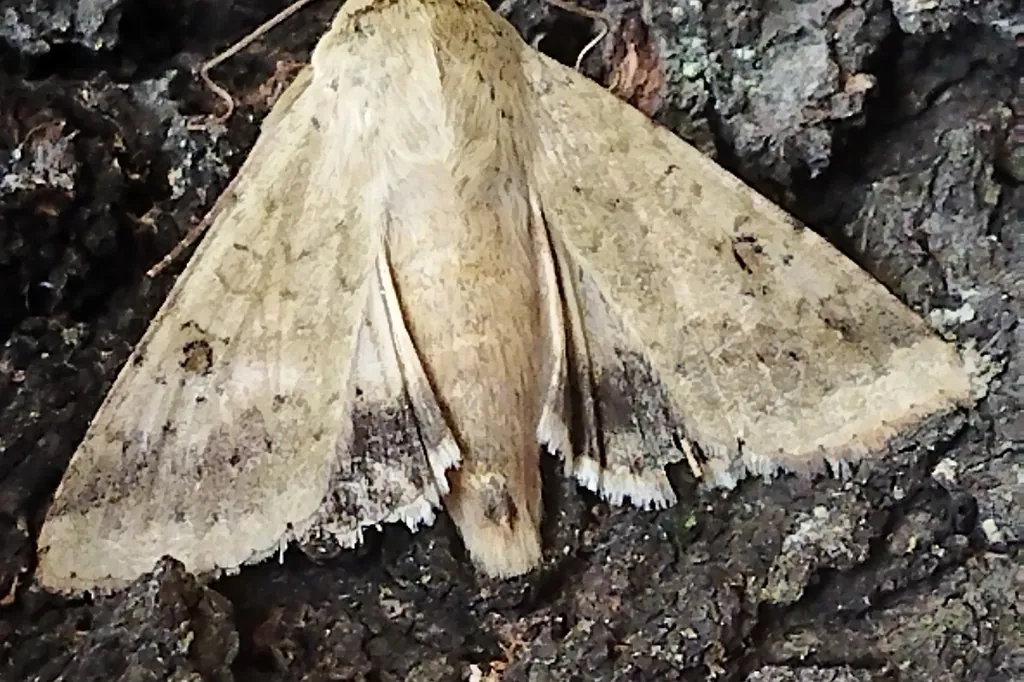
What Is Corn Earworm?
The corn earworm is also called the gram pod borer or fruitworm. It is one of four major insect pests of corn in the Philippines. The others are the corn seedling maggot, the root grub and the Asian corn borer. Philippine research notes that the corn borer does the most harm and the earworm causes occasional, uneven damage.
It also attacks cucurbits, tomato and other solanaceous crops, legumes, cotton, tobacco and onion. Farmers care because the larva feeds on the part that is sold, the ear or the fruit, and it hides inside.
| Fact | Details |
|---|---|
| Name | Corn earworm |
| Scientific name | Helicoverpa armigera |
| Kind | Insect |
| Crops it attacks | Corn, tomato, legumes and other vegetables |
| Local names | None recorded |
| Where it strikes | Panicles and ears and fruits, pods and nuts |
| When it strikes | At silking and the milk stage in corn, and at flowering and fruiting in vegetables. |
| Life cycle | Moths lay eggs on the silks and on flowers and fruits. The young larvae feed on the silk, then bore into the ear or fruit as they grow. |
How to Identify Corn Earworm
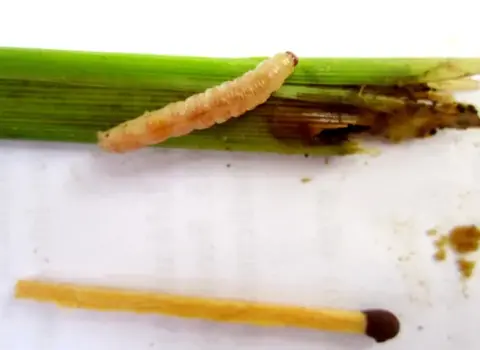
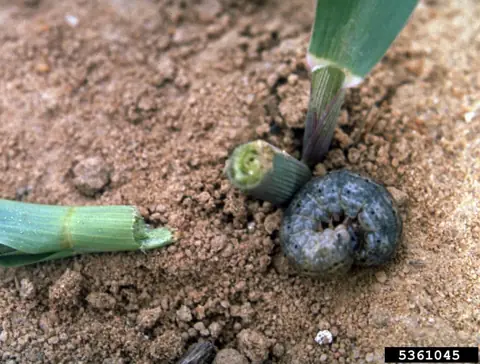
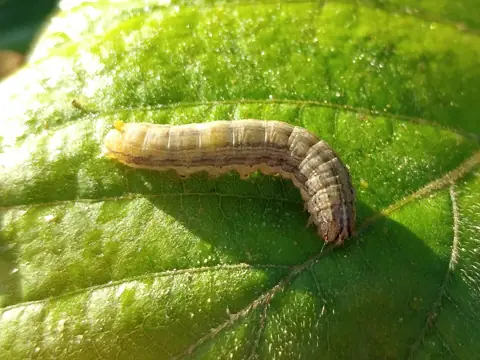
Open the ear tip. You find a fat caterpillar, with frass at the entry hole, feeding on the silks and then the kernels. The Asian corn borer is far more common in corn. It attacks the stalk and the tassel as well, while the earworm stays at the ear.
- Silks are chewed and frass lies at the ear tip.
- Kernels at the ear tip are eaten and the damage runs down the ear.
- A hole with frass beside it shows where a larva entered a tomato, a bean pod or another fruit.
- Fruits are hollow inside, because the larva eats the flesh.
- Eaten ears and fruits rot more easily afterwards.
In vegetables the fall armyworm and the legume pod borer also eat holes in fruits and pods. In corn the fall armyworm also feeds in the whorl, which the earworm does not.
How Corn Earworm Hurts Your Corn
Philippine research ranks it among four major insect pests in corn, with sporadic damage compared with the corn borer. We found no sourced national yield loss figure, so we give none. In vegetables, a single larva can ruin each fruit it enters.
A Philippine field study on Mindoro tested the IPM methods built for the corn borer against the earworm. Scout at silking and check the ear tips, since the larvae are small and easy to kill before they go in.
How to Control Corn Earworm
- Monitor the field at silking. Look at the silks and the ear tips for eggs and young larvae, and note the dates on the lot.
- Remove weeds and volunteer plants, and till the soil after harvest. East West Seed also lists plastic mulch to stop pupation in vegetables.
- Pick the larvae by hand when the area is small, and destroy damaged fruits and ears.
- Release Trichogramma wasps. A Philippine study found that Trichogramma chilonis, at 50 cards per hectare, reduced earworm damage. Natural enemies such as lady beetles and spiders helped.
- Use a trap crop such as sunflower, taro or castor around vegetables, as East West Seed lists. Spare the natural enemies.
- Use Bacillus thuringiensis, neem extract or the fungi Beauveria bassiana and Metarhizium before a synthetic spray.
When a Spray Makes Sense
Once larvae are inside the ear, insecticides work poorly. So spray only early, while the larvae are small and exposed on the silks. Choose an FPA registered product for this use and follow the label.
| Active ingredient | IRAC group | On Philippine labels |
|---|---|---|
| Chlorantraniliprole | IRAC 28 | A first choice. Registered products name it on corn, tobacco and tomato. |
| Bacillus thuringiensis kurstaki | IRAC 11A | A first choice. Registered products name it on tobacco, cotton and tomato. |
| Bacillus thuringiensis aizawai | IRAC 11A | A first choice. 1 registered product names it on corn. |
| Emamectin benzoate | IRAC 6 | A first choice. Registered products name it on corn and tomato. |
| Chlorantraniliprole plus thiamethoxam | IRAC 28 plus 4A | A sound second choice. 6 registered products name it on tobacco. |
| Flubendiamide | IRAC 28 | A sound second choice. Registered products name it on tobacco and tomato. |
| Indoxacarb | IRAC 22A | A sound second choice. Registered products name it on corn and tobacco. |
| Abamectin | IRAC 6 | A sound second choice. 2 registered products name it on tobacco. |
| Lufenuron | IRAC 15 | A sound second choice. 2 registered products name it on tomato. |
| Pyridalyl | IRAC UN | A sound second choice. Registered products name it on corn and tobacco. |
The table stops at the ten best. 19 more on Philippine labels for it are older or broad chemistry. The Pest Finder in anee.io lists every one, crop by crop, with the products sold here.
These are on Philippine labels for it, but we leave them off the list above, for the reasons below.
- Deltamethrin, cypermethrin, alpha cypermethrin, beta cypermethrin, permethrin, beta cyfluthrin, lambda cyhalothrin and fenvalerate: Corn earworm resists pyrethroids across Asia, and the spray kills the egg wasps, spiders and bugs that eat it.
- Lambda cyhalothrin plus thiamethoxam and acetamiprid plus bifenthrin: Its pyrethroid part is widely resisted by earworm in Asia, and the other part does nothing to caterpillars.
Resistance. Corn earworm (Helicoverpa armigera) resists pyrethroids across Asia through a gene now found almost everywhere, and in places resists organophosphates, carbamates and Bt cotton too. Rotate by generation, one group for about 30 days, among 28, 6, 22A, 5 and Bt, and never follow one group 28 product with another.
Use only products registered with the Fertilizer and Pesticide Authority, and follow the label for the rate, the timing and the protective clothing. Switch to a different insecticide group next time, so the pest does not learn to survive it. Our guide to integrated pest management explains how.
Keep It Out Next Season
- Plow after harvest to break the pupal cells in the soil, and keep weeds and volunteer plants out of the field.
- Plant corn at the same time as your neighbors, so silking does not drag on across the area.
- Pick larvae by hand on small plots, and destroy bored fruits and ears so the larvae do not finish growing.
- Plant a border of sunflower, marigold or castor around tomato and pepper as a trap crop, and spray or pick the larvae there.
- A sex pheromone trap shows when moths arrive, so you know when to start checking silks and flowers.
Natural Enemies and Biological Help
- Trichogramma egg wasp cards cut earworm damage on corn in local trials. Release them as silking begins.
- Spiders, lady beetles, assassin bugs and ants eat the eggs and young larvae. Skip pyrethroids to keep them.
- Bt, neem and the fungi Beauveria and Metarhizium kill young larvae. Use them before any synthetic spray.
- Helicoverpa NPV, where sold, kills the larvae and spares every natural enemy.
Not Sure What You Are Seeing?
Take a clear photo of the insect, the damage and the whole plant, then ask Anee, the smart farm technician in anee.io, in Tagalog or English. Anee tells you what it most likely is and what to do at the age of your crop. You can also put your scouting days on the cropping calendar, so the team knows when to walk the field.
anee.io keeps your scouting, spraying and harvest on one calendar, and Anee answers when something looks wrong.
- Scouting days dated from each lot's own planting day
- Photos and notes for every lot
- Anee, the smart farm technician, in Tagalog or English
Questions Farmers Ask About Corn Earworm
Is the corn earworm the same as the corn borer?
Why is it hard to kill?
Can wasps control it?
What else does it eat?
Stop Corn Earworm from costing you the harvest
With Libre + Anee, read the whole guide: how to be sure it is this pest, when it pays to act, and what to spray, by active ingredient.
The account is free, no credit card.