Asian Corn Borer: Signs, Damage and How to Control It
The Asian corn borer (Ostrinia furnacalis), also called the Asiatic corn borer, is the caterpillar that drills into corn stalks, tassels and ears. It is the most widespread and destructive corn stemborer in Southeast Asia, and Filipino farmers have fought it for decades. This guide covers how to spot it, how it hurts the crop, and the Philippine methods that keep it down.
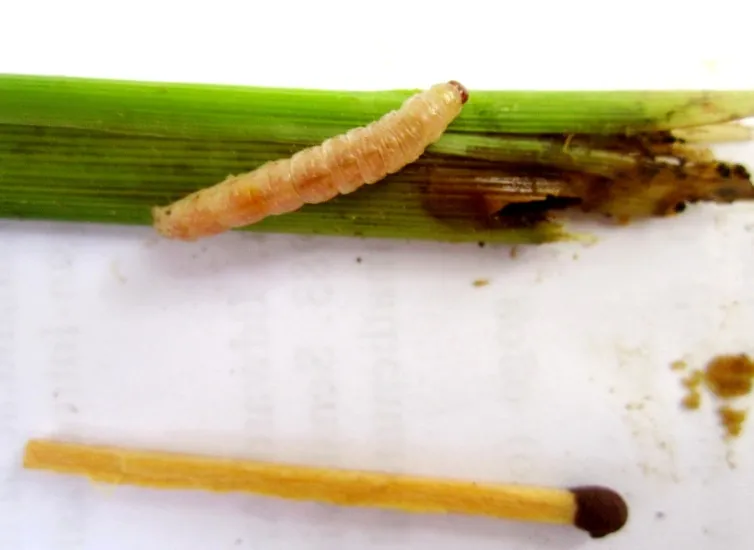
What the Asian corn borer is
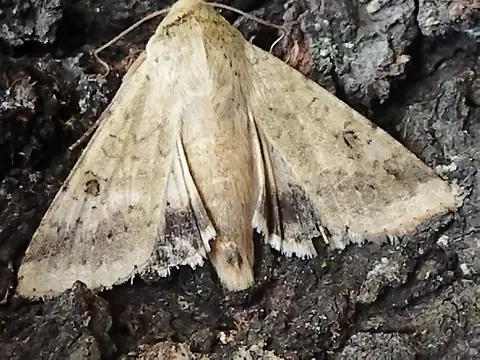
The adult is a small, pale brown moth that flies at night. Only the larva does damage. In the tropics, it can complete two generations within one corn season, so a single field may carry eggs, larvae and pupae at once.
It is also the main target of the Bt corn that the Philippines approved in 2002, the first approval of its kind in Asia.
Life cycle and signs of damage
- Eggs. Flat and white to pale yellow, laid 10 to 60 together in clusters that overlap like the scales of a fish. You find them on the underside of leaves near the midrib, and they hatch in 3 to 5 days.
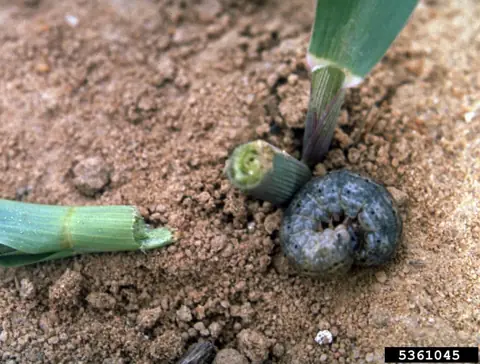
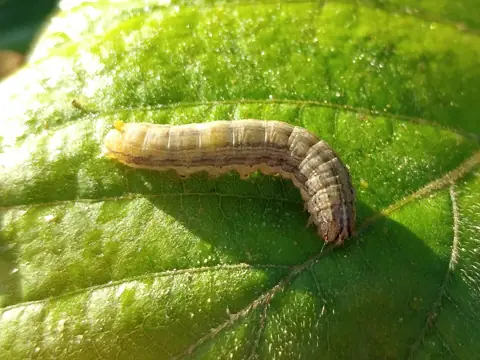
- Larvae. Creamy white with a dark head when young. As they grow to 20 to 25 mm their color shifts to a pale pink or light brown, and each segment carries dark spots.
- Timing. Corn borer eggs begin to hatch around the eight leaf stage.
Look for these signs in the field:
- Pinholes and shot holes in whorl leaves
- Holes in the stalk, the base of the tassel or the ear shank, with granular frass at the opening
- Broken stalks and clumped tassels
- Partly eaten cobs and, in bad cases, dropped ears
Yield loss comes from poor grain filling, smaller ears, broken plants and ears that fall before harvest. Cobs that larvae bore into can also rot from secondary infections.
Asian corn borer or fall armyworm?
| Sign | Asian corn borer | Fall armyworm |
|---|---|---|
| Larva color | Creamy to pinkish, with dark spots | Brown to dark, with three pale lines |
| Head mark | No Y mark | Upside down Y |
| Where it feeds | Whorl first, then bores into stalk, tassel and ear | Whorl and later the ears, without boring the stem |
| Frass | Granules at holes in the stalk | Wet piles like sawdust in the whorl |
If the larva carries the Y mark, read our full fall armyworm guide instead. Scout both pests on the same weekly walk.
How to control the Asian corn borer
Plant together and clean up
Synchronous planting comes first.When every farm in the area plants at the same time, moths have no younger corn nearby to move into.
After an infestation, cut and plow under or burn the stubble. Tassels you pull off can be buried, burned or fed to your animals.
Detasseling
Many young larvae feed on the developing tassel, so pulling tassels at the right time removes a large share of them. Follow three rules:
- Remove the tassels of 75 percent of the plants before pollen shed.
- Follow a ratio of one tasseled row to three detasseled rows.
- Always detassel the first row.
The rows you leave tasseled still shed pollen for the whole field. Timing decides the result. A Philippine field study by Felkl (1988) found that detasseling 75 percent of plants at early tasseling cut larval infestation and tunneling, while detasseling after pollen shed had no effect.
Trichogramma and earwigs
Trichogramma are tiny wasps that lay their eggs inside corn borer eggs, so the borer never hatches. Release Trichogramma cards twice, at 28 to 30 and 35 to 37 days after planting. Use 50 to 70 cards per release in new areas, and 30 to 50 cards where releases happened before.
Earwigs (Euborellia annulata) eat borer eggs and larvae. Release them twice, at mid whorl and at tasseling to silking, two colonies per release, with about 5,000 earwigs in each colony. Release points sit 10 meters apart. Ask your Municipal Agriculturist or the DA Regional Crop Protection Center about cards and earwig colonies.
Bt corn
Bt corn carries a gene from the soil bacterium Bacillus thuringiensis that makes the plant toxic to the Asian corn borer. The USDA 2024 biotechnology report notes that nearly all GM corn planted in the Philippines now stacks Bt with herbicide tolerance. Buy it only as approved, certified seed, and keep scouting for other pests. Our corn seeds guide explains the seed options.
Insecticides
Larvae inside the stalk are hard to reach, so a spray only works while they still feed in the whorl. Several Syngenta Philippines labels list corn borers on corn. Lambda cyhalothrin (Karate 2.5 EC) covers corn borers, while cypermethrin (Cymbush 5 EC) covers borers and earworms. Emamectin benzoate (Proclaim Opti 5 WG) covers the Asiatic corn borer.
Use only products that the FPA registered for corn borer on corn, follow the label rate and harvest interval, and rotate insecticide groups. Our guide to Karate, Cymbush and Selecron explains these products in more detail.
Active Ingredients on Philippine Labels
| Active ingredient | IRAC group | On Philippine labels |
|---|---|---|
| Chlorantraniliprole | IRAC 28 | A first choice. 34 registered products name it on corn. |
| Emamectin benzoate | IRAC 6 | A first choice. 1 registered product names it on corn. |
| Pyridalyl | IRAC UN | A sound second choice. 2 registered products name it on corn. |
| Bacillus thuringiensis aizawai | IRAC 11A | A sound second choice. 1 registered product names it on corn. |
| Flubendiamide | IRAC 28 | A sound second choice. 1 registered product names it on corn. |
| Indoxacarb | IRAC 22A | A sound second choice. 1 registered product names it on corn. |
| Tetraniliprole | IRAC 28 | A sound second choice. 1 registered product names it on corn. |
| Cypermethrin | IRAC 3A | Older or broad chemistry: a last resort. 100 registered products name it on corn. |
| Lambda cyhalothrin | IRAC 3A | Older or broad chemistry: a last resort. 91 registered products name it on corn. |
| Methomyl | IRAC 1A | Older or broad chemistry: a last resort. Registered products name it on corn and sorghum. |
The table stops at the ten best. 15 more on Philippine labels for it are older or broad chemistry. The Pest Finder in anee.io lists every one, crop by crop, with the products sold here.
These are on Philippine labels for it, but we leave them off the list above, for the reasons below.
- Carbosulfan: Here it is a seed treatment, which wears off before the borer eggs hatch near the eight leaf stage.
- Clothianidin plus imidacloprid: A seed treatment for maggots and hoppers. It is spent before the borer comes near the eight leaf stage.
Every insecticide label in the Philippines carries an FPA registration for named crops and pests. Spray only what the label allows, at the rate it gives, and wait the days it lists before harvest.
On anee.io, the growth stages view shows the stage of each lot on any date, so you can see when the eight leaf stage, the Trichogramma windows and tasseling arrive. Put those tasks on the cropping calendar, and anee.io reminds you when they fall due.
Set your planting date and anee.io dates your Trichogramma releases, detasseling and scouting by days after planting. Ask Anee, the smart farm technician, in Tagalog or English if you find damage you cannot name.
Start freeAsian corn borer FAQ
Is the Asiatic corn borer the same as the Asian corn borer?
When should I detassel against corn borer?
Does Bt corn control the corn borer?
What insecticide works on corn borer?
- ASEAN FAW Action: Stem borers of maize
- Felkl (1988): Economic aspects of detasseling corn plants and insecticide use to control Asian corn borer in the Philippines, Journal of Applied Entomology
- USDA FAS: Philippines Agricultural Biotechnology Annual 2024
- Syngenta Philippines: Karate 2.5 EC label
- Syngenta Philippines: Cymbush 5 EC label
- Syngenta Philippines: Proclaim Opti 5 WG label
Stop Asian Corn Borer from costing you the harvest
With Libre + Anee, read the whole guide: how to be sure it is this pest, when it pays to act, and what to spray, by active ingredient.
The account is free, no credit card.