Avocado Nutrient Deficiency: Signs, Causes and the Fertilizer That Fixes It
Avocado nutrient deficiency is one of the first things to check when the leaves of your abukado (avocado) turn yellow, purple or burnt at the edges. On Philippine farms the usual ones are nitrogen, potassium, zinc, phosphorus, boron and iron. This guide shows where each one starts, how to be sure, and the fertilizer that fixes it.
Start with one question: did the change begin on the old leaves or on the young ones? Nitrogen, potassium and phosphorus move inside the plant, so a shortage shows on the old, lower leaves first. But zinc, boron and iron stay where the plant first put them, so the young leaves and the growing tip show it first. After that, the color and the pattern narrow down which avocado nutrient deficiency you have, and a soil test confirms it. Each one below has its signs, its causes and its fix.
Avocado nutrient deficiency signs, old leaves and young leaves
Shows first on the old leaves
| Nutrient | Where it starts | What you see | Fix with |
|---|---|---|---|
| Nitrogen | the whole plant, old, lower leaves | Leaves fade from dark green to light green or yellow. Thin canopy of small leaves and few fruits. | Ammonium sulfate 21 0 0, Urea 46 0 0 |
| Potassium | old, lower leaves, leaf edges and tips | Old leaves yellow between the veins and along the edge, turning tan then brown. Leaves curve down. | Muriate of potash 0 0 60, Sulfate of potash 0 0 50 |
| Phosphorus | old, lower leaves, the whole plant | Dull or bronzed leaves with purple veins underneath and purplish leaf stalks. Slow growth. | Complete 14 14 14, 16 20 0 |
Shows first on the young leaves
| Nutrient | Where it starts | What you see | Fix with |
|---|---|---|---|
| Zinc | young leaves and the tip, between the veins | Little leaf: new leaves small, mottled yellow between the veins and crowded in tufts at the twig tips. Fruit small and round. | Zinc sulfate, Agricultural lime |
| Boron | young leaves and the tip, fruit, grain or tubers | Tip growth discolored and burnt, leaves twisted with corky split veins. Lumpy, misshapen fruit. | Solubor, Borax |
| Iron | young leaves and the tip, between the veins | Young leaves go yellow, leaving thin dark green lines on each vein. Later the veins pale too and leaves drop. | Iron chelate (Fe EDDHA) |
Before you buy fertilizer for a avocado nutrient deficiency
So use the table to pick the likeliest avocado nutrient deficiency, then read its section below. Also keep in mind that dry soil, standing water, cold nights, a pest or a disease can look the same. That is why it pays to check the roots and the whole field first.
Nitrogen deficiency in avocado
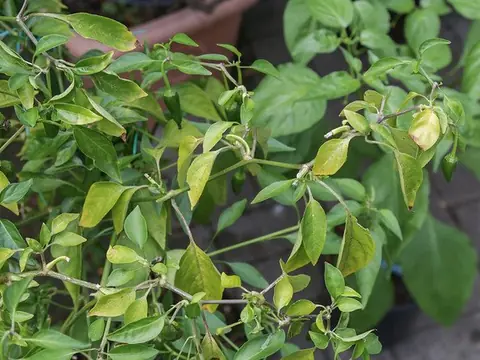
At first the leaves just fade a little and new shoots grow more slowly. Later the dark green leaves turn evenly light green to yellow, the canopy thins out and new leaves are smaller, narrow and stiff. Trees set and hold fewer fruits. You see it most at this stage: young trees, and bearing trees after several years of fruiting with no fertilizer.
Why nitrogen deficiency happens in abukado
Many Philippine avocado trees are grown with no fertilizer at all, which a review links to the fall in yield and quality after a few years of bearing. Heavy rain on sandy or eroded soils washes nitrogen away.
How to tell it apart
Phytophthora root rot also gives small, pale green or yellowish leaves and a thin canopy. But the leaves wilt even when the soil is wet, leaf tips brown, branches die back. To be sure, leaf test: pick leaves near the shoot tips from the last main flush, ones that have just finished growing and hardened, about 5 to 7 months old. Check roots and drainage. Trees that green up after ammonium sulfate or urea confirm it.
What to apply for nitrogen deficiency
Apply Ammonium sulfate 21 0 0 or Urea 46 0 0 in a ring under the canopy at the start and end of the rainy season. Philippine growers give young, non bearing trees 100 to 200 grams of Ammonium sulfate or 50 to 100 grams of Urea per tree twice a year. Bearing trees about 500 grams of Complete 14 14 14 twice a year. Full bearing trees about 2 kg of complete fertilizer a year. Add manure or compost.
- Ammonium sulfate 21 0 0
- Urea 46 0 0
- Complete 14 14 14
Sold here with nitrogen: Atlas Granular Urea (46 0 0) by Atlas Fertilizer, Amigo Planters Ammonium Chloride by La Filipina (25 0 0), Agripower 46 0 0 (Locally Blended) Coated by Green Acres Agri Tech and Calcipro by Ramgo (15.5 0 0 with 18.8 percent calcium). Check the FPA registration on the bag and follow the label rate. For the how and when, see our guide to urea fertilizer, and the page on nitrogen deficiency in every crop. In anee.io, Anee, the smart farm technician, reads a photo of the leaf and tells you which nutrient is short.
To keep it away, fertilize every year in two splits and keep a mulch of leaves or compost under the canopy, away from the trunk. Let a soil test and the crop's color set the season's nitrogen.
Potassium deficiency in avocado
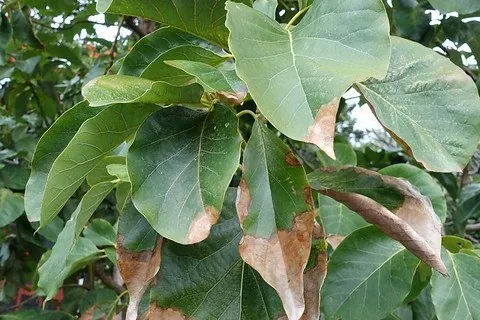
Older leaves show it first. Yellowing starts between the veins and in an uneven band along the edge, then turns tan and brown. Scorched dead patches appear over the leaf. Leaves may curve downward. Fruits stay small, and the veins in the flesh may blacken. You see it most at this stage: bearing trees, most of all while fruits fill.
Why potassium deficiency happens in abukado
Sandy or leached soils, heavy fruit crops, and fertilizer programs that give nitrogen only.
How to tell it apart
Magnesium deficiency also starts on old leaves, but the veins stay dark green and bright while the tissue between them pales. Root rot gives brown leaf tips too, but with wilting, a thin canopy and dead black roots. To be sure, leaf test of recently matured leaves near the shoot tips, 5 to 7 months old, and a soil test for potash.
What to apply for potassium deficiency
Give bearing trees a fertilizer richer in potash, following the soil test. For bearing trees, pick a mix with 9 to 15 percent potash and only 2 to 4 percent phosphate. Add Muriate of potash 0 0 60 or Sulfate of potash 0 0 50 to the complete fertilizer in two splits during the rains. Give 200 to 500 grams of Muriate of potash 0 0 60 a bearing tree a year in two doses, more while fruits are filling.
- Muriate of potash 0 0 60
- Sulfate of potash 0 0 50
- Complete 14 14 14
Sold here with potassium: Atlas Muriate of Potash (MOP) by Atlas Fertilizer (0 0 60), Simplot Sulfate 0 0 50 by Nutranta, Potassium Nitrate by Parafield (13 0 46) and Qrop Mix Production 14 0 23 plus 13 Cao by Farmtech Agriland (14 0 23 with 9.3 percent calcium). Check the FPA registration on the bag and follow the label rate. For the how and when, see our guide to potash fertilizer, and the page on potassium deficiency in every crop.
To keep it away, switch from a nitrogen only program to a complete fertilizer once trees bear, and return fallen leaves as mulch.
Zinc deficiency in avocado
Early on, the leaves yellow between the veins and come out a little smaller. In bad cases the leaves are much smaller and narrower, trough shaped and bent back, yellow or bronzed between the veins. Old leaves get many small dead spots. Twigs grow very short so the leaves crowd into tufts like a feather duster. Fruits stay small and round, sunburn easily and get dead spots on the skin, and twig tips die back. You see it most at this stage: new flushes, often worst while the crop matures and after long dry spells.
Why zinc deficiency happens in abukado
Limestone and high pH soils, long droughts without watering. Years of feeding only chemical nitrogen, with no manure or compost. Heavy phosphorus fertilizer makes it worse.
How to tell it apart
Iron deficiency also yellows young leaves between green veins, but the leaves keep their normal size and shape and do not tuft. Manganese deficiency starts as yellowing near the midrib that spreads out. To be sure, leaf test of recently matured leaves near the shoot tips, and a soil test for pH and zinc. Spray a few trees: small leaves that already formed only green up, but the next flush comes out normal size. In a soil test, less than 0.8 ppm of zinc is low.
What to apply for zinc deficiency
Spray Zinc sulfate with hydrated lime just before a main growth flush. Where little leaf is bad, mix about 12 grams of Zinc sulfate and 6 grams of hydrated lime in a liter of water. Half that for mild ones. Young trees need 3 to 4 nutrient sprays a year that include zinc. Give 50 to 100 grams of Zinc sulfate a young tree and 100 to 250 grams a bearing tree a year under the canopy.
- Zinc sulfate
- Agricultural lime
Sold here with zinc: Harvester Zinc Sulphate Heptahydrate by Universal Harvester (22 percent zinc), Tierramino ZN by Unilox Far East Resources (7 0 0 with 10 percent zinc), Liquid Chelate Zinc with Sulfur by Sagrex (10 percent zinc and 5 percent sulfur) and Nemes Foliar by SCL Filipinas (4.8 0 0 with 10 percent zinc, 4.9 percent boron and 4.8 percent magnesium). Check the FPA registration on the bag and follow the label rate. For the how and when, see our guide to fertilizer with zinc, and the page on zinc deficiency in every crop.
To keep it away, give manure or compost along with chemical fertilizer, water in long dry spells, and keep zinc in the yearly foliar sprays. Test the soil every two or three years. Do not overdo phosphorus.
Phosphorus deficiency in avocado
Signs are often not clear. Leaves look dull and can turn bronze, the veins on the underside turn purple, and leaf stalks may take a purple cast. Older leaves can show uneven dead spots between the veins. Growth is slow, the canopy is thin and leaves drop early. You see it most at this stage: young trees after planting, and trees on poor acid soils.
Why phosphorus deficiency happens in abukado
Acid, weathered soils that lock up phosphorus and soils low in organic matter.
How to tell it apart
Potassium and magnesium deficiency also mark old leaves, but with yellowing between the veins rather than a dull purplish cast. Root rot also slows growth and thins the canopy, so check the roots. To be sure, soil test for available phosphorus and pH, and a leaf test of recently matured leaves near the shoot tips.
What to apply for phosphorus deficiency
Use a complete fertilizer for young trees, following the soil test. Young trees do best on a mix with 6 to 10 percent phosphate, bearing trees on 2 to 4 percent. Where the soil test is very low, add 16 20 0 or Superphosphate 0 20 0 in the ring, and lime very acid soils. Give 200 to 500 grams of Complete 14 14 14 a young tree, up to 1 to 2 kg a bearing tree, when the rains begin.
- Complete 14 14 14
- 16 20 0
- Superphosphate 0 20 0
- Agricultural lime
Sold here with phosphorus: Philphos 18 46 0 (Di Ammonium Phosphate), Atlas Super Gro (16 20 0) by Atlas Fertilizer, Amigo Planters Granular Single Super Phosphate by La Filipina (0 18 0 with 11 percent sulfur) and Triple Super Phosphate by Newman Chemicals (0 46 0). Check the FPA registration on the bag and follow the label rate. For the how and when, see our guide to 16 20 0 fertilizer, and the page on phosphorus deficiency in every crop.
To keep it away, put phosphorus and compost in the planting hole and use a complete fertilizer in the first years.
Boron deficiency in avocado
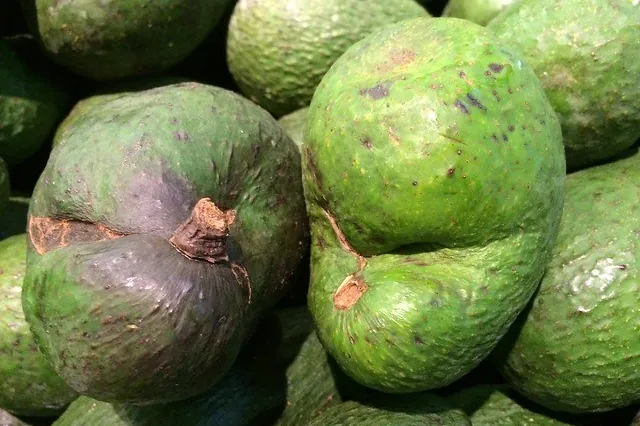
The shoot tips discolor, young leaves burn and twist, and their veins split and turn corky. Twigs may swell. Small holes with a pale ring around each may also form between the veins. In bad cases dead patches on branches and the trunk. Fruits can be lumpy, curved or misshapen, with sunken corky patches. You see it most at this stage: new flushes, flowering and fruit set.
Why boron deficiency happens in abukado
In other tree crops such as coffee it comes with soils low in boron, heavy liming, heavy potash and long droughts. The same likely holds here.
How to tell it apart
Calcium deficiency also distorts young leaves with dead tips and uneven edges, but without split corky veins. Copper deficiency kills the growing tips after the internodes shorten, with dark green leaves. To be sure, leaf test of recently matured leaves near the shoot tips, and a soil test for boron. In a soil test, less than 0.5 ppm of boron is low.
What to apply for boron deficiency
Mix boron into 3 to 4 nutrient sprays a year for young trees. Keep going later if the trees still need it. Use Solubor or Borax at the label rate, then retest the leaves. Too much boron is toxic. Give 25 to 50 grams of Borax a young tree and 50 to 100 grams a bearing tree a year, spread evenly under the canopy. A spray of Borax or Solubor at 0.1 to 0.2 percent (16 to 32 grams in a 16 liter sprayer) before flowering also works. Use the soil dose or the spray, not both.
- Solubor
- Borax
Sold here with boron: Etifert 11 (Borax Decahydrate) by Zetryl Chem (11 percent boron), Fertibagra 15G by Unilox Far East Resources (14.6 percent boron), B17 (Boric Acid) by Newman Chemicals (17 percent boron) and Better Yield by Bacphil Planters Fertilizer (0 0 0.9 with 10 percent boron). Check the FPA registration on the bag and follow the label rate. For the how and when, see our guide to foliar fertilizer, and the page on boron deficiency in every crop.
To keep it away, add organic matter, mulch and water in dry spells. Keep a small boron dose in the foliar program where tests run low. Test the soil every two or three years.
Iron deficiency in avocado
Young leaves turn yellow between the veins while narrow strips along the veins stay dark green. Later the veins yellow as well and the leaves may fall. Leaves keep a normal size and shape. You see it most at this stage: new flushes, on limestone soils and after waterlogging.
Why iron deficiency happens in abukado
Alkaline, high pH soils such as limestone soils, overliming, and waterlogged soils. Soggy, poorly drained ground also brings shortage signs and dieback to avocado.
How to tell it apart
Zinc deficiency also yellows young leaves between the veins, but the leaves are small, narrow and crowded in tufts. Manganese deficiency starts near the midrib and turns dull. To be sure, soil test for pH and check drainage. Look at the roots. A test treatment of iron chelate on one or two trees that greens the next flush confirms it.
What to apply for iron deficiency
Drench an iron chelate made for high pH soil into the ground under the canopy during the months of active growth. Leaf sprays of iron seldom work on avocado. Give about 15 to 20 grams of chelate per tree in the first year. Raise it to about 55 to 110 grams a year once trees are five years or older. Improve drainage where water stands. Spray Ferrous sulfate at 0.5 to 1 percent (80 to 160 grams in a 16 liter sprayer), or an iron chelate at the label rate, two or three times 7 to 10 days apart.
- Iron chelate (Fe EDDHA)
Sold here with iron: DDDD Planter's Choice Ferrous Sulphate Heptahydrate by Modern Time (19 percent iron), Ferrous Sulfate Monohydrate by Zetryl Chem (30 percent iron), Ferrous Sulphate Monohydrate by Newman Chemicals (30 percent iron) and Liquid Chelate Iron with Sulfur by Sagrex (5 percent iron and 3 percent sulfur). Check the FPA registration on the bag and follow the label rate. For the how and when, see our guide to foliar fertilizer, and the page on iron deficiency in every crop.
To keep it away, plant on a mound where water stands, avoid overwatering and overliming. Test the soil every two or three years. Keep organic matter up with compost, manure or crop residues.
A soil test is the surest check for any avocado nutrient deficiency. Before you buy, ask your Municipal Agriculture Office where to send a soil sample. The DA regional soil laboratories test soil, and the result says how much of each fertilizer your abukado needs. That saves money, because extra fertilizer is money lost.
Open the Nutrient Deficiency Finder, pick abukado, say where the leaves changed first and what you see, and get the fertilizers sold here that fix it.
- Anee, the smart farm technician, reads a photo of the leaf
- The cropping calendar dates every fertilizer application of your season
Avocado nutrient deficiency questions
Why are my abukado leaves turning yellow?
What fertilizer fixes nitrogen deficiency in avocado?
What fertilizer fixes potassium deficiency in avocado?
What fertilizer fixes zinc deficiency in avocado?
How do I know which nutrient my abukado lacks?
- Barnard, Cillie and Kotze 1991, Deficiency symptoms in avocados (South African Avocado Growers' Association Yearbook)
- Haifa: Avocado nutrient deficiencies
- UC IPM: Avocado fertilization (leaf sampling)
- UC IPM: Phytophthora root rot of avocado
- Ruehle 1940, Zinc deficiency of the avocado (Proceedings of the Florida State Horticultural Society)
- U.S. Borax: Boron and coffee plant nutrition (causes in a related tree crop)
Find the missing nutrient and fix it
With Libre + Anee, read the whole guide: how to tell the deficiency from look alikes, how to be sure, what to apply, and the fertilizers sold here that supply it.
The account is free, no credit card.