Downy Mildew: How to Spot It and Stop It in Ampalaya and Cucurbits
Downy mildew is a leaf disease of ampalaya, cucumber, squash, melon and the other cucurbits. It makes yellow, angular spots on top of the leaf and a gray fuzz underneath, and in wet weather it can kill the vines. This page shows how to spot it early and how to stop it.
What Is Downy Mildew?
Downy mildew of cucurbits comes from Pseudoperonospora cubensis. This is not a true fungus but a water mold, so it behaves differently and needs different sprays. The disease attacks cucumber, gourds, melon, pumpkin, squash (kalabasa), watermelon and zucchini. It needs living tissue, so between crops it hangs on in stray cucurbits that came up on their own and in weeds of the same family.
In the Philippines, downy mildew is the most common disease of ampalaya. Several ampalaya varieties are sold as tolerant or resistant to it. So if you grow ampalaya, pipino or kalabasa in the rainy months, expect to meet it. Do not mix it up with powdery mildew or with corn downy mildew, a different disease of mais.
| Fact | Details |
|---|---|
| Name | Downy mildew of cucurbits |
| Scientific name | Pseudoperonospora cubensis |
| Kind | Water mold (an oomycete) |
| Crops it attacks | Ampalaya, cucumber, squash, melon, watermelon and gourds |
| Local names | None recorded |
| Where it strikes | Leaves and the whole plant |
| When it strikes | It can strike from the vine stage to harvest, and it moves fastest in warm, wet weeks with fog, heavy dew or long hours of wet leaves. |
| How it spreads | It lives only on living cucurbits and their weeds, never on dead leaves. Its spores travel in wind and rain splash, and far on humid air currents. |
How to Identify Downy Mildew
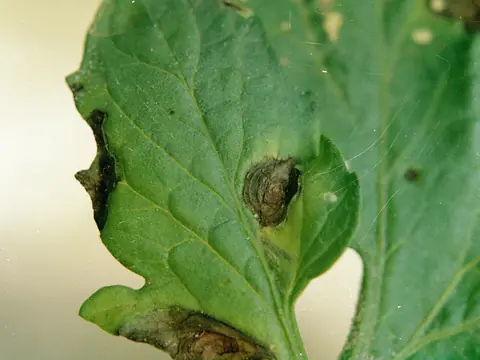
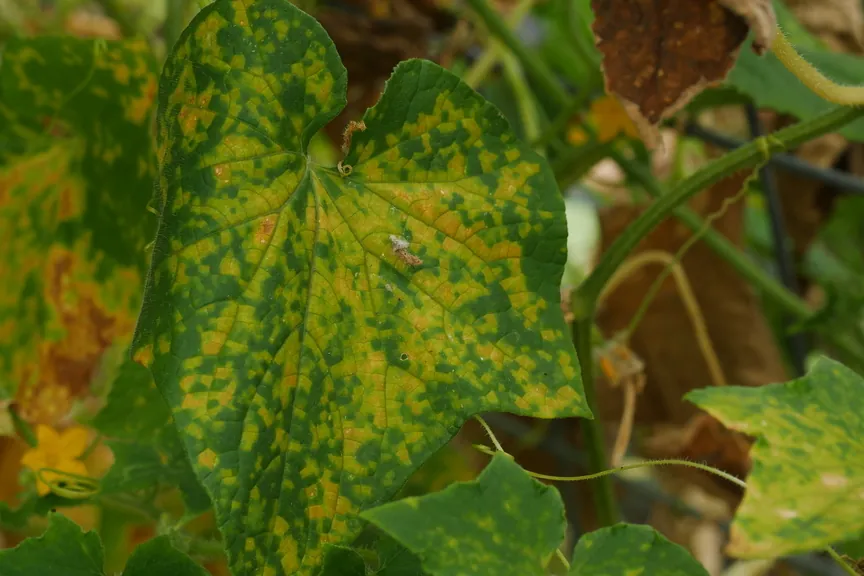
Turn over an older leaf. Downy mildew makes yellow spots on the upper side that are round at first, then angular, because the leaf veins box them in. Later the spots dry and turn brown. In humid weather, the underside of each spot carries a purple gray, felt like fuzz where the spores form, and a 20X hand lens shows it well. On watermelon and melon the spots may not look angular, so check the underside. Powdery mildew is different: its white powder sits on the leaf surface, often on top.
- Yellow spots appear on older leaves, round at first, then angular between the veins.
- A purple gray, downy fuzz grows on the underside of the spots in wet or humid weather.
- The spots dry and turn brown, and whole leaves collapse and die.
- Spots start on the older leaves and climb the vine while the weather stays wet.
- Fruit stay healthy looking but small, and they may fail to ripen or get sunscald.
Powdery mildew and angular leaf spots from other causes are the usual mixups. Downy mildew spots are yellow and boxed in by the veins, with a purple gray fuzz only underneath, while powdery mildew is a white powder that wipes off.
How Downy Mildew Hurts Your Crop
Downy mildew does not attack the fruit itself. Instead, it destroys the leaves, so the fruit stay small and may not ripen, and bare fruit burn in the sun. Severe attacks can cut yield or kill the plant. The Pacific Pests and Pathogens sheet says it develops quickly in warm, wet weather of about 18 to 23 degrees Celsius, and fog or heavy dew make it worse.
No fixed threshold is set, because the disease moves too fast. Leaves wet for 6 to 12 hours are ideal for infection. So treat the rainy weeks as high risk, and scout the older leaves often. Once you find the first angular spots, act the same day.
How to Control Downy Mildew
- Plant tolerant or resistant varieties first. Several ampalaya varieties resist or tolerate downy mildew, so ask your seed dealer.
- Keep the leaves dry. Avoid overhead watering, or water early in the morning so the leaves dry fast.
- Give the vines air. Space the plants well, run the rows along the usual wind, and keep the trellis open.
- Scout often, remove the infected leaves as soon as you see them, and pull badly sick plants.
- Time your planting to avoid the wettest weeks where you can, since cool, wet nights and heavy dew drive the disease.
When a Spray Makes Sense
Spray when the weather turns wet and before the disease spreads, because these products protect better than they cure. This water mold builds resistance fast, so alternate FRAC groups and tank mix with a protectant. Use only FPA registered products and follow the label.
| Active ingredient | FRAC group | On Philippine labels |
|---|---|---|
| Mancozeb | FRAC M03 | A first choice. Registered products name it on squash, cucumber, watermelon and melon. |
| Chlorothalonil | FRAC M05 | A first choice. Registered products name it on bitter gourd, squash, cucumber, sponge gourd and more. |
| Cyazofamid | FRAC 21 | A first choice. 1 registered product names it on watermelon. |
| Fluopicolide plus propamocarb | FRAC 43 plus 28 | A first choice. 1 registered product names it on watermelon. |
| Propineb | FRAC M03 | A sound second choice. Registered products name it on bitter gourd, squash, cucumber, sponge gourd and more. |
| Copper hydroxide | FRAC M01 | A sound second choice. Registered products name it on cucumber and watermelon. |
| Cuprous oxide | FRAC M01 | A sound second choice. 2 registered products name it on cucumber. |
| Captan | FRAC M04 | Older or broad chemistry: a last resort. Registered products name it on squash, cucumber, watermelon and melon. |
These are on Philippine labels for it, but we leave them off the list above, for the reasons below.
- Carbendazim: Benzimidazoles do not act on water molds. Carbendazim does nothing to downy mildew.
- Tebuconazole plus trifloxystrobin: Downy mildew resists the strobilurin half, and the triazole half does not touch water molds at all.
- Azoxystrobin: Cucurbit downy mildew resists strobilurins widely in Asia, starting in Japan. Azoxystrobin often fails on it.
Resistance. Cucurbit downy mildew resists the strobilurins (FRAC 11) and metalaxyl (FRAC 4) widely in Asia, and resistance to the CAA group (FRAC 40) has been found in some countries. Keep mancozeb or chlorothalonil in every spray and change the downy mildew group (21, 28 with 43, 40) each time.
Use only products registered with the Fertilizer and Pesticide Authority, and follow the label for the rate, the timing and the protective clothing. Switch to a different fungicide group next time, so the disease does not learn to survive it. Our guide to plant diseases explains how.
Keep It Out Next Season
- Plant a tolerant or resistant variety. In the rainy season it is the cheapest protection you can buy.
- Water early in the day at the base of the vines so the leaves dry before night.
- Space the plants well, run rows with the usual wind, and keep the trellis open so the leaves dry fast.
- Pick off infected older leaves early, pull badly sick vines, and plow under old vines right after the last harvest.
- Do not plant a new crop beside an old infected one, and avoid the wettest weeks of the year when you can.
Not Sure What You Are Seeing?
Take a clear photo of the spots or the damage up close, then the whole plant, then ask Anee, the smart farm technician in anee.io, in Tagalog or English. Anee tells you what it most likely is and what to do at the age of your crop. You can also put your scouting days on the cropping calendar, so the team knows when to walk the field.
anee.io keeps your scouting, spraying and harvest on one calendar, and Anee answers when something looks wrong.
- Scouting days dated from each lot's own planting day
- Photos and notes for every lot
- Anee, the smart farm technician, in Tagalog or English
Questions Farmers Ask About Downy Mildew
What causes downy mildew in ampalaya?
How do I tell downy mildew from powdery mildew?
Which fungicide works on downy mildew of cucurbits?
Stop the spread of Downy Mildew
With Libre + Anee, read the whole guide: how to tell it from look alikes, what makes it spread, and what to spray and when.
The account is free, no credit card.