Corn Downy Mildew: How to Spot It and Protect Your Mais
Corn downy mildew is the disease behind pale, striped, stunted mais seedlings with white fuzz on the leaves. In the Philippines, Peronosclerospora philippinensis causes it. It is one of the main diseases that can destroy a young corn stand.
What Is Corn Downy Mildew?
Peronosclerospora philippinensis, a water mold that behaves like a fungus, causes corn downy mildew. It attacks corn, and the disease is most common in warm, humid regions and in fields that flood. Researchers test corn lines against it. Breeding for resistance has been hard.
It matters because young plants are the most open to attack. A field can lose plants before it forms a crop. In severe cases, research papers report yield loss up to total loss. Our guide to corn seeds and the page on planting corn help you choose seed and plan around wet weeks.
| Fact | Details |
|---|---|
| Name | Corn downy mildew |
| Scientific name | Peronosclerospora philippinensis |
| Kind | Water mold (an oomycete) |
| Crops it attacks | Corn |
| Local names | None recorded |
| Where it strikes | Leaves, the whole plant and panicles and ears |
| When it strikes | Corn downy mildew hits young corn most, in the first weeks after emergence, and it grows fastest in warm, humid weather and in fields that flood. |
| How it spreads | The fungus like organism makes spores on the leaf at night in humid air, and wind carries them to nearby corn. The Philippine species spreads from plant to plant by these spores and has no insect vector. |
How to Identify Corn Downy Mildew
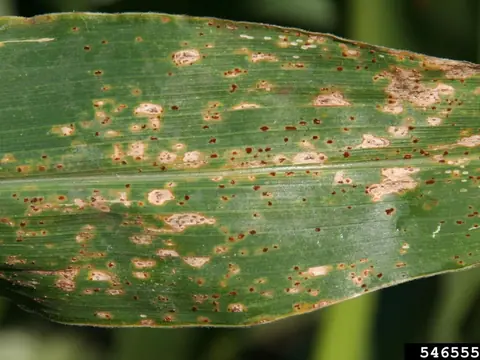
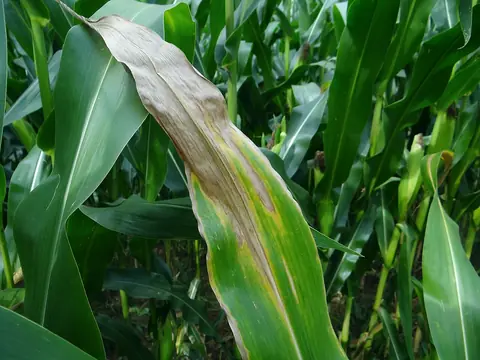
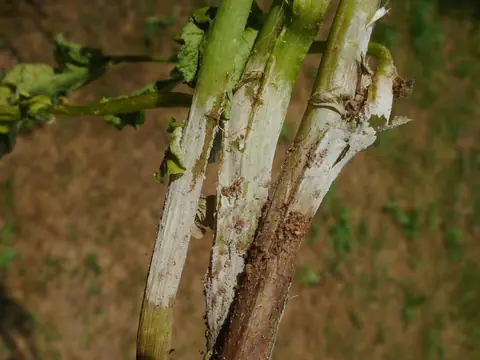
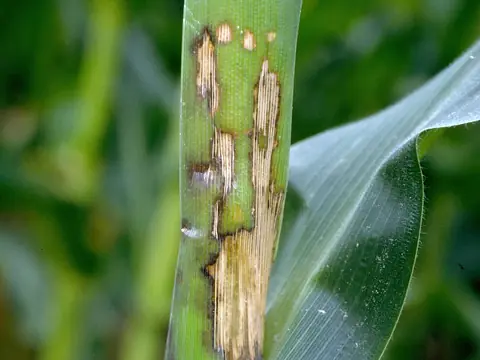
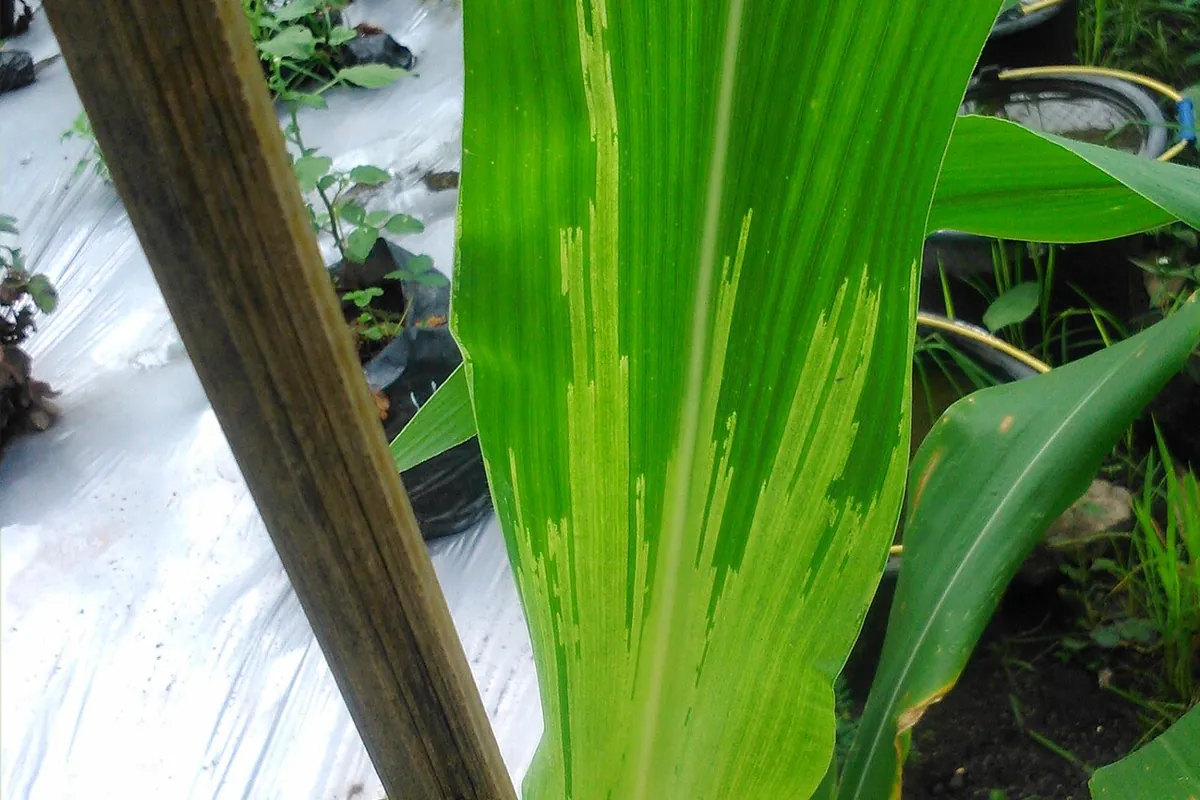
Look at the first true leaves of seedlings. The first sign is chlorotic stripes or a general yellowing. Early in the morning, check the underside of the leaf for a grayish white downy growth. Older infected plants have narrow, stiff, upright leaves, and their tassels come out malformed. Note that maize streak virus can hide the mildew symptoms. So check the leaf underside in the early morning, when the downy growth is easiest to see.
- Pale or yellow stripes on the first true leaves of young seedlings.
- A grayish white, downy growth on both sides of the leaf, easiest to see in the early morning.
- Narrow, stiff and upright leaves that look dried out on older plants.
- Stunted plants in patches, often in low areas that hold water.
- Malformed tassels, little pollen, and ears that do not form or hold sterile seed.
Early stripes look like a nutrient problem or maize streak virus. A true downy mildew also shows grayish white fuzz on the leaf underside in the early morning. The plant stands stiff and narrow leaved.
How Corn Downy Mildew Hurts Your Corn
Researchers rate Peronosclerospora downy mildews a major constraint on corn production. Research papers report yield loss up to 100 percent in severe attacks. How bad it gets depends on the variety, the weather and how early infection strikes the plant. Plants hit at the seedling stage seldom give any ear.
There is no set spray threshold. Because the damage begins in the first weeks, the plan must be in place before sowing. Pick a tolerant variety, treat the seed and avoid low, wet ground. Planting corn again in the same field after a wet season? Check our guide on crop pests in the Philippines. See our overview of plant diseases in the Philippines too.
How to Control Corn Downy Mildew
- Plant a resistant or tolerant variety where one is sold. Trials found some inbred lines with a high level of resistance, and your seed supplier or local agriculture office can say what suits your area.
- Avoid fields that flood or hold water, and improve drainage before planting.
- Walk the field in the first weeks, early in the morning, and pull and destroy infected seedlings right away.
- Plant on time with your neighbors so that young corn does not stand beside older infected corn.
- Clear grassy weeds and volunteer corn from the field and the bunds.
- Treat the seed with a fungicide when the variety is not resistant, as the East West Seed plant doctor page advises.
When a Spray Makes Sense
Seed treatment is the usual first step against downy mildew. Researchers report that the Philippine pathogen can develop resistance to metalaxyl. So growers often use a mixture. Follow the FPA registered label.
| Active ingredient | FRAC group | On Philippine labels |
|---|---|---|
| Dimethomorph | FRAC 40 | A first choice. 2 registered products name it on corn. |
| Cyazofamid | FRAC 21 | A sound second choice. 1 registered product names it on corn. |
| Metalaxyl | FRAC 4 | A sound second choice. 1 registered product names it on corn. |
| Metalaxyl M | FRAC 4 | A sound second choice. 1 registered product names it on corn. |
These are on Philippine labels for it, but we leave them off the list above, for the reasons below.
- Chlorothalonil: A contact spray cannot reach downy mildew inside the plant. Seed treatment and pulling sick plants do the work.
Resistance. This mildew has lost sensitivity to metalaxyl (group 4) seed treatment in parts of Asia. Where metalaxyl has failed, switch to a dimethomorph (group 40) seed treatment or use the two together, and never rely on metalaxyl alone season after season.
Use only products registered with the Fertilizer and Pesticide Authority, and follow the label for the rate, the timing and the protective clothing. Switch to a different fungicide group next time, so the disease does not learn to survive it. Our guide to plant diseases explains how.
Keep It Out Next Season
- Plant treated seed of a resistant or tolerant hybrid. Resistance is the main defense.
- Plant on time with your neighbors, so young corn never stands beside older infected corn or sugarcane.
- Pull, bag and burn striped seedlings in the first three weeks, before they shed spores.
- Clear volunteer corn, sorghum and wild grasses such as talahib from the field and its edges.
- Drain the field well and avoid planting where water stands.
Not Sure What You Are Seeing?
Take a clear photo of the spots or the damage up close, then the whole plant, then ask Anee, the smart farm technician in anee.io, in Tagalog or English. Anee tells you what it most likely is and what to do at the age of your crop. You can also put your scouting days on the cropping calendar, so the team knows when to walk the field.
anee.io keeps your scouting, spraying and harvest on one calendar, and Anee answers when something looks wrong.
- Scouting days dated from each lot's own planting day
- Photos and notes for every lot
- Anee, the smart farm technician, in Tagalog or English
Questions Farmers Ask About Corn Downy Mildew
What does corn downy mildew look like?
Can corn downy mildew kill my whole field?
Does metalaxyl still work against it?
Stop the spread of Corn Downy Mildew
With Libre + Anee, read the whole guide: how to tell it from look alikes, what makes it spread, and what to spray and when.
The account is free, no credit card.