Coffee Leaf Rust: How to Spot It and Protect Your Coffee Trees
Coffee leaf rust is a fungus that makes yellow orange powdery spots on the underside of coffee leaves, and then the leaves fall. A tree with few leaves gives a poor crop and can die back. This guide shows how to spot it and how to protect your farm.
What Is Coffee Leaf Rust?
Coffee leaf rust is caused by the fungus Hemileia vastatrix. It attacks both arabica and robusta coffee. It is the most serious constraint on arabica production in many countries, according to a global variety trial reported in PMC. The disease causes wilting and defoliation, and a loss of production of up to 50 percent. It is one of the major challenges for Philippine coffee, along with the coffee white stem borer.
The good news is that resistance exists. Researchers have found local Philippine coffee varieties with resistance to the rust. If you farm coffee and other perennial crops, choosing the right variety, shade and spacing is your first defense.
| Fact | Details |
|---|---|
| Name | Coffee leaf rust |
| Scientific name | Hemileia vastatrix |
| Kind | Fungus (a fungal disease) |
| Crops it attacks | Coffee, both arabica and robusta |
| Local names | None recorded |
| Where it strikes | Leaves |
| When it strikes | It builds up in the wet season, because the spores need water to germinate, and it hurts most on heavy bearing trees. |
| How it spreads | Spores blow in the wind and can also ride on insects, and they need water on the leaf to germinate. It is a fungus that feeds only on living coffee tissue. |
How to Identify Coffee Leaf Rust
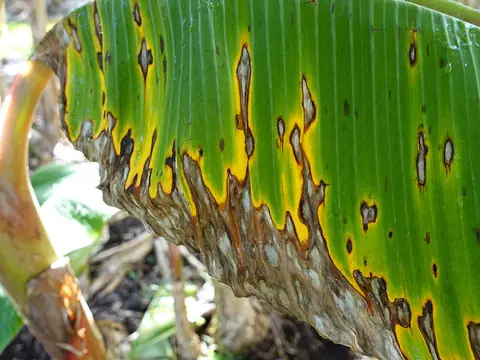
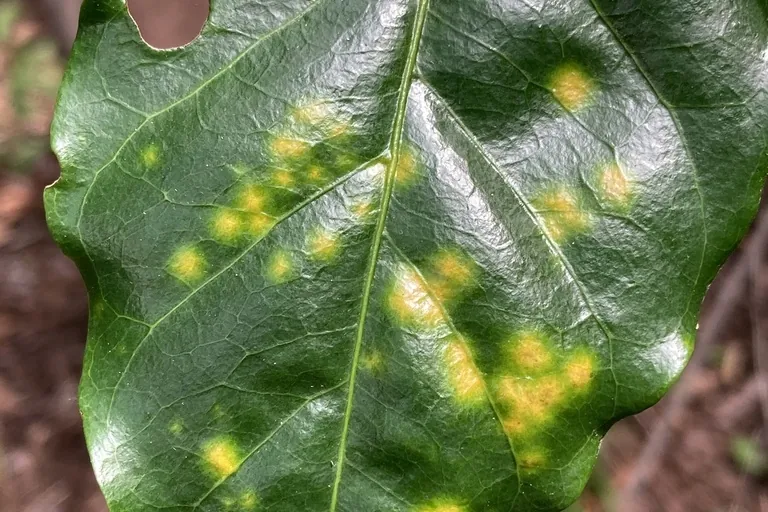
Turn a leaf over. The underside has yellow orange powdery blotches, which start as small spots of about 2 to 3 mm and grow to about 15 mm. On the upper side, the same spots show as pale yellow patches that turn brown. Many spots join, and the leaf yellows and falls. Look at the lower, older leaves first. The orange powder is the sign that tells it apart from other leaf spots that do not make powder on the underside.
- Small spots of about 2 to 3 mm appear and grow to about 15 mm.
- The underside of the leaf has yellow orange powdery blotches.
- The top of the leaf shows spots with yellow halos that turn brown.
- Badly hit leaves fall early, and shoots can die back.
- Berries stay small, and branches and trees can die in bad cases.
Other leaf spots and nutrient yellowing can also mark coffee leaves, but only rust makes the orange powder on the underside.
How Coffee Leaf Rust Hurts Your Crop
Coffee leaf rust causes wilting and defoliation that result in up to 50 percent loss in production. The Pacific Pests and Pathogens fact sheet adds that it causes defoliation, smaller berries, and branch and tree death. On high yielding trees, a heavy crop uses up the tree's reserves, so rust can cause stem dieback.
The loss depends on the variety, the weather and the shade, so your own farm may see less. Scout before the rainy season starts, so you know your risk before the leaves start falling.
How to Control Coffee Leaf Rust
- Plant resistant or tolerant varieties. The Pacific fact sheet names Catimor as a resistant type, and Philippine researchers have found local varieties with resistance. Ask your agriculturist what is available near you.
- Space trees so air moves through the rows, and prune so leaves dry quickly after rain.
- Use the right shade. The fact sheet lists spacing, soil nutrition and shade as the critical cultural factors.
- Feed the trees well, because a strong tree with enough nutrients holds its leaves and bears a heavy crop with less damage.
- Keep the farm clean and well weeded, so leaves dry faster after rain.
- Use clean seedlings, and follow the DA and BPI quarantine rules when you move coffee planting material.
When a Spray Makes Sense
Fungicide comes after the steps above. The Pacific fact sheet says copper is a protectant that you apply before infection, and triazoles are systemic. The same fact sheet says treatment is usually not needed above 1,700 meters. Use only products registered for coffee by the FPA and follow the label.
| Active ingredient | FRAC group | On Philippine labels |
|---|---|---|
| Copper hydroxide | FRAC M01 | A first choice. 12 registered products name it on coffee. |
| Cuprous oxide | FRAC M01 | A first choice. 2 registered products name it on coffee. |
| Bordeaux mixture | FRAC M01 | A sound second choice. 2 registered products name it on coffee. |
Use only products registered with the Fertilizer and Pesticide Authority, and follow the label for the rate, the timing and the protective clothing. Switch to a different fungicide group next time, so the disease does not learn to survive it. Our guide to plant diseases explains how.
Keep It Out Next Season
- When you replant, choose rust resistant or tolerant coffee and clean seedlings. Arabica at low and middle elevations suffers most.
- Give light, even shade and prune every year so leaves dry quickly after rain. Heavy shade keeps leaves wet and feeds the rust.
- Feed the trees well, above all in heavy bearing years. Trees that bear heavily on poor soil drop their leaves to rust first.
- Space trees so air moves through the rows and keep the farm weeded.
- Renew old, exhausted trees by stumping. Young vigorous growth stands rust better.
Natural Enemies and Biological Help
- A white fungus (Lecanicillium) often grows over old rust spots and slows the rust. It is a friend, not a new disease.
Not Sure What You Are Seeing?
Take a clear photo of the spots or the damage up close, then the whole plant, then ask Anee, the smart farm technician in anee.io, in Tagalog or English. Anee tells you what it most likely is and what to do at the age of your crop. You can also put your scouting days on the cropping calendar, so the team knows when to walk the field.
anee.io keeps your scouting, spraying and harvest on one calendar, and Anee answers when something looks wrong.
- Scouting days dated from each lot's own planting day
- Photos and notes for every lot
- Anee, the smart farm technician, in Tagalog or English
Questions Farmers Ask About Coffee Leaf Rust
How much crop can coffee leaf rust take?
Are there rust resistant coffee varieties in the Philippines?
Do I need to spray every year?
Stop the spread of Coffee Leaf Rust
With Libre + Anee, read the whole guide: how to tell it from look alikes, what makes it spread, and what to spray and when.
The account is free, no credit card.