Black Sigatoka: How to Spot It and Save Your Banana Leaves
Black sigatoka is a fungal leaf disease that streaks banana leaves with brown and black and kills them before the bunch is full. Fewer green leaves mean smaller fruit and early ripening. This guide shows you how to recognize it and how to hold it back.
What Is Black Sigatoka?
Black sigatoka is caused by the fungus Pseudocercospora fijiensis. A paper on the disease in the Philippines notes that it is one of the important diseases of banana here. Researchers collected 164 isolates of the fungus from ten banana growing provinces in Luzon. They found most of the genetic variety inside each province and each variety. The fungus is mixed and adaptable.
The disease kills leaf area, and a banana plant needs its leaves to fill the bunch. It matters to Cavendish exporters, but also to anyone who grows banana in the Philippines for the local market. A fungus that rests on old leaves in your own field is hard to clear. The work is steady care, not a single fix.
| Fact | Details |
|---|---|
| Name | Black sigatoka |
| Scientific name | Pseudocercospora fijiensis |
| Kind | Fungus (a fungal disease) |
| Crops it attacks | Banana, including Cavendish and cooking bananas |
| Local names | None recorded |
| Where it strikes | Leaves |
| When it strikes | It strikes banana of any age and is worst in warm, wet weather, when leaves stay wet for long hours. |
| How it spreads | The fungus makes airborne spores that wind carries several kilometers, and other spores that move over short distances between leaves. |
How to Identify Black Sigatoka
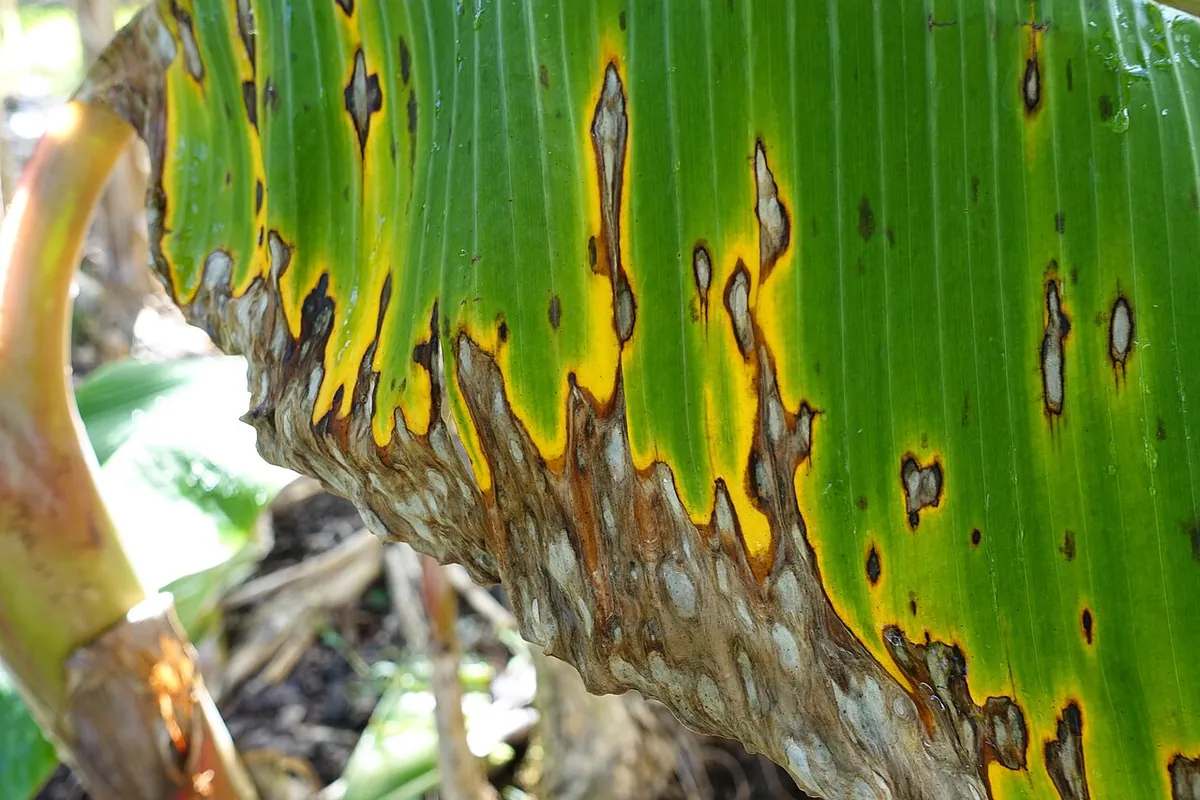
On a young leaf, look for tiny reddish brown flecks on the underside. They grow into narrow streaks along the veins, then into dark brown to black lesions with a thin yellow halo. Many spots close together kill large patches, and the leaf collapses. Fruit from badly hit plants fills poorly and may ripen too soon. Do not confuse it with the yellow, bunched leaves of banana bunchy top or with wilt diseases. Black sigatoka shows as streaks on the leaf blade.
- Small reddish brown flecks appear first on the underside of young leaves.
- The flecks grow into narrow streaks that run along the leaf veins.
- Streaks turn into dark brown to black lesions with a thin yellow halo, and many spots together kill large areas of the leaf.
- Leaves collapse early, so the plant carries few green leaves.
- Bunches fill poorly, and the fruit can ripen too early.
Other banana leaf spots look similar at first. Black sigatoka begins with flecks on the underside of young leaves. Ask a field expert or a laboratory to confirm which spot you have.
How Black Sigatoka Hurts Your Crop
The disease cuts the leaf area that feeds the bunch. A review in PMC says yield losses can pass 50 percent when nothing is done. On large export farms, growers spray up to 70 times a year. In Costa Rica the sprays can take 10 to 15 percent of total production cost. Those figures come from large plantations abroad, so your own loss and cost will vary with weather and variety.
For a smallholder, each leaf you save is fruit weight. When a plant has only a few green leaves left at flowering, expect a light, early ripening bunch.
How to Control Black Sigatoka
- Plant disease free tissue cultured plantlets in fertile, well drained soil, so plants grow strong and fast.
- Prune and remove badly diseased leaves, and do it often in the rainy months so the fungus has less leaf to feed on.
- Space plants so air and sunlight dry the leaves, and keep weeds and extra suckers under control.
- Where you can, grow banana in light partial shade. The PMC review reports that partial shade can raise marketable yield by 50 percent.
- Try the resistant types. Breeders have made black sigatoka resistant dessert bananas, cooking bananas and plantains, but resistance can break down, so ask your agriculturist what is tested near you.
- Spray only after the cultural steps, and rotate fungicide groups so the fungus does not become immune.
When a Spray Makes Sense
Large plantations depend on fungicides, but resistance builds up when the same group is used again and again. A smallholder should spray only if leaves keep dying even after leaf removal and spacing. Rotate groups, and follow the product label and the FPA registration.
| Active ingredient | FRAC group | On Philippine labels |
|---|---|---|
| Mancozeb | FRAC M03 | A first choice. 110 registered products name it on banana. |
| Chlorothalonil | FRAC M05 | A first choice. 107 registered products name it on banana. |
| Difenoconazole | FRAC 3 | A sound second choice. 56 registered products name it on banana. |
| Pyraclostrobin | FRAC 11 | A sound second choice. 27 registered products name it on banana. |
| Benomyl | FRAC 1 | A sound second choice. 26 registered products name it on banana. |
| Thiophanate methyl | FRAC 1 | A sound second choice. 19 registered products name it on banana. |
| Propineb | FRAC M03 | A sound second choice. 16 registered products name it on banana. |
| Propiconazole | FRAC 3 | A sound second choice. 15 registered products name it on banana. |
| Tebuconazole | FRAC 3 | A sound second choice. 12 registered products name it on banana. |
| Tridemorph | FRAC 5 | A sound second choice. 12 registered products name it on banana. |
The table stops at the ten best. 37 more on Philippine labels for it are older or broad chemistry. The Disease Finder in anee.io lists every one, crop by crop, with the products sold here.
These are on Philippine labels for it, but we leave them off the list above, for the reasons below.
- Iprodione: Its banana label is mainly for crown rot of the fruit. It does little against black sigatoka on the leaves.
- Mineral oil: A spray oil: it carries the fungicide and slows the fungus a little, but alone it will not hold black sigatoka.
- Isoprothiolane: A rice blast fungicide with no good proof against black sigatoka. Use a proven protectant instead.
- Organosilicone surfactant plus non ionic surfactant and non ionic surfactant plus c12 Fatty Acids: A wetting agent, not a fungicide: it only helps a real fungicide spread and stick.
- Saponin (tea seed): A tea seed extract that works mostly as a wetting agent. No good proof that it holds black sigatoka.
Resistance. This fungus resists group 1 (benomyl, thiophanate methyl) and group 11 (strobilurins) widely in Latin America and Africa. Philippine plantations still test sensitive, so keep it that way. Mix every systemic with mancozeb or chlorothalonil, never spray one group twice in a row, keep groups 1, 7, 11 and 21 to about 3 sprays a year each and group 3 to 8, never over half of all sprays.
Use only products registered with the Fertilizer and Pesticide Authority, and follow the label for the rate, the timing and the protective clothing. Switch to a different fungicide group next time, so the disease does not learn to survive it. Our guide to plant diseases explains how.
Keep It Out Next Season
- Plant clean tissue culture plantlets on well drained land, with rows along the usual wind and wide spacing, so leaves dry fast after rain.
- Every week in the wet months, cut off leaves more than half dead and cut out streaked parts. Take them out of the field or bury them.
- Keep 3 or 4 plants per mat (the bearing plant, one follower and one or two small suckers) and remove the rest so air moves.
- Keep weeds down, keep drains open and feed the plants well, with enough potash, so they hold their leaves longer.
- After harvest, strip the dead leaves from the cut mother plant too. Old leaves on the ground feed the next wave of spores.
- Where the disease is heavy, grow tolerant cooking banana types. Dessert types lose their leaves fastest.
Natural Enemies and Biological Help
- Bacillus based biologicals and tea tree oil products can fill drier weeks inside a program, but none holds black sigatoka alone in heavy rain.
Not Sure What You Are Seeing?
Take a clear photo of the spots or the damage up close, then the whole plant, then ask Anee, the smart farm technician in anee.io, in Tagalog or English. Anee tells you what it most likely is and what to do at the age of your crop. You can also put your scouting days on the cropping calendar, so the team knows when to walk the field.
anee.io keeps your scouting, spraying and harvest on one calendar, and Anee answers when something looks wrong.
- Scouting days dated from each lot's own planting day
- Photos and notes for every lot
- Anee, the smart farm technician, in Tagalog or English
Questions Farmers Ask About Black Sigatoka
Can I stop black sigatoka with fungicide alone?
How far does black sigatoka spread?
Does black sigatoka kill the banana plant?
Stop the spread of Black Sigatoka
With Libre + Anee, read the whole guide: how to tell it from look alikes, what makes it spread, and what to spray and when.
The account is free, no credit card.