Clubroot: How to Spot It and Stop It in Cabbage and Pechay
Clubroot is a soil disease of cabbage, Chinese cabbage, pechay and the other crucifers. It swells the roots into thick clubs, so the plant wilts, yellows and fails to head. Once it is in a field it stays for years, so this page shows how to spot it, slow it and keep it out.
What Is Clubroot?
Clubroot comes from Plasmodiophora brassicae, a soil organism that is not a true fungus. The Pacific Pests and Pathogens sheet places it in a separate group of protists. Every member of the cabbage family can catch it, including the weeds. Chinese cabbage, head cabbage, broccoli and turnip are very susceptible, while cauliflower suffers a little less.
In the Philippines, a 1983 survey in Philippine Phytopathology found clubroot serious in some cabbage fields of Atok, Benguet, and suspected it in Bangao and Buguias. The authors warned that it could limit cabbage production there. The acid soils and the intensive cropping favor it. Later trials tested lime and friendly fungi against it. If your cabbage wilts in moist soil, pull a plant and check the roots.
| Fact | Details |
|---|---|
| Name | Clubroot |
| Scientific name | Plasmodiophora brassicae |
| Kind | Water mold (an oomycete) |
| Crops it attacks | Cabbage, Chinese cabbage, pechay, broccoli, cauliflower and other crucifers |
| Local names | None recorded |
| Where it strikes | Roots and base, the whole plant and seedlings |
| When it strikes | It infects from the seedbed onward in wet, acid soil at about 20 to 25 degrees Celsius. So cool, wet highland fields are at risk. |
| How it spreads | Resting spores live in the soil for 10 years or more. They move with soil water, runoff, muddy boots and tools, and on the roots of infected seedlings. |
How to Identify Clubroot
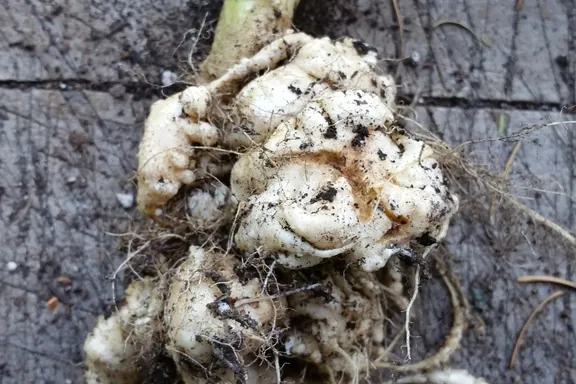
Pull up a wilting plant and wash the roots. Clubroot turns them into swollen, twisted, club shaped lumps with few fine roots. New infections show small galls of 1 to 20 mm, while old ones form long, spindle shaped clubs. Above ground, the leaves look pale green, yellow, purplish or blue green. They also wilt even in moist soil. Root knot nematodes also make galls. But theirs are small beads along the roots, while clubroot makes big clubs.
- Plants droop even though the soil is still wet.
- Leaves turn pale green, yellow or purplish, and the plants stay small.
- Pulled roots show thick, swollen, club shaped lumps with few fine roots.
- Heads fail to form or stay too small to sell when the plants are infected late.
- Badly infected plants wilt for good, and their leaves rot.
Root knot nematode galls are the usual mixup. Nematode galls are small and bead like along the roots, while clubroot makes large, spindle shaped clubs, mostly on the main roots of cabbage family crops.
How Clubroot Hurts Your Crop
Clubroot kills by thirst. The clubs block water uptake, so early infections stunt the plants, and later ones stop the heads from forming. The Pacific Pests and Pathogens sheet reports yearly losses of at least 10 percent in brassica crops in Australia, with total crop loss possible over time. Worse, once a field is infested, the resting spores stay alive for 10 years or more.
The disease needs four things: acid soil below pH 7, wet soil, about 20 to 25 degrees Celsius, and a host crop. That is why cool, wet highland fields suffer. In a trial, lime plus the friendly fungus Paecilomyces lilacinus gave about 70 percent control. Lime alone gave about 59 percent. So lime is the backbone of control, and no spray cures a clubbed root.
How to Control Clubroot
- Raise the soil pH. Lime to a pH of 7.1 to 7.5, and the Benguet trial found lime alone gave about 59 percent control. Have the soil tested first, and lime before transplanting.
- Plant only clean seedlings. Raise them in clean trays with pasteurized or soilless mix. Never buy seedlings from a field with clubroot, since the 1983 Benguet survey traced spread to infected seedlings.
- Drain the field. Use raised beds and open canals, because wet soil lets the spores swim to the roots.
- Add biological help to the lime. In a trial, Paecilomyces lilacinus plus lime gave the best result, about 70 percent control.
- Keep the spores home. Wash soil off boots, tools and tillers before you move from an infested field to a clean one. The diamondback moth also cut yields in that trial, so manage both.
When a Spray Makes Sense
The Pacific Pests and Pathogens sheet says no chemicals are available to smallholders for clubroot. In the United States, fluazinam and cyazofamid are registered for it, applied to the soil before or at transplanting. Check the FPA registration in the Philippines before you use either, and follow the label.
| Active ingredient | FRAC group | On Philippine labels |
|---|---|---|
| Cyazofamid | FRAC 21 | A first choice. 2 registered products name it on cabbage. |
| Bacillus amyloliquefaciens | FRAC BM02 | Older or broad chemistry: a last resort. 1 registered product names it on cabbage. |
Use only products registered with the Fertilizer and Pesticide Authority, and follow the label for the rate, the timing and the protective clothing. Switch to a different fungicide group next time, so the disease does not learn to survive it. Our guide to plant diseases explains how.
Keep It Out Next Season
- Lime the field to a pH of 7.1 to 7.5 before transplanting. Test the soil first so you lime enough.
- Raise seedlings in clean trays with pasteurized or soilless mix, and never buy seedlings from a field with clubroot.
- Plant on raised beds and open the drains. Wet soil lets the spores swim to the roots.
- Grow a clubroot resistant cabbage or Chinese cabbage variety in fields with a history of the disease.
- Wash soil off boots, tools and tillers before moving from an infested field to a clean one.
- Rotate away from the cabbage family for as long as you can and pull cabbage family weeds. The spores live many years.
Natural Enemies and Biological Help
- In trials, lime plus the soil fungus Paecilomyces lilacinus gave better control than lime alone.
- Bacillus based soil products add a little protection when used with lime.
Not Sure What You Are Seeing?
Take a clear photo of the spots or the damage up close, then the whole plant, then ask Anee, the smart farm technician in anee.io, in Tagalog or English. Anee tells you what it most likely is and what to do at the age of your crop. You can also put your scouting days on the cropping calendar, so the team knows when to walk the field.
anee.io keeps your scouting, spraying and harvest on one calendar, and Anee answers when something looks wrong.
- Scouting days dated from each lot's own planting day
- Photos and notes for every lot
- Anee, the smart farm technician, in Tagalog or English
Questions Farmers Ask About Clubroot
What causes clubroot in cabbage?
Does lime cure clubroot?
How is clubroot different from root knot nematode?
Stop the spread of Clubroot
With Libre + Anee, read the whole guide: how to tell it from look alikes, what makes it spread, and what to spray and when.
The account is free, no credit card.