Cercospora Leaf Spot: How to Spot It and Stop It in Vegetables
Cercospora leaf spot is a fungal disease that makes small round spots, with dark edges and pale centers, on the older leaves of vegetables. Left alone, the spots join, the leaves yellow and drop, and the crop yields less.
What Is Cercospora Leaf Spot?
Cercospora leaf spot is a name for a group of related fungi in the genus Cercospora. Each one prefers its own crop. Cercospora citrullina attacks melons, watermelon and other cucurbits, and Cercospora beticola attacks beet, spinach and Swiss chard.
Cercospora fungi also live in the Philippines. Researchers recorded a Cercospora fungus on red Basella (alugbati) leaves in Laguna. We found no Philippine extension sheet that ranks the disease for local vegetables. So most advice here comes from university extension services that study the same fungi. The habits are the same in warm, humid weather. A tropical fact sheet on the pepper form shows the same pattern. Leaf spots on vegetables are often confused with anthracnose or early blight, so it helps to check the shape of the spot.
| Fact | Details |
|---|---|
| Name | Cercospora leaf spot |
| Scientific name | Cercospora spp. (for example C. citrullina on cucurbits and C. beticola on beet and spinach) |
| Kind | Fungus (a fungal disease) |
| Crops it attacks | Cucurbits (melon, watermelon, cucumber), beet, spinach and other vegetables |
| Local names | None recorded |
| Where it strikes | Leaves |
| When it strikes | It builds in warm weather with long leaf wetness, and it starts on the older leaves before it climbs the plant, usually once the crop has a full canopy. |
| How it spreads | The fungus survives in crop residue, seed and weeds. Rain splash, wind, tools and workers carry its spores from the old residue to the leaves, and each new spot makes more spores. On pepper, the Pacific fact sheet adds that the fungus can ride on the seed. |
How to Identify Cercospora Leaf Spot
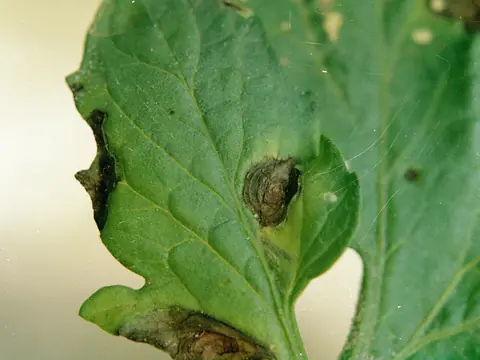
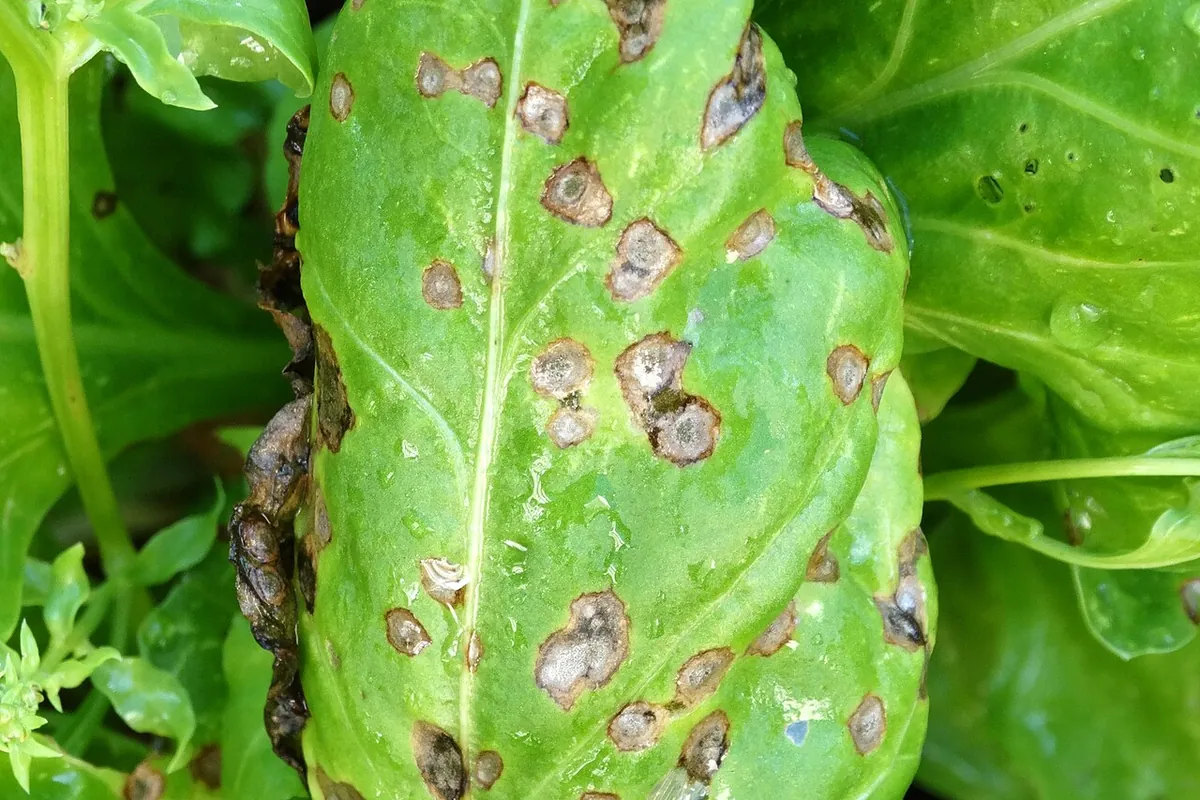
Start with the older leaves. The first sign is a small, round, light colored spot that grows and gets a dark margin, which can be red to purple on beet. The center turns white, tan or gray, and it may fall out and leave a hole. A yellow halo may circle the spot as it grows. In wet weather, the stems and leaf stalks can also be hit. Tiny black dots in the center of the spot are the structures that make spores.
- Small, round spots appear on the older leaves first.
- Each spot has a dark, reddish or purple edge, and a white, tan or gray center.
- The center may drop out and leave a hole in the leaf.
- A yellow halo may surround the spots, and many spots join into dead areas.
- Heavily hit leaves yellow and drop, and the stem or leaf stalk may be spotted in humid weather.
Round spots with a pale center can look like anthracnose on some crops. Cercospora spots start small and round on the older leaves, with a dark margin and a pale center.
How Cercospora Leaf Spot Hurts Your Crop
Cercospora leaf spot lowers the yield by killing the leaves that feed the crop, and it can spoil the look of leafy vegetables that you sell by the bundle. How much you lose depends on the crop, the variety and how long the leaves stay wet. We did not find a sourced loss figure for vegetables in the Philippines, so we give none. A tropical fact sheet on the pepper form says severe attacks join the spots and drop the leaves. It adds that fruit yield falls and that warm wet weather favors the disease.
The fungus survives in plant residue and in soil for up to 3 years, according to Cornell. So the spots you see this season often come from last season's leaves. Good sanitation costs little, and it works better than any spray. See our guide to growing vegetables in the Philippines.
How to Control Cercospora Leaf Spot
- Space plants so the air moves through the canopy and the leaves dry fast after rain or watering.
- Use drip or furrow irrigation, and avoid overhead watering when you can, since wet leaves are what the fungus needs.
- Remove and destroy diseased leaves early in the season, and carry them out of the field.
- Rotate with crops that are not hosts, for at least 2 years, for 3 or more years where beet or spinach is the host, and for at least 3 years after the disease has hit pepper.
- Pull out weeds that act as hosts, such as lambsquarters and pigweed, which carry the beet fungus.
- After harvest, destroy the crop residue by deep plowing so that the old leaves are buried and cannot send spores to the next crop.
When a Spray Makes Sense
Fungicides help best when they protect the leaves before the disease builds up. Extension services advise a protectant spray from the time the vines touch, and earlier in fields with a history of the disease. Some Cercospora fungi have become resistant to strobilurin fungicides in New York, so do not rely on that class alone. Follow the label of an FPA registered product, and rotate groups. Copper oxychloride also works on the eggplant form. The Pacific fact sheet lists chlorothalonil, copper oxychloride and mancozeb for pepper.
| Active ingredient | FRAC group | On Philippine labels |
|---|---|---|
| Chlorothalonil | FRAC M05 | A first choice. Registered products name it on carrot, bitter gourd, okra, chili and more. |
| Benomyl | FRAC 1 | A sound second choice. Registered products name it on mungbean, cabbage, chili and bell pepper. |
| Thiophanate methyl | FRAC 1 | A sound second choice. Registered products name it on mungbean, lettuce and cabbage. |
| Tebuconazole plus trifloxystrobin | FRAC 3 plus 11 | A sound second choice. Registered products name it on bitter gourd, chili and bell pepper. |
| Captan | FRAC M04 | A sound second choice. Registered products name it on carrot, chili, bell pepper and watermelon. |
| Copper hydroxide | FRAC M01 | A sound second choice. 3 registered products name it on carrot. |
| Fluopyram plus trifloxystrobin | FRAC 7 plus 11 | A sound second choice. Registered products name it on bitter gourd, chili and bell pepper. |
| Bacillus amyloliquefaciens | FRAC BM02 | A sound second choice. Registered products name it on cabbage, bitter gourd and watermelon. |
Resistance. Cercospora fungi have become resistant to the benomyl group (FRAC 1) and the strobilurins (FRAC 11) in many countries. Keep chlorothalonil, mancozeb or copper as the base, and use those groups only in mixes or in turn.
Use only products registered with the Fertilizer and Pesticide Authority, and follow the label for the rate, the timing and the protective clothing. Switch to a different fungicide group next time, so the disease does not learn to survive it. Our guide to plant diseases explains how.
Keep It Out Next Season
- Use clean seed. On mungbean and pepper the fungus rides on the seed.
- Space plants so air moves through, and water by drip or furrow instead of over the leaves.
- Pick off spotted lower leaves early and carry them out of the field.
- Rotate for at least two years with crops that are not hosts, and pull weedy hosts such as kulitis and other pigweeds.
- Plow under or remove crop residue after harvest so old leaves cannot spread spores to the next crop.
- Feed the crop with balanced fertilizer, with enough potash. Weak plants spot faster.
Natural Enemies and Biological Help
- Bacillus based biofungicides help as protectants when sprayed before the spots spread.
Not Sure What You Are Seeing?
Take a clear photo of the spots or the damage up close, then the whole plant, then ask Anee, the smart farm technician in anee.io, in Tagalog or English. Anee tells you what it most likely is and what to do at the age of your crop. You can also put your scouting days on the cropping calendar, so the team knows when to walk the field.
anee.io keeps your scouting, spraying and harvest on one calendar, and Anee answers when something looks wrong.
- Scouting days dated from each lot's own planting day
- Photos and notes for every lot
- Anee, the smart farm technician, in Tagalog or English
Questions Farmers Ask About Cercospora Leaf Spot
What does Cercospora leaf spot look like?
Where does the fungus come from?
Do I need to spray every season?
Stop the spread of Cercospora Leaf Spot
With Libre + Anee, read the whole guide: how to tell it from look alikes, what makes it spread, and what to spray and when.
The account is free, no credit card.