Squash Beetle: How to Spot It and Protect Your Cucurbits
The squash beetle is a bright orange beetle that chews holes in the leaves of squash, cucumber, melon and other cucurbits. Its grubs also eat the roots below the soil. This page shows how to spot the squash beetle early and how to protect young plants.
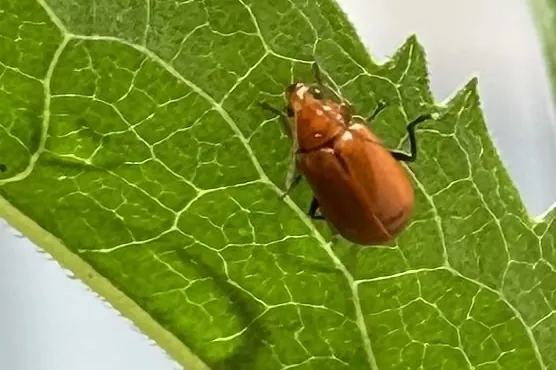
What Is Squash Beetle?
The squash beetle, also called the pumpkin beetle or cucurbit beetle, is a leaf beetle of the genus Aulacophora. Aulacophora similis is an old name that many now treat as Aulacophora indica. The University of Guam notes that the species look very alike and are often confused, but their biology and control are largely the same.
It lives across Asia and the Pacific, including the Philippines. It attacks pumpkin, squash, cucumber, melon, bottle gourd, bitter gourd, ridge gourd and watermelon. Young plants suffer the most, and heavy early damage can delay or stop the crop.
| Fact | Details |
|---|---|
| Name | Squash beetle |
| Scientific name | Aulacophora similis (now often treated as Aulacophora indica) |
| Kind | Insect |
| Crops it attacks | Squash, pumpkin, cucumber, melon, watermelon, ampalaya and upo |
| Local names | None recorded |
| Where it strikes | Leaves, fruits, pods and nuts, roots and base and seedlings |
| When it strikes | Damage is worst on seedlings and young plants, mostly in warm, dry weather, and the adult beetles keep returning through the season. |
| Life cycle | Adults feed on the leaves, flowers and fruit. Females drop their eggs into the soil close to the stem, and the grubs that hatch eat the roots. A female can lay up to 500 eggs, and several generations overlap each year. |
How to Identify Squash Beetle
The adults are small to medium sized beetles colored bright orange red to reddish brown, and they fly off quickly when you touch the plant. The grubs are creamy white, soft and elongate, and they live in the soil. Look at the leaf edges first. The beetles chew round holes between the veins, cut circular discs and sometimes eat only the green tissue, leaving the veins behind. The melon fly damages the fruit from inside, but the squash beetle damages leaves and the skin.
- Round or irregular holes in the leaves, often starting at the leaf margins.
- Leaves that are skeletonized, with only the veins left.
- Bright orange beetles feeding on leaves and flowers, especially in the morning and evening.
- Scars and blemishes on the skin of fruit that rests on the soil.
- Seedlings and young plants that wilt, grow slowly or die.
- Wilting vines in older plants where grubs have fed on the roots.
Several Aulacophora beetles look alike, and the ladybird beetle does not eat plants. Check the beetle on the leaf. Orange beetles that chew holes are the squash beetle. Ladybird beetles, which are rounded and spotted, do not.
How Squash Beetle Hurts Your Crop
The University of Guam says adult beetles can kill young plants when they are present in large numbers. The grubs feed on the roots and stems, and they can kill vines before the fruits mature. They also scar fruit that rests on the soil, and that lowers the price.
The same fact sheet quotes a rule of thumb from US research. Check three adjacent plants. If you find 6 or more adults before flowering, or 11 or more after flowering, take action. That threshold comes from another country, so treat it as a guide and keep watching your own fields. Because the grubs feed underground, the damage often stays hidden until it is severe, so scout the adults while the plants are young.
How to Control Squash Beetle
- Scout the seedlings every day or two in the first weeks after emergence, and check again after flowering.
- Handpick the beetles early in the morning or in the evening, when they are slow, and drop them in soapy water.
- Plant a few extra seeds, because the beetles tend to settle on certain plants, and avoid planting new cucurbits next to old, infested ones.
- Feed and water the crop well. Fast growing plants outgrow the damage, as both Pacific Pests and the University of Guam note.
- Remove wild cucurbit vines, such as sponge gourd, from the area before planting.
- After harvest, gather and destroy what is left of the crop, then plow or till so the pupae are turned up into the open. Wait 1 to 2 months before replanting cucurbits in the same spot. See the integrated pest management guide.
When a Spray Makes Sense
Use a spray only when the counts are high. Pacific Pests lists plant based sprays first, such as neem, derris and pyrethrum with soap. Synthetic pyrethroids also work but they kill the helpful insects. The University of Guam suggests spraying alternate rows, because the strong flying adults then touch the spray while natural enemies survive in the unsprayed rows. Follow the FPA registered label.
| Active ingredient | IRAC group | On Philippine labels |
|---|---|---|
| Cartap hydrochloride | IRAC 14 | A first choice. Registered products name it on bitter gourd, squash, cucumber, sponge gourd and more. |
| Cypermethrin | IRAC 3A | Older or broad chemistry: a last resort. 100 registered products name it on watermelon. |
| Lambda cyhalothrin | IRAC 3A | Older or broad chemistry: a last resort. 91 registered products name it on watermelon. |
| Methomyl | IRAC 1A | Older or broad chemistry: a last resort. 58 registered products name it on melon. |
| Fipronil | IRAC 2B | Older or broad chemistry: a last resort. 31 registered products name it on watermelon. |
| Carbaryl | IRAC 1A | Older or broad chemistry: a last resort. Registered products name it on bitter gourd, squash, cucumber, sponge gourd and more. |
| Fenvalerate | IRAC 3A | Older or broad chemistry: a last resort. Registered products name it on bitter gourd, squash, cucumber, sponge gourd and more. |
| Alpha cypermethrin | IRAC 3A | Older or broad chemistry: a last resort. 1 registered product names it on watermelon. |
Use only products registered with the Fertilizer and Pesticide Authority, and follow the label for the rate, the timing and the protective clothing. Switch to a different insecticide group next time, so the pest does not learn to survive it. Our guide to integrated pest management explains how.
Keep It Out Next Season
- Handpick beetles in the early morning or evening, when they are slow, and drop them in soapy water.
- Cover young plants with fine net until they flower, then remove it so bees can reach the flowers.
- Remove wild cucurbit vines around the field, and do not plant new cucurbits beside old ones.
- Feed and water well from the start, so plants grow fast and outgrow the damage.
- After harvest, destroy crop remains and plow to expose grubs and pupae. Wait 1 to 2 months before cucurbits again.
- When you must spray, spray alternate rows so helpful insects survive in the rows left unsprayed.
Natural Enemies and Biological Help
- Ground beetles, spiders, ants and birds eat the grubs and pupae in the soil. Tilling after harvest exposes them.
- Neem, or pyrethrum with soap, sprayed late in the day repels the adults with less harm to bees.
Not Sure What You Are Seeing?
Take a clear photo of the insect, the damage and the whole plant, then ask Anee, the smart farm technician in anee.io, in Tagalog or English. Anee tells you what it most likely is and what to do at the age of your crop. You can also put your scouting days on the cropping calendar, so the team knows when to walk the field.
anee.io keeps your scouting, spraying and harvest on one calendar, and Anee answers when something looks wrong.
- Scouting days dated from each lot's own planting day
- Photos and notes for every lot
- Anee, the smart farm technician, in Tagalog or English
Questions Farmers Ask About Squash Beetle
Why do my squash seedlings have holes and then die?
What do the squash beetle grubs do?
Should I spray the whole field?
Stop Squash Beetle from costing you the harvest
With Libre + Anee, read the whole guide: how to be sure it is this pest, when it pays to act, and what to spray, by active ingredient.
The account is free, no credit card.