How Do I Compute the Cost of Producing Rice per Hectare?
To compute the cost of producing rice per hectare, add every cost of the season, whether paid in cash, paid in palay or supplied by you, then divide by the hectares you planted. Divide the same total by your harvest in kilos to get the cost per kilo. In 2024 the national average was PHP 59,695 per hectare, or PHP 14.52 per kilo of palay. anee.io, a farm app built for Filipino farmers, adds these costs up from the tasks you tick done.
Knowing your cost per hectare tells you two things. First, it shows whether the season paid. Second, it shows where to cut next time. Yet many farmers only count the cash they handed out, so they miss the palay given to harvesters, their own work and the rent on land they own.
The method below follows a costs and returns guide used to compare rice farms across Asia. It works for a quarter hectare or for ten.
- Count all three kinds of cost: cash, payments in palay, and the value of your own labor, land and money.
- Divide by hectares, then by kilos. Cost per hectare compares farms. Cost per kilo tells you your break even price.
- Compare with the national average. It was PHP 59,695 per hectare and PHP 14.52 per kilo in 2024.
- Labor is the biggest line. It came close to PHP 30,000 per hectare in 2024.
- Track it per lot. Lots on the same farm can differ a lot in cost.
What goes into the cost of producing rice per hectare?
The cost of a rice crop splits into the lines below. Some you pay in cash, some you pay in palay, and some you supply yourself. Put a peso value on all of them.
| Cost line | What to include | How you usually pay |
|---|---|---|
| Seed | Bought seed, or your own seed at the price of dry palay | Cash or own |
| Fertilizer | Every bag and bottle, at its price | Cash |
| Chemicals | Herbicides, insecticides, fungicides, molluscicides and rodenticides | Cash |
| Hired labor | Land preparation, crop establishment, crop care, harvesting and threshing, hauling | Cash or palay |
| Permanent worker | A caretaker paid for the whole season | Cash or palay |
| Own, family and exchange labor | Your work and your family's, at the going wage | Imputed |
| Machines and power | Tractor, thresher or animal rental, fuel and oil | Cash or palay |
| Irrigation | Irrigation fee, or pump rent and fuel | Cash |
| Food, transport, other | Meals for workers, hauling inputs, sacks and twine | Cash |
| Land | Rent paid, or the local rent value if you own the land, plus land tax | Cash, palay or imputed |
| Interest | Interest on the cash you spent before harvest | Cash or imputed |
How do I compute it, step by step?
List every cost by lot
Go through the table above for each lot. Use receipts, your stock records and your worker list, not memory.
Turn palay payments into pesos
If harvesters, the thresher or a caretaker took a share, multiply the kilos they took by your selling price.
Add the costs you did not pay in cash
Value your own and your family's days at the local daily wage. If you own the land, add what it would earn as rent.
Add interest
If you borrowed for the crop, add the interest you paid. Count up to four months of interest on the cash spent before harvest.
Divide by the hectares
Total cost divided by the area planted gives your cost per hectare.
Divide by the kilos
Total cost divided by your harvest in kilos gives your cost per kilo.
A worked example for one season
Say your lot is 0.8 hectare and the whole season cost PHP 46,000, counting everything above. Your cost per hectare is PHP 46,000 divided by 0.8, or PHP 57,500. If you harvested 3,200 kg of palay, your cost per kilo is PHP 46,000 divided by 3,200, or about PHP 14.38.
That farm sits close to the 2024 national average of PHP 14.52 per kilo. If buyers pay more than PHP 14.38 per kilo, the season made money. If they pay less, it lost money, even when the cash in your pocket seemed fine.
What the main lines cost today
| Line | Amount per hectare | Basis |
|---|---|---|
| Basal: 2 bags of 14 14 14 | PHP 3,794.00 | PHP 1,897.00 per 50 kg bag |
| Top dressing: 2 bags of urea | PHP 4,520.78 | PHP 2,260.39 per bag of granular urea |
| Half a bag of 0 0 60 | PHP 836.94 | PHP 1,673.88 per bag |
| Seed | PHP 4,316 | 2024 national average |
| Labor, all kinds | Close to PHP 30,000 | 2024 national average |
| All costs together | PHP 59,695 | 2024 national average |
Fertilizer prices move every week, so check the latest weekly price list before you budget. Our guide to fertilizer for rice explains the bag plan and its timing.
Many costs stay about the same whether you harvest 3 tons or 5, so every extra cavan spreads them thinner. In 2013 and 2014, Philippine farms produced a kilo of palay for PHP 11.13 in the high yielding season, but PHP 14.31 in the low yielding season. Raising yield often cuts cost per kilo faster than cutting inputs.
Why does the cost differ so much between farms?
Wage rates, land rent and the season all move the total. A farm that hires transplanting and harvest crews pays more for labor than one that uses a combine and direct seeding. Rented land carries a bigger rent line than land you own, although you should still count the rent value of your own land.
So compare your figure with your own past seasons first, then with the national average. To raise your yield instead, see how to increase rice yield per hectare, and to trim inputs, read how to lower fertilizer cost.
How can anee.io compute it for me?
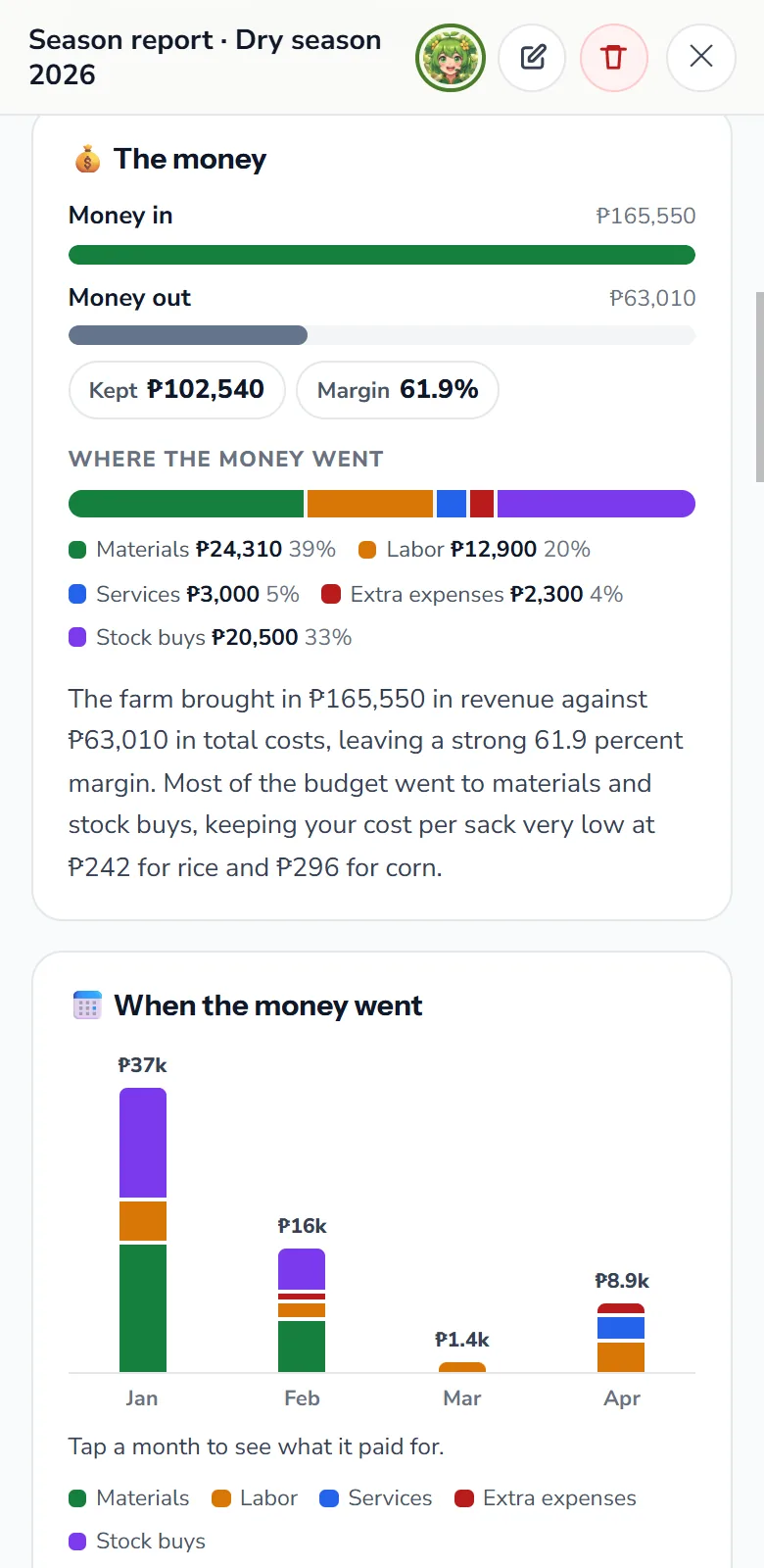
In anee.io, the costs collect as you work. Each fertilizer or spray task you tick done takes its bags out of stock and puts the cost in your expenses. Workers on each task add their wages. Hired services and extra expenses sit on their days. After harvest, you note yield, price and buyer in harvest records.
The expenses report then shows every peso the season cost, grouped so you see where it went, and the Profit Report sets it against your sales. You can also tap any day to see the cash to prepare for it.
Sign up free, add your lots and tasks, and watch your cost per hectare build itself as you work.
Start free