Paspalum scrobiculatum: How to Spot and Control This Rice Field Grass
Paspalum scrobiculatum is an annual grass weed of rainfed lowland rice fields in the Philippines. Its English name is kodo millet. It grows from seed and fights your palay for light, water and fertilizer. This page shows how to spot it in the field and how to control it before it drops seed.
What Is Paspalum scrobiculatum?
This damo is a grass from the Poaceae family, the same family as palay. Farmers know it as bias biasin, angangsug or sabung sabungan. In India, farmers grow the same species as a grain called kodo millet. Here at home, Paspalum scrobiculatum turns up as a weed in rainfed lowland rice fields, where the water comes from rain alone.
It is an annual, so each plant lives for only one season. It spreads by seed, and its stems do not creep along the ground to root at the joints. Every plant that flowers drops fresh seeds into the soil. Those seeds then wait for the next planting. So the best time to stop it is before its seed heads turn reddish brown.
| Name | Paspalum scrobiculatum |
|---|---|
| English name | Kodo millet |
| Family | Poaceae (Graminae) |
| Weed group | Grasses (see the three groups) |
| Local names | Bias biasin, angangsug, sabung sabungan |
| Life cycle | Annual |
| Spreads by | Seeds |
| Where it grows | Rainfed lowland rice fields |
How to Identify Paspalum scrobiculatum
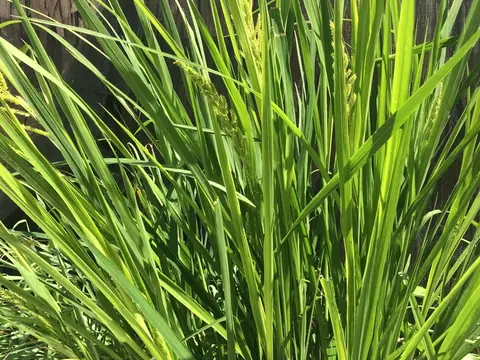
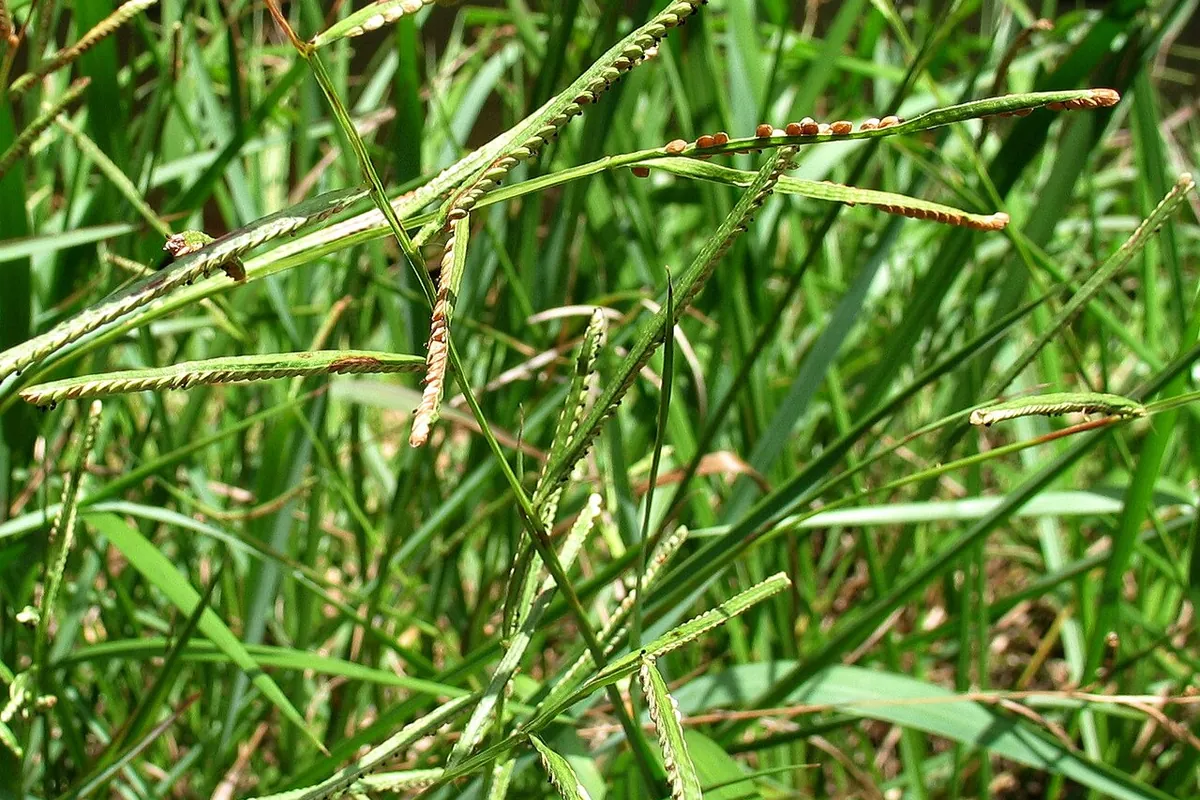
Like all grasses, this weed has a round, hollow stem with nodes, or joints, along its length. The stems are smooth and slender, with a purplish color near the base. They stand up instead of creeping. Leaf blades are flat and narrow, and their edges feel rough between your fingers. The leaf sheath is dark green and hairy close to the blade. Where the blade meets the sheath, look for a long, brown, papery ligule.
- Stem bases turn purplish, while the rest of the slender stem stays smooth.
- Run a finger along the leaf edge and you will feel that it is rough.
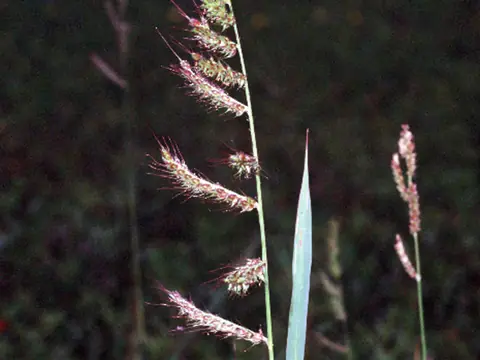
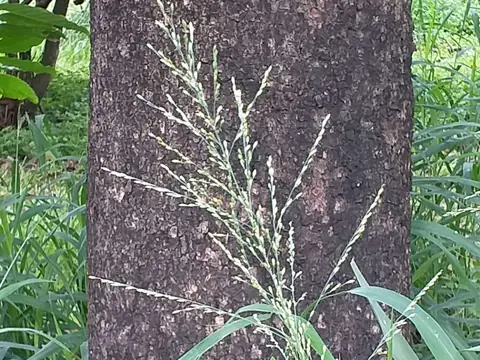
- Seed heads carry three to four spike like branches set one after another along the stalk.
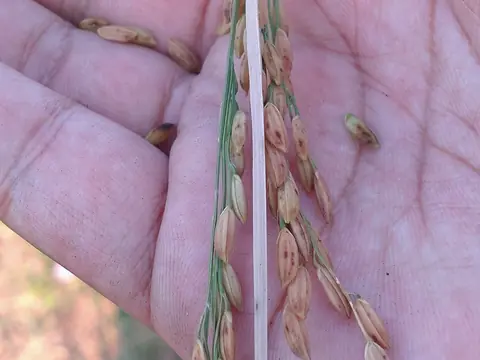
- Spikelets sit in two neat rows, round to egg shaped, pale at first and reddish brown later.
- Tiny purple stigmas peek out of the spikelets when the plant is in flower.
- The plant stands upright and never roots along the ground like a creeping grass.
Why It Hurts Your Palay
Like other grass weeds, Paspalum scrobiculatum competes with palay for sunlight, water and fertilizer. Because it is a grass too, its young plants can look a lot like rice seedlings. As a result, some plants slip past early weeding and keep feeding on nutrients meant for your crop.
Once it flowers, it drops seed that adds to the weed seed bank in your soil. Then the problem grows a little bigger each season. Its seeds can also mix with harvested palay and lower the quality of seed you keep for planting. Thick stands give shelter to rats and insect pests close to the rice hills, too.
How to Control Paspalum scrobiculatum
- Keep water standing in the paddy whenever the rains allow, because a flooded soil surface holds back many grass seeds from sprouting.
- Pull young plants by hand before seed heads appear. It spreads by seed only, so no flowering plant means no new seed.
- Weed the bunds and field edges as well, because plants left there shed seed that washes back into the paddy.
- After harvest, cut or pull any plants still standing before they drop seed, so the next crop starts cleaner.
What to Do at Each Age of Your Rice
- 0 to 5 days: keep the soil saturated. Use a pre emergence herbicide only if the field had many weeds last season.
- 6 to 10 days: hand weed in transplanted rice. In direct seeded rice, this is the window for an early post emergence spray.
- 11 to 20 days: keep water in the field, weed by hand or with a rotary weeder, and let Azolla and the Altica beetle help. Spray only if those fail.
- 21 to 30 days: top up the water and keep weeding. Spray only if weeding fails.
- 31 to 40 days (transplanted rice): hand weed. A spray this late is only a rescue.
- After any post emergence spray, bring the water back within 1 to 3 days at 3 to 5 cm and hold it for 4 to 5 days. Keep young rice above it.
Active Ingredients That Work on Grasses
If water and weeding cannot hold Paspalum scrobiculatum down, choose an active ingredient that works on grasses at the age of your rice. Each active ingredient in it is in a herbicide registered in the Philippines for rice. Shop by the ingredient on the label, never by the brand. If your field also has other kinds of weeds, the weed control helper in anee.io finds the ingredients that cover all of them.
| Rice age (days after planting) | Transplanted rice (lipat tanim) | Direct seeded rice (sabog tanim) |
|---|---|---|
| 0 to 5 days | Butachlor, Pretilachlor, Oxadiazon, Butachlor plus 2,4 D IBE, Pendimethalin, Pyrazosulfuron ethyl plus pretilachlor, Clomazone, Penoxsulam plus butachlor, Tefuryltrione plus triafamone, Tetflupyrolimet, Thiobencarb plus 2,4 D IBE | Butachlor, Pretilachlor, Oxadiazon, Pretilachlor plus butachlor, Butachlor plus 2,4 D IBE, Pendimethalin, Pyrazosulfuron ethyl plus pretilachlor, Butachlor with safener, Clomazone, Tetflupyrolimet |
| 6 to 10 days | Butachlor plus propanil, Cyhalofop butyl plus bispyribac sodium, Bispyribac sodium, Penoxsulam plus cyhalofop butyl, Pendimethalin, Cyhalofop butyl plus propanil, Propyrisulfuron, Clomazone plus propanil, Thiobencarb plus propanil, Flucetosulfuron, Cyhalofop butyl plus florpyrauxifen benzyl | Butachlor plus propanil, Cyhalofop butyl plus bispyribac sodium, Bispyribac sodium, Cyhalofop butyl, Metamifop, Pyribenzoxim plus cyhalofop butyl, Penoxsulam plus cyhalofop butyl, Cyhalofop butyl plus propanil, Pyrazosulfuron ethyl plus pretilachlor, Pendimethalin, Propyrisulfuron, Clomazone plus propanil, Thiobencarb plus propanil, Pretilachlor plus pyribenzoxim, Penoxsulam, Flucetosulfuron, Cyhalofop butyl plus florpyrauxifen benzyl |
| 11 to 20 days | Cyhalofop butyl plus bispyribac sodium, Bispyribac sodium, Pyribenzoxim plus cyhalofop butyl, Penoxsulam plus cyhalofop butyl, Metamifop plus bispyribac sodium, Cyhalofop butyl plus ethoxysulfuron, Propyrisulfuron, Fenoxaprop P ethyl plus ethoxysulfuron, Flucetosulfuron, Florpyrauxifen benzyl, Cyhalofop butyl plus florpyrauxifen benzyl, Profoxydim | Cyhalofop butyl plus bispyribac sodium, Bispyribac sodium, Cyhalofop butyl, Metamifop, Pyribenzoxim plus cyhalofop butyl, Penoxsulam plus cyhalofop butyl, Metamifop plus bispyribac sodium, Pyribenzoxim, Cyhalofop butyl plus ethoxysulfuron, Propyrisulfuron, Fenoxaprop P ethyl plus ethoxysulfuron, Flucetosulfuron, Florpyrauxifen benzyl, Cyhalofop butyl plus florpyrauxifen benzyl, Profoxydim |
| 21 to 30 days | Metamifop plus bispyribac sodium, Fenoxaprop P ethyl plus ethoxysulfuron | Cyhalofop butyl plus bispyribac sodium, Metamifop, Pyribenzoxim plus cyhalofop butyl, Metamifop plus bispyribac sodium, Pyribenzoxim |
| 31 to 40 days | No herbicide listed at this age. Hand weed and keep the water up. | Not listed for direct seeded rice |
Spray Safely
Use only herbicides registered with the Fertilizer and Pesticide Authority, and follow the label on the pack: the rate, the timing, the water and the protective clothing. Switch herbicide groups between seasons so the weeds do not learn to survive them. Our guide to herbicides for rice explains the groups.
Keep Paspalum scrobiculatum Out Next Season
- Plant clean, certified seed. Weed seeds mixed into the punla are the easiest way in.
- Keep the seedbed, the canals and the bunds free of weeds, so seed does not wash or blow into the paddy.
- Prepare the land well: flood, plow, let the weed seeds sprout, then kill them when you harrow. Level the field so water covers it evenly.
- Pull escapes before the seed heads open, and clean the thresher and harvester before they enter the field.
- Keep the field clean after harvest and through the fallow, so fewer seeds build up in the soil for next season.
These steps work for every grass weed in the paddy, not only this one. The weed management guide puts them in order for a whole season.
Not Sure It Is Paspalum scrobiculatum?
Take a clear photo of the leaf, the stem and the flower or seed head, then ask Anee, the smart farm technician in anee.io, in Tagalog or English. Anee tells you which weed it most likely is, its group, and what to do at the age of your rice. You can also put the weeding days on your cropping calendar, so the team knows when to go in.
anee.io keeps your weeding, spraying and water on one calendar, and Anee answers when a plant looks wrong.
- Weeding days on the season calendar
- Photos and notes for every lot
- Anee, the smart farm technician, in Tagalog or English
Questions Farmers Ask About Paspalum scrobiculatum
What do Filipino farmers call Paspalum scrobiculatum?
How do I control this grass in my rice field?
Why does it keep coming back every season?
Get Paspalum scrobiculatum out of your field
With Libre + Anee, read the whole guide: how to tell it from your crop, and what to do and spray at every age of your crop.
The account is free, no credit card.